


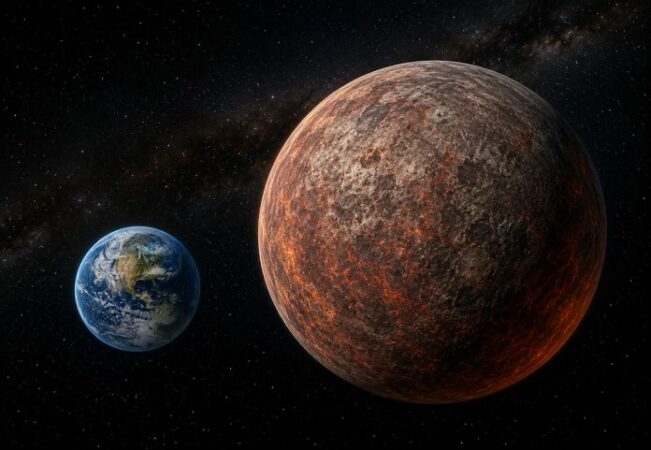



Astronomers have discovered an extremely unusual exoplanet, GJ 523b, with a mass about 23,5 times that of Earth, but which, contrary to what planetary formation models predict, appears to have remained mostly rocky and not transformed into a gas-rich giant, according to the BBC.
The planet is about 2,55 times wider than Earth and its high density suggests that it contains relatively little atmosphere.
It was first identified by NASA's TESS satellite, which detects exoplanets by recording the tiny changes in the brightness of stars when a planet passes in front of them.
Subsequent measurements were conducted by researchers at the University of Wisconsin-Madison, using the 3,5-meter WIYN telescope at the Kitt Peak National Observatory in Arizona.
Observations showed that GJ 523b has a density of about 126.82 grams per cubic inch and completes an orbit around its star every 17,75 days.
The planetary system is estimated to be about 170 million years old.
A planet that doesn't follow the expected rules
GJ 523b is located in an unusual zone between rocky planets and gas giants.
In the Solar System, scientists think that Jupiter and Saturn began rapidly accumulating large amounts of hydrogen and helium after their cores reached approximately 20 Earth masses.
GJ 523b has passed this limit, but does not appear to have developed a thick gaseous envelope.
This makes it a type of "mega-Earth," an informal term used for extremely massive rocky planets.
One possibility is that the planet was originally born with a much thicker atmosphere, but lost most of it due to the radiation and activity of the young star.
Another hypothesis is a giant collision between the two planets, which may have created a larger rocky body while expelling most of the gas into space.
However, these are still just hypotheses.
The researchers emphasize that it is difficult to draw general conclusions about planet formation from just one example.
The discovery of 20-30 similar planets could enable astronomers to understand whether GJ 523b is a rare case or part of a broader class of planets.