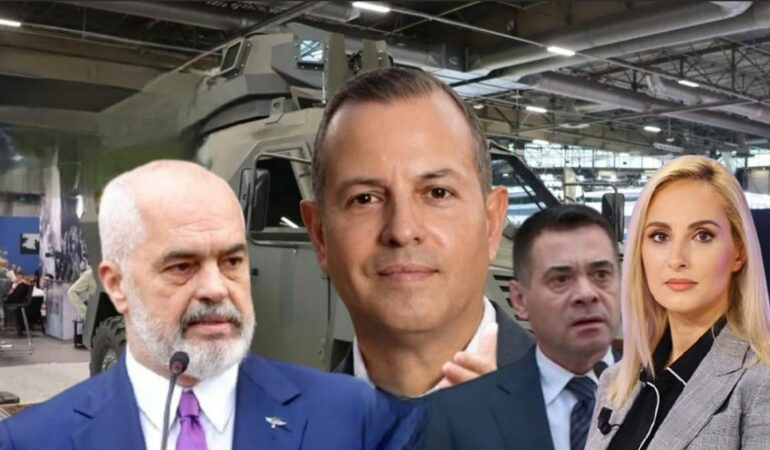



By Ornela Çuçi (Former Deputy Minister of Tourism)
For a long time, in the geopolitical forums and dialogues I participate in, one of the discussions that constantly returns when talking about Ukraine is corruption. Especially the control over foreign funds, procurement, reconstruction and the billions that the international community is mobilizing for a country that, in addition to having to win the war, must convince its allies that their money is managed with rules and control.
And this is not a debate invented by Ukraine’s critics. It is one of the issues that its partners themselves insist on. The World Bank reports that since the beginning of the Russian invasion, over $90 billion in financial support has been mobilized for Ukraine, while the financing mechanisms are also linked to strengthening governance, the fight against corruption, procurement and public financial management. The European Union also continues to treat the strengthening of anti-corruption institutions as an essential part of the integration process and donor confidence.
So, Ukraine is under scrutiny (that's why Roni has also come out in a corner of wiretapping), with a real corruption problem). According to Transparency International's Corruption Perceptions Index 2025, Ukraine has 36 points out of 100 and ranks 104th out of 182 countries. Albania has 39 points and ranks 91st. So, Ukraine is perceived as more corrupt than Albania.
But Ukraine is also at war. Since 2022, it has been operating under martial law, with occupied territories, bombed cities, and extraordinary military needs. If there is a country where the emergency could be used as an argument to shorten procedures, it is Ukraine.
And for this very reason, that part of the leaked wiretap has shocked me more than any name mentioned in it. The Ukrainians are asking for a tender. The leaked conversation says that they cannot do things differently because they are “in the eyes of NATO”. Think about how absurd this is for us. A country at war, under martial law, worse than Albania in the corruption perception index and dependent to an extraordinary extent on international financial and military support, I know they are seeing it. I know that it has to justify the procedure.
What about us? We are a country at peace, a member of NATO since 2009, negotiating membership in the European Union and talking every day about the rule of law, European standards and strengthening institutions. In fact, in the Transparency International index we rank slightly better than Ukraine. And Albania itself appears in this conversation as the country where things can be done without tenders.
This is where Roni Yefet's story ends for me and our story begins. Because, in the end, it doesn't really matter what Roni thinks about Albanians. Although, to be honest, I felt terribly sorry for us poor people when I heard how a man who has only benefited from this country perceived us. Who and what convinced him that the Albanian state functions like this? Who did he negotiate with? What did he see? What was offered to him? Who gave him the confidence to speak of Albania as a country where what the Ukrainians cannot do, because they are "in the eyes of NATO", can be solved here?
For me, this is another level of corruption. Corruption is not just an envelope that passes under the table. This is its most banal form. True institutional degradation begins when the lack of order becomes part of your country's offer; when someone who comes to do business with the state considers access to decision-makers more important than procedure; when the sentence "in Albania we do it" takes on a meaning that no longer needs explanation. And I cannot accept as an answer the argument "it is a military industry". Of course, defense and security have special procedures. Of course, there can be confidentiality and exceptions provided for by law. There is information that for reasons of national security cannot and should not be made public. But ... special procedure does not mean lack of procedure. Confidentiality does not mean lack of control. State secret does not mean secret from the state. In fact, it should be the opposite. The more strategic the sector, the more serious the institutional control should be. When we talk about weapons, ammunition, military technology, foreign companies, state assets, and public money, the public may not have the right to know every detail, but the state must know and control every detail.
Therefore, if the interception is authenticated, SPAK should identify what was done without a tender and on what legal basis? Who authorized it? Who negotiated on behalf of the state? How were the companies selected? Who verified the owners and ultimate beneficiaries? Who checked their capital, experience and capacities? How was the economic interest of the Albanian state assessed? Were there alternatives? Who signed? And, above all, who controlled this entire process?
In a functional state, the publication of a material with claims of this nature should immediately produce an institutional reaction. Every ministry and institution involved should produce documents, explain the procedure and take its responsibility. And where administrative or political explanation is not enough, the work of justice should begin. In fact, what should have begun yesterday was an institutional revolution of responsibility, ministers who give account, mandates made available, institutions that open documents, audits, investigations and a Parliament that exercises the function for which it exists. Morally, this state has long since fallen. Now the question is whether what we are seeing is proof that the fall has also become institutional.
And what a paradox...the Ukrainians, in a country at war and under martial law, say they need a tender because they are "in the eyes of NATO."
They are in the eyes of NATO.
We are NATO. Since 2009.
And yet, someone seems to be selling Albania as a country where eyes are closed. And that's why it's not Roni Yefet who is bringing us down as a country. If what we hear is proven, we must have the courage to accept something much more painful. It is we who have taught them that the Albanian state can be treated like this. We, the most absurd state of the new millennium.
So, where the hell do we live?