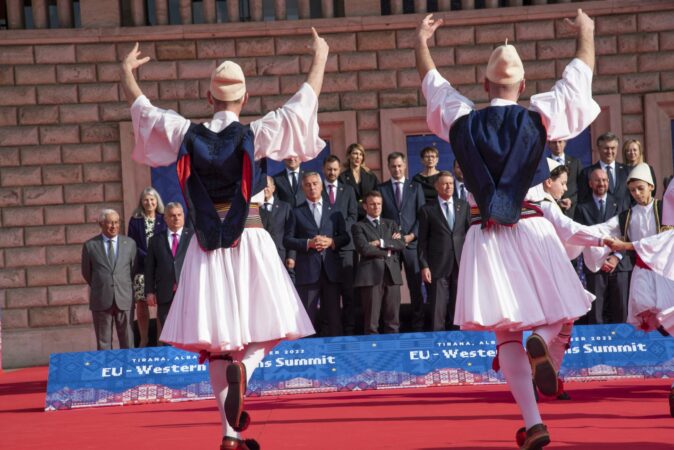



The European Commission presented on October 6 a new package of political guidelines called "Preparing for a Wider Union" - which aims to adapt the EU's governance, policies and budget for the upcoming enlargement.
The package also offers the possibility of gradual integration of candidate countries into certain EU policies, before full membership, to bring tangible benefits to citizens. However, the countries must meet the criteria required by Brussels.
To simplify and speed up the process, the document suggests using qualified majority voting to open group negotiating chapters, aiming to avoid vetoes by member states. But the ease of decision-making comes at the cost of strong post-accession safeguard clauses, which could lead to the suspension of voting rights in the Council for serious breaches of EU values – a mechanism that would remain in place for 15 years after accession.
The proposal on paper appears to ease Albania's path to membership, giving it early access to benefits such as SEPA payments or roaming-free zones. However, experts warn that the substance of the proposal finds the country deeply unprepared.
One of the weak points is Albania's fragile economy, which risks being hit hard by premature competition from the single market unless safeguards are taken. Meanwhile, weaknesses in audit capacity and corruption expose the country to the rapid freezing of vital funds.
The establishment of such lengthy post-accession oversight mechanisms signals a deep lack of trust from Brussels, creating what analysts see as the risk of a peripheral membership, with truncated rights.
“It essentially constitutes changing the rules of the game since 1956,” says researcher Blendi Çeka. “If we are not full members, we accept the status of the periphery, without a voice, without equal rights,” he added.
Proposal to lift the veto
Relations between Albania and the European Union represent one of the country's longest journeys since the fall of the communist system in the early 90s. In 1992, Albania signed the Trade and Cooperation Agreement with the European Community, but it took 14 years for the country to sign the Stabilization and Association Agreement.
Despite the early application, successive internal political crises caused Albania to receive candidate country status only in June 2014, losing momentum. According to the new membership methodology adopted in March 2020, the process is carried out grouped into six chapter groups known as “Clusters”.
Albania opened the group chapters on October 15, 2024, with an ambitious goal of closing them all by the end of 2027. The Rama government's goal remains full membership in 2030.
To provide a clear framework for this process, the European Commission plans to present in the 2026 Enlargement Package specific “indicative roadmaps” for the most advanced countries such as Albania, Montenegro, Ukraine and Moldova, which will serve as a negotiating compass, with the strict condition that these countries maintain the pace of reforms. However, as experts point out, the “Achilles heel” of this ordeal remains the first group of chapters, which directly deals with the rule of law, fundamental rights and democratic institutions. This group of chapters opens first and necessarily closes last, dictating the entire pace of the process.
The Commission's proposal to replace unanimity with qualified majority voting for intermediary decisions in negotiations, such as the opening of group chapters, has been seen as a major diplomatic move to remove the veto as a bilateral blocking tool. But beyond the superficial enthusiasm, experts are skeptical.
European integration expert Geron Kamberi calls this initiative a logical paradox, since: “in order to remove unanimity in the EU, there must be unanimity.” According to him, the veto has served small or medium-sized states to feel equal within the union and maintain political weight to balance their powerlessness in the face of large states.
Blendi Ceka also shares the same skepticism, assessing it as a decision that can hardly pass the European Council, as member states fear "creating a precedent" and see the lifting of the veto as a disintegrating move.
"I don't believe that member states, for conceptual reasons and fear of creating a precedent, will give up unanimity," he says.
However, for Gledis Gjipali, leader of the European Movement in Albania, if this becomes a reality, the importance is essential.
"For Albania, although it has opened all the group chapters, this approach is important for their closure. It will also eliminate any excuse for slowing down internal reforms, due to a possible veto during the process," said Gjipali.
Fear of the EU
The Commission's new plan balances the lifting of the veto during negotiations with an ironclad security cordon after accession, providing for institutional safeguard clauses that go as far as suspending voting rights in the Council for a period of up to 15 years after formal accession, in the event of a violation of the Union's core values.
For analyst Blendi Ceka, this unprecedented conditioning of voting rights proves that the decision "is entirely political" and that the claimant states will be put to the test.
“Lack of voting rights treats candidate countries as the current status quo combined with increased access to financial gain in some sectors,” he says.
Kamberi recalls that this "early EU syndrome" has been tested in the past with Romania and Bulgaria for problems of the rule of law and corruption, for 15 consecutive years 2008-2023.
Gjipali also thinks that this clause reflects Brussels' direct fear that after accession, its coercive instruments will run out.
“The clause expresses the EU's fear of a repeat of a case like Hungary with new member states,” he notes, explaining that reforms undertaken quickly often take years to produce their full effects.
But Gjipali also adds that the activation of the 15-year mechanism does not mean an automatic suspension of the vote for 15 years, but offers additional guarantees for countries skeptical of enlargement.
“The legitimate concern is that they be proportional, based on facts and do not create arbitrary treatment of new members, without taking into account the specifics of their internal development,” says Gjipali.
The strict conditionality also extends to the financial and economic side. The European plan foresees that the funds of the “Global Europe” instrument will be inextricably linked to the implementation of reforms, where payments can be suspended “if serious defects in financial management” and deficiencies in the rule of law are observed.
Gjipali emphasizes that while SEPA and roaming bring direct cost reductions for citizens, market opening increases competition and it will be "small businesses, farmers and professionals who will be the first to bear the costs of adaptation."
Ceka is more drastic in his reading.
He emphasizes that Albania "is not ready by almost any standard to face the common market and competition."
If approved, the European Union's new approach appears to favor candidate countries, but it still remains a two-sided coin.
"Change can take you back to the starting point of the process if you have not managed to properly utilize this favorable moment," says Gjipali, adding that change only comes through real and sustainable reforms. /BIRN/