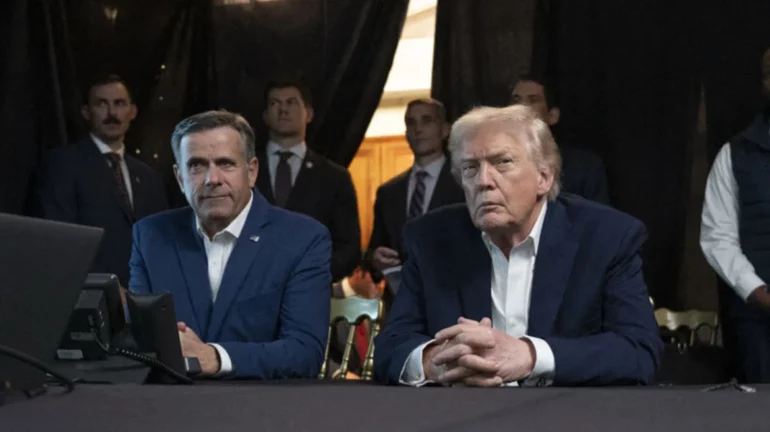



CIA Director John Ratcliffe's secret visit to Moscow has raised serious questions about the message Washington is sending to the Kremlin. President Donald Trump has described the trip as "semi-routine," but the circumstances of the mission suggest it is an extremely unusual visit.
Ratcliffe arrived in the Russian capital on a US military plane and held meetings with Russian intelligence officials, including Sergei Naryshkin, the head of the SVR.
He did not meet Vladimir Putin in person, but the Kremlin confirmed that the Russian president was briefed on the content of the talks.
The CIA has not provided details about the mission, while Trump has denied that Ratcliffe sent a specific message regarding NATO or Iran.
However, reports based on US intelligence sources suggest that one of the objectives of the visit may have been to warn Moscow against taking action against a NATO member country.
Why was the head of the CIA sent?
Washington has numerous diplomatic channels to communicate with Moscow. For this reason, sending the CIA director on such a mission carries special weight.
A meeting between intelligence leaders could enable the American side to convey a much more direct warning: that Washington may have information about Moscow's movements, military preparations, or plans.
This makes the possibility that the US would be concerned about a limited Russian action against NATO particularly relevant.
This is not necessarily a Ukraine-like invasion. A more complex scenario would be a limited operation, sabotage, cyberattack, drone strike, or an action in the “gray zone,” where Russia might initially deny its involvement.
Estonia, Latvia, and Lithuania have been at the center of potential scenarios for a confrontation between Russia and NATO for years.
One strategic peculiarity is the Suwalki Corridor, a narrow strip of territory between Poland and Lithuania that connects the Baltic states with the rest of NATO and separates Belarus from the Russian enclave of Kaliningrad.
A crisis in this area would have major military and political consequences for the Alliance.
The main problem for NATO would not only be the military response, but also the political decision: how quickly would the 32 member countries reach the conclusion that a particular incident constitutes an attack on the Alliance and requires a collective response?
Visits by CIA leaders to Moscow have been rare and have usually taken place during periods of great tension.
In 1992, Robert Gates visited Moscow and met with Boris Yeltsin and Yevgeny Primakov. In subsequent years, James Woolsey and George Tenet also held meetings with Russian officials.
In 2010, Leon Panetta visited Moscow as part of the Obama administration's efforts to "reset" relations with Russia.
In 2016, John Brennan made a secret visit to Moscow during the conflict in Syria.
But one of the most significant precedents was that of November 2021.
In November 2021, President Joe Biden sent CIA Director William Burns to Moscow.
Burns met with Nikolai Patrushev and Sergei Naryshkin, while Vladimir Putin, who was in Sochi, was briefed on the talks.
At that time, American intelligence had begun to detect the massing of Russian forces near the border with Ukraine.
The American message was that Washington knew what was being prepared and that an invasion would have serious consequences.
Just a few months later, Russia launched a full-scale invasion of Ukraine.
It is precisely this precedent that makes Ratcliffe's visit all the more important. It does not mean that a new conflict with NATO is inevitable, but it does show that Washington may consider the situation serious enough to use one of the most sensitive communication channels at its disposal.
The war in Ukraine continues, while Ukrainian attacks on targets on Russian territory have increased.
Moscow has long argued that Western support for Ukraine has turned the conflict into an indirect confrontation with NATO.
The question now worrying Western planners is how far Vladimir Putin might go if the war continues to escalate.
A new response could be limited to more intense attacks on Ukraine, but it could also take the form of hybrid warfare in Europe: cyberattacks, sabotage, arson, infiltration, and covert operations.
The most dangerous line would be an attempt to test NATO's commitment through a small, brief, and deliberately vague attack.
In this context, Ratcliffe's visit to Moscow may have been a way to convey a simple but very important message to the Kremlin: a limited attack on NATO does not necessarily mean that the US will stay out of the conflict.