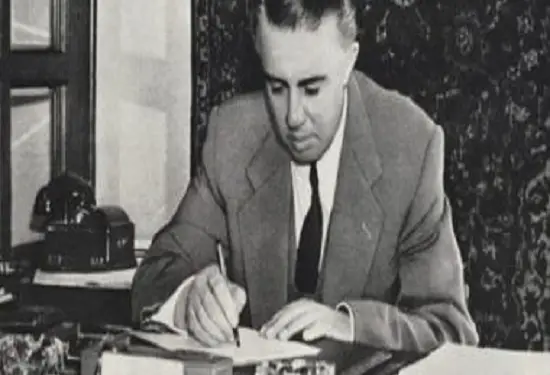



In 1956, clashes began within the Communist Party led by Enver Hoxha. According to a declassified document by the CIA, many members expressed reservations about the party's policies. They demanded accountability from Beqir Balluku, who urgently called Mehmet Shehu and Enver Hoxha, who were in Shkodra and Vlora. On the other hand, it is shown how Tropoja turned into a strong center of espionage.
October 1949
The Balkan situation
The Soviet war of nerves against Tito has already led to the annulment of the friendship treaty with Yugoslavia and is showing the consequences of Tito's defection from the structure of Soviet communism. The successful challenge to Tito is becoming a focal point for dissident communist groups and may become a means of uniting an anti-Stalinist front. The question, of course, is whether world communism will be politically led by the USSR, or by an international party apparatus.
Tito cast doubt on the ability of the USSR leadership, presenting his leadership style as more benevolent. This point of tension in Yugoslavia-USSR relations has brought about a change in the situation in the Balkans. The Soviet Union can generate anti-Yugoslav policies in many directions such as from Hungary, Bulgaria, Romania and Albania. But this capacity can be hindered by a certain rapprochement between Yugoslavia and Greece as well as by the uncertainty of the Albanian position. But the USSR can act for this by exploiting antagonistic nationalisms, which can focus on Macedonia.
A few months ago, when the Greek communist guerrillas began to take control, there were signs of the beginning of Soviet unrest in Macedonia, or of the incitement of nationalism among Albanians in Kosovo and other minorities. The Greek guerrillas have now been reduced to only 2500 in Greece, and their withdrawal from neighboring countries such as Albania and Bulgaria indicates that there will be no organized operations. The guerrillas no longer have the capacity to negotiate with the Greek government. The latter are now confident in their strength and had sought to pursue the communists beyond the Albanian border, but this would have brought old territorial revenge and was stopped by the Americans and British.
The Greek government has now pledged not to act against Albania but has asked the UN to investigate any new infiltration of guerrillas from Albania and Bulgaria. During these developments, both Greece and Yugoslavia, encouraged by the US, have improved their positions by reducing the USSR's ability to achieve anything in Greece. Therefore, Moscow is diverting attention from the guerrilla effort in Greece, perhaps to organize it this time towards Yugoslavia.
Refocusing efforts to promote old Slav-Macedonian aspirations would serve a dual purpose. On the one hand, it would attempt to undermine Tito and the Yugoslav federation, to which the Slav-Macedonians had allied themselves, and on the other hand, trained guerrilla units in Macedonia could threaten Greece if the need arose.
August 21, 1950
The situation of resistance in Albania
From one of our missions in Albania, which is in close contact with the resistance movement, we have received the information set out in the following paragraphs. According to our mission, many members of the Albanian resistance believe that they can no longer bear the suffering they are enduring and have decided to escape to Yugoslavia at the earliest opportunity. They would prefer to go to Greece, were it not for the great distance from northern Albania to the Greek border. Despite all the efforts made to persuade them to stay in Albania, it is clear that they cannot survive another winter in the mountains, as life is so difficult that it is driving them to madness.
Tropoja, center of espionage
The leader of this mission wanted to know whether the Yugoslav political activists in Albania (previously reported to you) were known to us and whether they represented the Allied effort. They also asked whether anti-communist activists from Albania would be well received in Yugoslavia. In connection with Yugoslav support for the Allies, it was asked what Yugoslavia's policy was regarding Korea.
The above message informs us that Tropoja is the center of Albanian and Yugoslav espionage, with Yugoslav and Albanian agents constantly crossing the border. The Yugoslav agents are described as having all been former members of Albanian resistance groups. On August 10, 1950, our mission in the country sends a contact to investigate an invitation to meet an unidentified person who wished to supply Yugoslav arms and ammunition to the mission.
Yugoslav movements
There is a strong belief among the populations of Northern Albania that the Yugoslavs are planning an armed movement in Albania, with the aim of raising the morale of the mountain resistance groups. Some quantities of arms are reported to have been distributed daily by the Yugoslavs, which have also been accepted by the nationalist Albanians, who have been approached with money, but have refused, awaiting approval from our mission. The leader of the mission fears that such generosity on the part of the Yugoslavs will have the effect of winning the sympathy of many people who have suffered greatly while working for us. In conclusion, the leader of the mission said that his persuasive work would not be sufficient, and that he therefore needed urgent instructions on the course of action to be followed.
March 1957
Controversies among members of the Central Committee
At a meeting of the party's Central Committee in Tirana in the spring of 1956, the Tirana delegates expressed harsh criticism of the Central Committee and the policies of the Communist Party. The meeting was preparatory in nature to the party congress that was held in May 1956. At the meeting, the government was represented by the Minister of Defense Beqir Balluku, since Enver Hoxha was in Vlora on vacation and Mehmet Shehu was in Shkodra. Balluku was asked by the delegates to provide explanations regarding the control and censorship of the press.
But he was unable to give an answer and felt that such questions had consequences. So he called Enver Hoxha and Mehmet Shehu and told them to return to Tirana immediately. The two leaders came to the meeting and tried to calm the representatives. This was done mainly by Enver Hoxha through numerous promises for the future. A day later, at the meeting of the central committee, Hoxha and Shehu attacked some representatives, calling them traitors and reactionaries, which led to the dismissal of two generals, Hulusi Spahiu and Tahir Kadare.
Some others were transferred to areas far from the capital. Members of the party's central committee were further sent as delegates to various areas of the country to calm the population. Mehmet Shehu was sent to Vlora where he spoke at a meeting held in the city's cinema, and pushed back the implementation of the government's plans.
The morale of the people
Discontent and anger prevail throughout Albania due to the difficult economic situation. People hope for war to break out as the only way to remove the communist regime, since heavy security measures make it almost impossible to start an internal uprising. Although everyone knows the terrible consequences of a war, they no longer fear it, because it is the only way to bring about a change towards improving living conditions. Listening to foreign broadcasts on the radio is prohibited, those who own a radio listen to the Albanian and Greek broadcasts of the “Voice of America”, the BBC and Radio Athens.
The collectivization campaign
The government aims to complete the collectivization of agriculture by 1958 and is taking all measures. Peasants living in the city are being asked to return to the countryside to implement agricultural projects. In general, all government efforts are focused on improving agriculture and agricultural production. In the Vlora area, 4 cooperatives have been organized, which have about 25 -30.000 sheep. Its director is Hasan Muço. The cooperative also has 40 beehives, which produce about 200 kg of honey per year.
July 1957
The situation in Albania
At the meeting of the party's Central Committee in Tirana in the spring of 1956, criticism was leveled at some party members, and as a result some of the delegates were accused of being traitors and reactionaries. Generals Hulusi Spahiu and Tahir Kadare were dismissed. In October 1956, a Vlora infantry unit was relocated and its troops were distributed to other units in Gjirokastër, Korçë, Përmet and Shkodër. About 150 people remain in the Vlora barracks. The purpose of the relocations is believed to have been to reinforce the Greek and Yugoslav borders.
An artillery military group is located about 1000 m. south of Vlora. Its commander is Vasil Xhelo from Himara. From the beginning of February 1957 to the beginning of March, mobilization exercises of reservists and light training were held. The Vlora infantry barracks are located on the eastern side of the road to the Port, 500 m. away from the latter and 1500 meters from the city center. Vlora has a section of the Internal Branch, which is headed by the chief of the Sigurimi, Petrit Hakani, and his deputy, Skënder Paisi from Vlora.
The Vlora Naval Fleet has 2-3 fast boats that patrol the Vlora Bay and the island of Sazan. Its air defense consists of 4-8 20 mm. caliber artillery guns. located on the hill above the city in Kuzbaba, while four 37 mm. cannons. are located in the Vlora artillery barracks. Near the airfield there are four more cannons of the same size.
Education
Vlora has a high school named after the hero Ali Demi. In Poliçan there is a 4-year elementary school and a 3-year school called Unike. Elementary school students learn Greek and a few hours are devoted to Albanian. On the contrary, the curriculum of the Unike school teaches mainly Albanian and a few hours are devoted to Greek.
trust
Vlora has two Orthodox churches and three priests, and church services are held on Sundays and holidays. Mostly the elderly attend Sunday services, while on Orthodox holidays the churches are packed with people. Even on religious holidays, communists come to church to attract the attention of the people with political discussions. In general, religious feelings remain strong despite the repression and communist measures. Many families who own a radio listen to church services. There is also a Catholic church and a priest in Vlora. Few people go to this church, as most Christians are not Catholic.
There are four mosques in Vlora, but only three of them are used as churches, one has been turned into an archaeological museum. There are also several small mosques, but few people go to them. The civil hospital of Vlora is located in the northeast of the city and consists of five buildings, respectively for the treatment of infectious diseases, surgery, children's diseases, women's diseases, etc. The hospital has six doctors and about 150 beds. The city also has a maternity hospital. Insured citizens are treated free of charge at the hospital.
March 1975
Albanian editorial condemns the Soviet army
The Albanian anti-Soviet campaign must have reached new heights, as Tirana accuses Moscow of transforming the Soviet army into an “aggressive, putschist, fascist” force. The editorial was published in the party’s daily and was entitled “The Soviet Army, an Army of Conquest and Oppression of Peoples.” The following quotes are typical of the tone of the article: “The Soviet army is now in the hands of the bourgeoisie and serves the consolidation and domination of imperialist goals.
The revisionists have transformed it from a revolutionary army as created by Lenin and Stalin 57 years ago, into an army of counter-revolution and dictatorship of the bourgeoisie… it has now become an aggressive army of occupation and oppression of the peoples.” This barbaric aggression of the Soviet army against the Czechoslovak people is the first demonstration of aggressive, chauvinistic and fascist policy, as well as a signal for the launch of the offensive against the freedom and independence of the peoples.
“With the aim of completely enslaving the revisionist countries of Eastern Europe both politically and militarily, the Kremlin’s neo-tsarist leaders and their generals have demanded increased military maneuvers,” it said. It further declared: “The Soviet army is quietly strengthening the military occupation of Poland, Hungary, East Germany, Bulgaria and Mongolia, where it possesses a special status that only an aggressive occupying army can have.” Tirana does not need special provocations for outbursts like these, since for the Hoxha regime these things arise naturally.
But Albanians are certainly reacting to any sign of increased Soviet interest in the Balkans, especially in Yugoslavia, to which Hoxha has recently promised assistance in repelling any possible Soviet attack. Now that Yugoslavia has raised the issue for the second time in six months against satellite countries, Tirana may make even sharper accusations against the Kremlin. Meanwhile, discussions are continuing between Belgrade and Tirana about the construction of a railway line, which would be Albania's first link to Europe.
The Belgrade-Bari line represents a long-held dream of Serbs and Montenegrins and has been under construction for a decade. It is expected to be completed in 1976 but has encountered difficulties due to the difficult terrain. Extending it to the Albanian border is relatively simple and most of the problems are purely political, such as the conviction of xenophobic Albanians of the economic advantages of connecting with the outside world. The government believes that this opening could expose the country to “corrupting influences” from the outside world.
China, which seeks to reduce Soviet influence in the region, is willing to finance the project, not only by building the Albanian part of the railway, but has reportedly offered a $75 million loan to Belgrade to finance its part as well. The Chinese apparently believe this will increase their influence in the Adriatic area, where they believe the Soviets are seeking to establish naval bases. China may see the move as an opportunity to improve Yugoslav military transport in the area. / Memorie.al