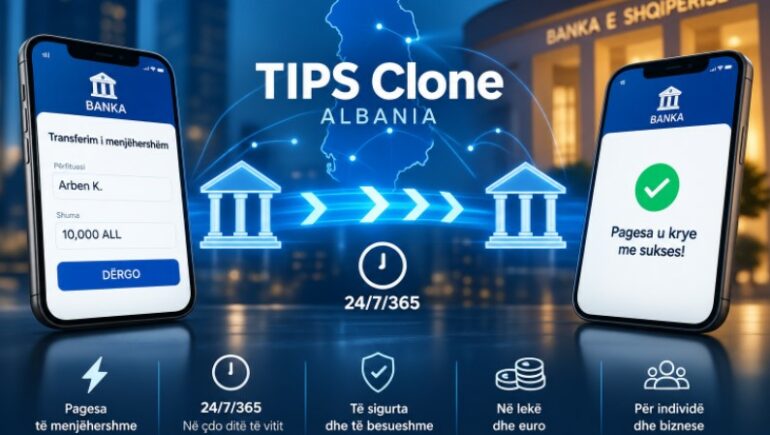



The Bank of Albania is preparing the regulatory framework for the implementation of the new national instant payment system, which will enable the transfer and settlement of money in lek and euro, at any hour and any day of the year.
The draft decision of the Supervisory Council provides for the approval of the regulation “On the functioning of the instant payment system – XXX”, while in the document the infrastructure is also identified as “TIPS Clone Albania”. The Bank of Albania will be the owner, administrator, operator and settlement agent of the system.
The system is designed to operate 24 hours a day, 7 days a week and 365 days a year, including weekends and holidays. The regulation defines instant payment as a payment that is executed at any time of the year and that results in the immediate or near-instant settlement of the transaction, with the beneficiary's account credited and the payer's confirmation within seconds of initiation.
This will significantly change the way bank transfers are made in Albania. Instead of payments being dependent on the usual settlement system hours and business days, the new system will allow the exchange and settlement of payment instructions without time limits, as long as there are sufficient funds in the relevant account.
According to the project, “TIPS Clone Albania” will process instant payments in both lek and euro. The system will enable the exchange of instructions and their settlement 24/7/365, while the supply or withdrawal of liquidity will be realized through the connection with the existing AIPS and AIPS EURO systems, within the specified intervals.
Banks and non-bank institutions can participate
Another important element is the opening of the system not only to banks, but also to non-bank payment service providers. According to the project, participants may include the Bank of Albania, banks and non-bank PRBs.
The category of non-bank PRBs includes payment institutions and electronic money institutions licensed and regulated under the Law "On Payment Services", with the exceptions specified in the legislation.
The regulation creates two forms of participation: direct and indirect.
The direct participant will have one or more dedicated liquidity accounts in the instant payment system and transactions will be settled with the funds available in these accounts. To supply them with funds, the institution must have a settlement account in AIPS for the lek or AIPS EURO for the euro.
The indirect participant, on the other hand, does not have its own dedicated liquidity account. Its payments are settled through the account of a direct participant.
This structure could enable smaller financial institutions to offer instant payments without necessarily being required to maintain a dedicated liquidity account in the system themselves.
Liquidity is linked to AIPS and AIPS EURO
The architecture of the new system is built on a direct connection with the existing infrastructure of the Bank of Albania.
A dedicated instant payment account will be created for each direct participant. It will record debits and credits resulting from executed payments.
Meanwhile, the Bank of Albania will maintain separate transit accounts for the lek and the euro. These will be used to transfer liquidity from AIPS or AIPS EURO to the instant payment system and vice versa.
This means that payments between clients themselves can be made around the clock, while the transfer of liquidity between infrastructures will respect defined intervals.
The draft regulation defines three moments for this purpose: “cut-off-start”, which marks the beginning of the interval when liquidity can be transferred between AIPS and the new system; “cut-off-end”, which marks the end of this interval; and “cut-off-date”, the moment when the business or currency date changes in the system.
Payments according to SEPA Instant standards
An important element is the connection of the Albanian system with European instant payment standards.
The draft regulation creates the concept of "SEPAInstAL", which for payments in lek and euro implies the implementation of the rules of the pan-European SEPA Instant Credit Transfer - SCT Inst scheme, together with other acts that the Bank of Albania will adopt for instant payments.
Participants will have to guarantee compliance with these rules, while BIC11 codes registered in SWIFT will be used for technical identification. For direct participants, SWIFT or NEXI infrastructure is also required to access the system.
This places the new system on the same technical and operational logic as European instant payment infrastructures, although the Albanian system will also support payments in the national currency.
Even a third party can technically send payments
The regulation also introduces the concept of “instructing party.” It can be an entity or technical role that sends and receives instructions on behalf of a direct or indirect participant.
The ordering party does not automatically become a participant in the system. It acts only within the authorization granted by the relevant institution.
In this case, an agreement between the parties and a clear definition of responsibilities are required. The direct participant declares to the Bank of Albania that it bears full legal and financial responsibility for the actions sent to the system through the ordering party, as if it had performed them itself.
Anyone who enters the system directly must meet strict technical requirements.
Direct participation will not be automatic. Institutions must meet technical, operational and security requirements.
Among other things, the use of an approved network service provider, compliance with technical requirements and electronic signatures, compliance with SEPAInstAL rules, identification through BIC11, compliance with personal data legislation and cooperation with the Bank of Albania assistance center are required.
Institutions seeking direct participation must also have internal operating rules, procedures for information security and risk management, sufficient and qualified staff, and settlement accounts in AIPS or AIPS EURO.
The process also goes through technical and functional testing. After submitting the request, the Bank of Albania must return a reasoned response to the candidate within 10 working days. Then, the integration calendar is drawn up, configurations and testing are performed, and only after the Bank of Albania confirms that the conditions have been met, the go-live date is determined.
The Bank of Albania takes operational control of the system
The Bank of Albania will define the categories of participants, administer the membership process, technical configurations, system schedules and liquidity movement mechanisms. It will also monitor the system, manage incidents and provide technical and operational assistance.
The central bank's liability, however, is limited to the operations it administers. It does not assume any liability for damages arising from, among other things, incorrect instructions given by participants, lack of funds, problems with the participants' own infrastructure or the network services they have chosen.
For indirect participants, the responsibility is even more closely linked to the institution through which the settlement is carried out. The direct participant must declare to the Bank of Albania that it assumes legal and financial responsibility for the transactions settled under the activity of the indirect participant.
The draft regulation thus constitutes the regulatory step for the creation of a new national infrastructure where transfers in lek and euro will no longer depend on the day or time of the payment. Payments will be able to be exchanged and settled 24/7/365, while banks and non-bank institutions will be able to connect to the system directly or through another participant. /ekofin.al