



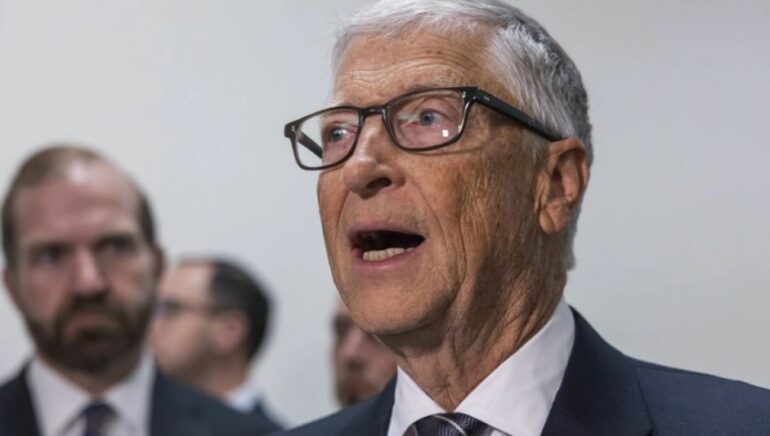



No government in the world is truly prepared for the changes that Artificial Intelligence will bring to society. The warning comes from Microsoft co-founder Bill Gates, who in an interview with Reuters said that governments have fallen far behind in the face of the rapid development of this technology.
Gates, who until recently was among the most optimistic voices about the potential of Artificial Intelligence, now expresses greater concerns about its impact on the job market, the risk of potential attacks, and the dependence that could be created by AI's digital "companions."
"I don't think any government is dealing with this to the extent that it should be," Gates said, adding that governments have fallen far behind on this issue.
However, he stressed that AI also has tremendous potential to help the world's poorest people, if used properly and if access is as equitable as possible.
The Gates Foundation announced Tuesday that it plans to invest at least $1 billion over the next two years to expand access to Artificial Intelligence.
Gates said he has discussed his concerns with world leaders, including US President Donald Trump and his team. He also said he is trying to meet with Chinese President Xi Jinping later this year.
The potential of AI in healthcare
Despite the warnings, Gates and his foundation believe that Artificial Intelligence can help narrow the gap between rich and poor countries, rather than widening it.
The $1 billion program is part of a broader plan by the Gates Foundation, which has announced it will spend about $9 billion a year. The new funds will be used to support partners working in areas such as education, health and agriculture.
Another goal is to create the databases necessary for the development of AI, including the possibility of large language models working on all the languages spoken in the world.
"In the healthcare sector, it's hard to overstate the magnitude of the opportunities," Gates said, referring to the use of AI to support healthcare workers, as well as for the discovery of new drugs and vaccines.
But he warned that governments must cooperate to avoid serious problems, comparing the development of AI to movie scenarios where an extraordinary threat forces rival countries to unite.
"AI is in a way like this alien intelligence. They're here and we better do what we see them do in these movies," he said.
The Epstein affair and the impact on Gates' reputation
In June, Gates testified before Congress about his relationship with Jeffrey Epstein, a convicted sex offender and now deceased.
Gates has not been charged with any crime and has repeatedly said he regrets his relationship with Epstein, saying he had hoped the financier could secure donations for global health causes.
Gates has also stated that Epstein tried to blackmail him using information regarding his extramarital affairs.
The case prompted the Gates Foundation to seek an external audit. According to the report, the investigation found no payments to Epstein or involvement in criminal activity.
Gates has stated that, despite the revelations, the relationship with Epstein has not caused significant damage to either his reputation or that of the foundation.
"In terms of my access to government leaders or the willingness of journalists to interview me, I don't see any decline," he said, adding that interest in the Gates Foundation's expertise in reducing child deaths and eliminating malaria has not diminished "at all."