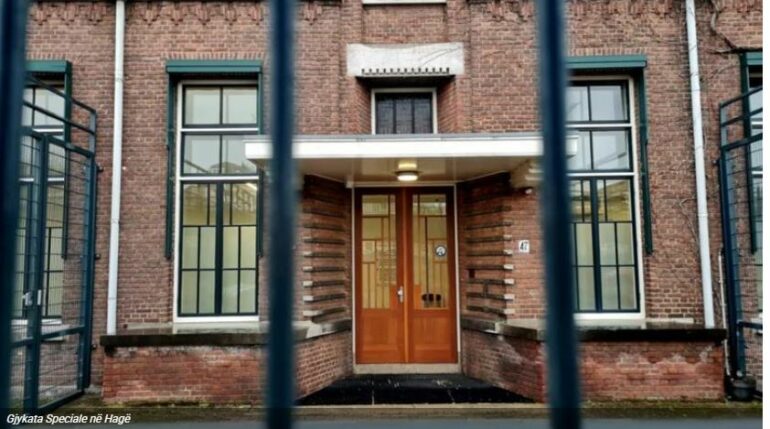



The Kosovo Assembly approved amendments to the Law on Specialist Chambers and the Specialist Prosecutor’s Office on October 6. The following day, the European Union expressed “deep concern” and said that the amendments conflict with Kosovo’s international obligations to the EU.
The Democratic Party of Kosovo, which proposed these changes, said that this is not true because they are not seeking the dissolution of the Special Court and that "Kosovo remains faithful to the obligations it has taken on to investigate allegations of organ trafficking."
Meanwhile, the ruling party, Vetevendosje Movement, told Radio Free Europe (RFE/RL) that it supported the change in the law, although it continues to have doubts about whether it could affect the judicial processes in The Hague.
"We have had our doubts and skepticism. We have said this publicly, both in meetings with the PDK and in our statements," the head of the LVV Parliamentary Group, Arbërie Nagavci, tells REL.
Even Prime Minister Albin Kurti himself, during the approval, had described the proposed changes as "hasty".
But, if changes through a domestic law conflict with an international agreement, can that agreement be changed?
Although the Assembly has the competence and mandate to adopt and amend laws, amending Kosovo law does not mean that the international agreement to which the relevant law is related is automatically amended.
According to Besfort Rrecaj, professor of international law at the Faculty of Law of the University of Pristina, the Kosovo-EU agreement on the Specialist Chambers is an international legal instrument and, as such, can be amended, but only "with the consent of the parties."
For this reason, according to him, Kosovo should first seek agreement with the EU on the changes.
"Kosovo can and should propose opening negotiations with the EU to amend the agreement, adapting it to the new changes," Rrecaj tells Radio Free Europe.
He emphasizes that any changes must preserve the independence of the judiciary and the integrity of judicial processes.
Who can challenge the law and which court has jurisdiction?
Any law adopted by the Assembly may be challenged before the Constitutional Court for constitutionality by the President, the Government, the Ombudsman, or the Assembly, while 10 or more deputies may object to it within eight days of its adoption.
However, in the case of amendments approved for the Law on Special, there is a separate procedure.
Point 3 of Article 162 of the Constitution stipulates that the Specialized Chamber of the Constitutional Court, composed of international judges, has exclusive jurisdiction over constitutional referrals related to the Specialized Chambers and the Specialized Prosecutor's Office.
The amendments approved by the Assembly aim precisely to change this rule through domestic law, by removing the competence of the Constitutional Chamber in The Hague to review the constitutionality of the law on Special and transferring this responsibility to the Constitutional Court of Kosovo.
However, the Constitution stipulates that ratified international agreements and legally binding norms of international law have priority over the laws of Kosovo.
At the end of 2015, for example, the Constitutional Court had requested that the Association of Serb-majority Municipalities be established as foreseen in the 2013 Brussels Agreement, although it had found that it was “not fully in line” with the Constitution. This was because it had found that, after the ratification of the agreement, “the establishment of the Association became part of the domestic legal system.”
For this reason, international law professor Rrecaj explains that if the new law conflicts with the international agreement with the EU, that domestic law cannot be used to override the agreement.
"According to the jurisprudence of the Constitutional Court, ratified international agreements have priority over Kosovo's laws. Also, the Constitution of Kosovo gives priority to international agreements over its own provisions," Rrecaj explains.
How were the changes for the Special rejected in 2020?
A similar case occurred in 2020, when then-president Hashim Thaçi proposed amending Article 162 of the Constitution, which establishes the mandate of the Specialist Chambers and the Specialist Prosecutor's Office.
He requested: to amend paragraph 13, so as to directly state that the mandate continues until the EU Council announces its termination, in consultation with the Government of Kosovo; and to delete paragraph 14 in its entirety, which linked the extension of the mandate to the 2014 Exchange of Letters.
The proposals were sent for preliminary assessment to the Special Constitutional Chamber in The Hague by the then Speaker of the Assembly, Vjosa Osmani. On 26 November 2020, the Chamber decided that the amendments would diminish the fundamental rights and freedoms guaranteed by the Constitution and, therefore, could not be adopted.
In the judgment, the Chamber also paid particular attention to the fact that Kosovo had not previously consulted the relevant EU authorities.
The Chamber called the lack of consultation a “procedural deficiency,” but clarified that its decision was not based solely on this issue. However, it found that the obligation to consult was part of the constitutional requirements and was relevant to the legislative process in Kosovo.
Where does the obligation to consult arise from?
The obligation to consult with the EU is linked to the way in which the legal framework of the Specialist Chambers was established.
The process began after a 2011 report by the Parliamentary Assembly of the Council of Europe, which contained allegations of serious crimes during and after the war in Kosovo. Following this report, the EU established a Special Investigative Task Force to investigate these allegations.
In 2014, the then-President of Kosovo, Atifete Jahjaga, and the EU High Representative, Catherine Ashton, exchanged letters on how cases would be handled if investigations led to indictments and trials.
Through this Exchange of Letters, Kosovo pledged to create specialized chambers and a specialized prosecutor's office, while it was envisaged that sensitive procedures would be conducted outside of Kosovo.
The document also provided for consultation with relevant EU authorities when amending laws that would affect these procedures.
The Assembly ratified the Exchange of Letters on 23 April 2014, giving it the status of an international agreement between Kosovo and the EU.
Then, on August 3, 2015, the Assembly approved the constitutional amendment that created Article 162 of the Constitution, as well as the Law on Specialist Chambers and the Specialist Prosecutor's Office.
Now, the lack of clarity on how the Government will implement the new law in relation to these international obligations leaves open the question of its legal effect in practice./ REL