Impunity continues to remain one of the main problems in Albania, according to a report by OSAC, a structure affiliated with the US Department of State.
The report assesses that the creation of the Special Structure Against Corruption and Organized Crime (SPAK) in 2019 has led to an increase in investigations, arrests, and criminal prosecutions of officials suspected of abuses, but emphasizes that many persons with political, administrative, and economic power still manage to avoid criminal responsibility.
According to OSAC, the efforts of Albanian institutions to implement the law continue to be hampered by corruption, the lack of efficient exchange of information between state agencies, insufficient institutional coordination, and a judicial system still in the process of development.
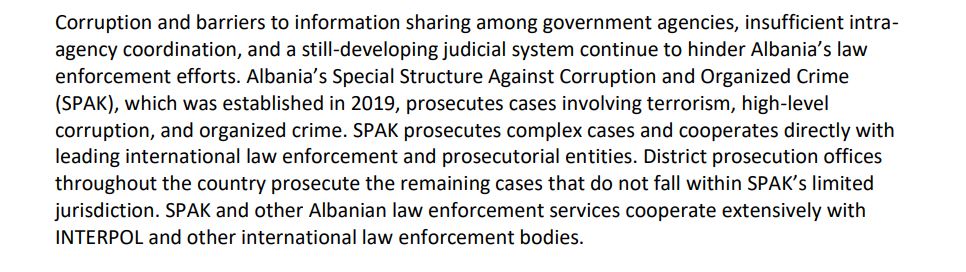
“Corruption and obstacles to information sharing between government agencies, insufficient coordination within agencies, and a still-developing judicial system continue to hamper law enforcement efforts in Albania. Albania’s Special Structure Against Corruption and Organized Crime (SPAK), which was established in 2019, prosecutes cases involving terrorism, high-level corruption, and organized crime. SPAK prosecutes complex cases and cooperates directly with key international law enforcement and prosecution entities. District prosecutors’ offices across the country prosecute remaining cases that do not fall within SPAK’s limited jurisdiction. SPAK and other law enforcement services in Albania cooperate extensively with INTERPOL and other international law enforcement bodies,” the report states.
Full report
Crime
The US Department of State has assessed Tirana as a MEDIUM threat country for crimes directed at or affecting official US government interests.
The U.S. Department of State has included a Crime Indicator “C” in the Travel Notice for Albania, indicating that there may be widespread violent crime and/or organized crime in the country, and/or that local law enforcement may have limited ability to respond to serious crimes.
The emergency hotline for crime in Albania is 112. Review the U.S. Department of State's Crime Victim Assistance brochure.
Crime: General threat
The overall crime rate in Albania increased from 2024 to 2025 by about 17%, with drug-related crimes, fraud, and weapons charges being the main drivers of this increase. Property crimes saw a small increase (about 3%), but robberies fell by 21%, continuing a nationwide shift toward non-violent, non-confrontational crimes. Violent crime, including homicides, also fell for the fifth consecutive year, decreasing by about 3% in 2025.
The Albanian government is making a concerted effort to improve the country’s law enforcement capabilities and reduce corruption. Organized crime has a significant impact in Albania, which is home to a network of criminal organizations involved in drug trafficking, extortion, bribery, money laundering, prostitution, and human trafficking. Much of Europe’s illicit weapons and explosives originate from or transit through Albania, and authorities have shifted their focus to disrupting arms trafficking networks.
Street crime is common in urban areas, especially at night. The most common are burglaries of unoccupied homes and vehicles, bag snatching, and street scams. Armed robberies and other violent crimes against foreign travelers are rare; if confronted by armed assailants, comply with their demands.
There have been attacks using small improvised explosive devices (IEDs) and targeting individuals in contentious disputes. Be vigilant when parking in unsupervised parking areas, avoid parking overnight in unsafe areas, and inspect vehicles for suspicious items. If you find anything strange, do not interfere and contact the Albanian State Police immediately. The immigrant community is not a specific target, although members may become victims due to circumstances or proximity.
Crime: Areas of Concern
As a security precaution due to the potential for retaliatory violence and/or reports of unfair business practices and safety concerns, the following restaurants are prohibited for U.S. Embassy personnel:
Juvenile
Juvenile Castle
Venezia Pastry Shop
4Magic Club
Review OSAC's reports, Everything You Need to Leave Behind , Hotels: Spaces and Amenities , Hotel Security Considerations , Getting Credit , and Our Opinion: Petty Crime Basics and How to Minimize the Risk .
Kidnapping threat
The U.S. Department of State has not included a Kidnapping Indicator “K” in the Travel Notice for Albania.
Review OSAC's reports, Kidnapping: Basics and Tips for Responding to Active Shooters and Kidnappers.
Terrorism
The US Department of State has assessed Tirana as a country with a MEDIUM threat of terrorism directed at or affecting official US government interests.
The U.S. Department of State has not included a Terrorism “T” Indicator in the Travel Notice for Albania.
There has not been a successful terrorist attack in Albania in the past decade, and the most recent foiled plots were in 2016 and 2018. The primary terrorist threat in Albania is the use of Albania as a source or transit country for money or materials by terrorists, as well as the potential for radicalization to violence by returnees from Syria. The return of foreign fighters from Syria continues to be of concern due to their more radicalized views, stronger ties to known terrorist groups, and newly acquired military tactics. The terrorist threat in Albania also includes Iranian plots against the displaced Iranian opposition group Mujahedeen-e-Khalq (MEK). In 2018, members of a cell of the Iranian Revolutionary Guard Corps (IRGC) were arrested after plotting to attack a MEK compound in Manez. Iranian cyberwarfare against this group in 2025 led to an official resolution by the Albanian Parliament declaring Iran a “state sponsor of terrorism.”
Albania has laws against terrorist acts; financing of terrorism; collecting, transferring, and concealing funds that finance terrorism; conducting transactions with persons on UN sanctions lists; recruiting and training people to commit terrorist acts; inciting terrorist acts; and creating, directing, and participating in terrorist organizations.
The Albanian State Police Counterterrorism Directorate (DKT) works closely with U.S. agencies to align Albanian government requirements with U.S. expertise and resources, facilitating the development of Albanian government capacities focused on counterterrorism. DKT can effectively and proactively detect, deter, and prevent acts of terrorism on its territory. The Directorate has worked with other regional counterterrorism units to monitor potential threats and, when appropriate, provide evidence.
Some terrorist groups, and those inspired by such organizations, intend to attack U.S. citizens abroad. Terrorists are using less sophisticated methods of attack, including knives, firearms, and vehicles to target crowds. U.S. citizens are reminded to remain vigilant about their personal safety and to exercise special caution at high-profile public events (sports competitions, political rallies, demonstrations, festive events, holiday gatherings, etc.); hotels, clubs, and restaurants frequented by tourists; places of worship; schools and parks; shopping centers and markets; and public transportation systems (including subways, buses, trains, and scheduled commercial flights).
Political violence and civil unrest
The US Department of State has assessed Tirana as a country with a LOW threat of political violence directed at or affecting official US government interests.
The U.S. Department of State has not included a “U” Indicator for Civil Unrest in its Travel Advisory for Albania. Civil unrest can develop quickly without warning, often disrupting logistics and services. Avoid demonstration activities, as even those planned to remain peaceful have the potential to turn violent.
Elections/Political Stability
Elections in Albania have previously involved elements of organized crime and corruption within the voting process. However, recent election cycles have resulted in a more balanced and fair process. Parliamentary elections were held in 2025, and election day was largely peaceful. There were isolated reports of irregularities involving candidates and their supporters, although the Central Election Commission has said that the reports will not negatively affect the election results.
Despite the exceptionally peaceful elections, a joint observation mission by the Office for Democratic Institutions and Human Rights of the Organization for Security and Co-operation in Europe (OSCE), the OSCE Parliamentary Assembly, the Parliamentary Assembly of the Council of Europe and the European Parliament have called for comprehensive electoral reform in Albania. They specifically noted that the electoral process was characterized by the misuse of public resources by the ruling party, the use of divisive language by the two main political parties, a lack of transparency in campaign financing and unbalanced media coverage of smaller parties.
Albania will hold the next local elections in 2027 and parliamentary elections in 2029.
Protests and demonstrations
Political demonstrations and protests are common in Albania. Protests are generally peaceful, but have resulted in violence in the past. Demonstrations vary in size from a few hundred to several thousand participants and often disrupt traffic. One of the most frequent locations of protest activity in the country is the capital's main boulevard, Dëshmorët e Kombit, which is home to many government, diplomatic, and cultural buildings. Molotov cocktails are common during demonstrations, although they are generally thrown at buildings rather than people.
Following the 2025 elections, opposition political groups engaged in significant anti-government protests throughout Tirana. Large marches blocked Tirana's Dëshmorët e Kombit Boulevard, and some demonstrations included the use of Molotov cocktails and other pyrotechnics. Civic groups also held sit-ins at government offices, some of which lasted over 100 days.
In 2026, large protests targeted a luxury tourism project on the island of Sazan. The rallies began as local environmental demonstrations, but when police broke up the rallies, thousands of Albanians took to the streets in major cities. The protests grew to include calls against government corruption, and some turned violent.
Anti-American/anti-Western sentiment
Anti-American sentiments are rare in Albania and are generally well-regarded by the international community.
Implementation of the Law
The Ministry of Interior oversees the Guard of the Republic and the Albanian State Police, which includes the Border and Migration Police. The Albanian State Police is primarily responsible for internal security. The Guard of the Republic protects high-ranking state officials, foreign dignitaries, and some state property. The Ministry of Defense oversees the armed forces. The State Information Service is responsible to the prime minister, collects information, and conducts foreign intelligence and counterintelligence activities. Civilian authorities maintained effective control over the security forces.
Corruption and obstacles to information sharing between government agencies, insufficient coordination within agencies, and a still-developing judicial system continue to hamper law enforcement efforts in Albania. Albania’s Special Structure Against Corruption and Organized Crime (SPAK), which was established in 2019, prosecutes cases involving terrorism, high-level corruption, and organized crime. SPAK prosecutes complex cases and cooperates directly with key international law enforcement and prosecution entities. District prosecutors’ offices across the country prosecute remaining cases that do not fall under SPAK’s limited jurisdiction. SPAK and other law enforcement services in Albania cooperate extensively with INTERPOL and other international law enforcement bodies.
Police Response
Police have a visible presence throughout Tirana and other major cities in Albania, although their response is often delayed due to limited resources and manpower. Police tend to respond more quickly to reports from members of the international community. However, the ability of law enforcement to protect and assist travelers is limited in some areas, especially in remote regions.
The Albanian government is attempting to make a concerted effort to improve the country's law enforcement capabilities, particularly in the areas of combating terrorism and organized crime. Corruption and lack of resources within the police represent ongoing challenges.
The emergency line for the police in Albania is 129.
Transportation Safety
Road Safety
Driving can be difficult. Travelers regularly encounter unsafe drivers across the country, and disregard for traffic laws is widespread. Road accidents are common and repeatedly result in serious injury or death. Those who choose to drive should exercise extreme caution and drive as defensively as possible.
The condition of roads in Albania continues to improve. The main roads between cities are usually paved highways. Many smaller roads in villages or neighborhoods are mostly dirt and rocky, and are in poor condition. In winter, roads through the mountains in northern Albania can be snowy and icy. Flash floods can occur at any time, opening deep and wide potholes, especially in suburban areas.
Driving at night is dangerous, with roads that are poorly lit. Avoid traveling between cities at night due to the risk of car accidents. Plan to arrive at your destination before dusk.
In Albania, you can only use an international driving license for one year and must apply for an Albanian driving license after one year. It is illegal to drive under the influence of alcohol. The police will seize your license and vehicle if you are caught. You could also be fined or face up to six months in prison. It is against the law to use a mobile phone without a hands-free kit while driving.
Fuel and repair services are common in populated areas, but there is no official roadside assistance. Spare tires and parts may not be available. Emergency response services are inadequate. First aid teams have limited medical training and equipment. Accident victims often have to be transported to the nearest hospital in a bystander's car.
Review OSAC's reports, Road Safety Abroad, Driving Abroad: Best Practices and Avoidant Driving Techniques; and read the U.S. Department of State's website on driving and road safety abroad.
Public Transport Safety
Public transport options are limited and generally not recommended for visitors. Train conditions are poor, limited and service inconsistent. Private buses travel between most major cities almost exclusively during the day on variable schedules. Intra-city bus transport has improved in recent years, although pickpocketing is common on public buses. Marked taxis are safe and recommended for use. Passengers should negotiate a price before boarding a taxi.
Concerns about aviation
Tirana Mother Teresa International Airport (TIA, also known as “Rinas”) is a newer and more modern airport. Well-known regional airlines fly regularly to Albania. There are no domestic commercial flights. Since there is no direct commercial air service to the United States by carriers registered in Albania, the U.S. Federal Aviation Administration (FAA) has not assessed the Civil Aviation Authority of the government of Albania for compliance with the aviation safety standards of the International Civil Aviation Organization (ICAO).
Albania continues to take steps to enhance border security, detect and deny entry to terrorists, and meet the standards of UN Resolution 2396, such as the use of API/PNR to improve air passenger screening.
Review the OSAC Report, Transit Security: Airplanes, Public Transportation, and Sleeping.
Maritime Safety
Albania supports a port security oversight system to meet the requirements under the International Maritime Organization's International Ship and Facility Security Code.
Mariners planning to travel to Albania should also check for U.S. marine advisories and warnings. Information may also be posted on the U.S. Coast Guard’s port website, and the NGA’s broadcast warnings website by selecting “broadcast warnings.”
Travelers with Special Considerations
For specific traveler concerns in Albania, review local laws and circumstances on the U.S. Department of State's country information page.
Women Travelers
Gay and lesbian travelers
Accessibility needs
Study abroad
Faith-Based Travel
Rule of Law, Arbitrary Detention, Official Harassment, Corruption and Transparency
The U.S. Department of State has not included a “D” Indicator of Risk of Unfair Detention in the Travel Notice for Albania. If you are arrested or detained, ask police or prison officials to notify the U.S. Embassy immediately.
The law and constitution prohibit arbitrary arrest and detention and provide for the right of every person to challenge the legality of his or her arrest or detention in court. The Albanian government generally respects these prohibitions, but there were instances in which police detained individuals for questioning for extended periods of time without formally arresting them.
Albania has a sound legal framework to combat corruption and prevent conflicts of interest of public officials and politicians, including their family members. However, foreign investors cite corruption, including in the judiciary, government, public procurement and media, a lack of transparency and competition, a large informal economy and poor contract enforcement as some of the biggest problems hampering the business environment in Albania.
Impunity remains a serious problem. With the creation of SPAK in 2019, the arrest and prosecution of officials who commit abuses has increased, yet many officials, politicians, judges, and individuals with powerful business interests are still able to evade prosecution.
Corruption continues to be a serious problem in detention centers, particularly in relation to access to work and special release programs.
Health concerns
The U.S. Department of State has not included an “H” Health Indicator in its Travel Notice for Albania. Review the U.S. Centers for Disease Control and Prevention (CDC) country-specific Travel Health Notices for current health issues affecting the health of travelers, such as disease outbreaks, special events or gatherings, and natural disasters.
Medical care is inadequate in some areas and emergency medical services are very limited. There are no trauma hospitals outside of Tirana. Individuals under ongoing medical supervision should consult their doctor before traveling. Albania has few ambulances. Injured or seriously ill individuals may need to take taxis or other vehicles to the nearest hospital.
Find contact information for medical services and air ambulance services available on the U.S. Embassy website. The U.S. Department of State strongly recommends purchasing international health insurance before traveling abroad. Review the U.S. Department of State website on health insurance abroad.
See OSAC's Guide to U.S. Government-Assisted Evacuations; review OSAC's reports, The Healthy Way, Shaken: Things Not to Do with Alcohol Abroad, Health 101: How to Prepare for Travel, and Fire Safety Abroad; and visit the U.S. Department of State's website on Your Health Abroad for more information.
vaccination
Get vaccinated against hepatitis A and B as a precaution before traveling to Albania. Travelers involved in outdoor activities should be vaccinated against rabies due to the large number of stray dogs.
Review the CDC Travelers' Health website for country-specific vaccination recommendations.
Problems while traveling with medication
Carry an adequate supply of any necessary medication with you, as pharmacies in Albania may not have the brand or type of medication you need available.
Review OSAC's report, Traveling with Medication.
Water quality
Drink only bottled water, as local tap water does not meet American standards.
Review the OSAC report, What Water Am I Drinking?
Natural Disaster
The U.S. Department of State has not included an “N” Indicator for Natural Disaster in the Travel Notice for Albania.
Albania is prone to destructive earthquakes. Tsunamis occur along its southwestern coast, and flooding and drought problems, including forest fires, are possible throughout the country.
Air pollution is a problem throughout Albania, especially in Tirana, due to outdated industrial and power plants.
Review the OSAC report, Earthquake Preparedness Toolkit.
Cyber security
Albania is a target for malicious cyberattacks by state actors, including Iran and Russia. Albania has also experienced ransomware attacks by cybercriminal groups. In 2026, Iran carried out cyberattacks against Albanian state websites and systems. Malicious cyberactivity by a state that intentionally damages critical infrastructure or impairs its use and functioning to provide services to the public can have domestic, regional, and global effects; poses a high risk of harm to populations; and can lead to escalation and conflict.
Review OSAC reports, Cybersecurity Basics , Best Practices for Maximizing Security on Public Wi-Fi , Traveling Abroad with Mobile Devices , and Guide to Using Satellite Phones Abroad .
Counterintelligence Issues
There are no counterintelligence problems related only to private sector operations in Albania.
Import/Export Restrictions
Albania's customs authorities enforce strict regulations on the import or export of certain items, including weapons, endangered wildlife, and narcotics. Certain categories of products require licenses and registration before being imported into Albania, including, but not limited to, insecticides, pesticides, and pharmaceuticals. There are no restrictions on satellite phones in Albania.
A country-specific list of items/goods prohibited from export to that country or otherwise restricted is available on the U.S. International Trade Agency website.