


It used to be one of the main topics that determined the winners and losers of elections.
But, a decade and a half later, relations with the European Union are no longer among the main messages of the election campaign in Serbia, even though it has the status of a candidate for EU membership.
In a country that was once among the most advanced in the European integration process, but is now among the most backward, only one electoral list has the EU at the center of its program.
The "European Serbia" list, composed mainly of Dragan Djilas' Party for Freedom and Justice and Zdravko Ponoshi's Heart Party (Srce), has focused its campaign on the need for EU membership.
For other parties, including those in power, European integration is not a main campaign topic.
Serbia, otherwise, has not opened any new chapters in its membership negotiations with the EU over the last five years.
This stalemate is related to Serbia's refusal to join the sanctions that the EU imposed on Russia, due to its invasion of Ukraine, as well as the deterioration of the rule of law situation.
As a result, Serbia is not even included in the roadmaps that the European Commission is preparing for the most advanced countries in this process.
Among them are: Montenegro, Albania, Ukraine and Moldova.
Serbian citizens will head to the ballot boxes on October 25th in early parliamentary elections.
The announcement of the elections was preceded by several months of mass protests, during which responsibility was sought for the collapse of a concrete shelter at the Novi Sad Railway Station on November 1, 2024, in which 16 people lost their lives.
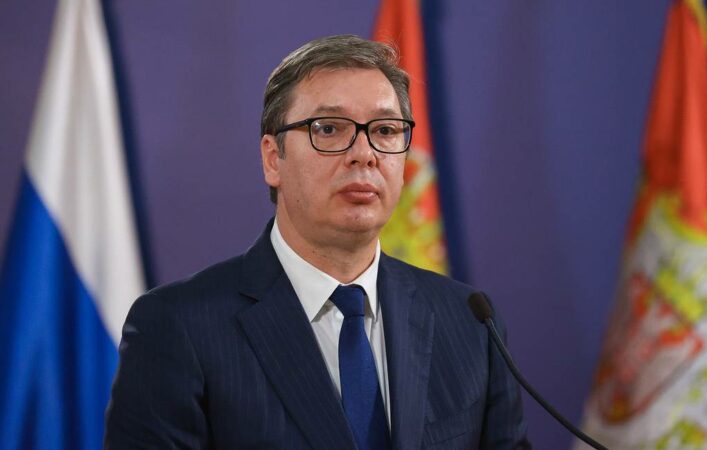
Former Serbian President Aleksandar Vučić is running for the post of Prime Minister.
He leads the "United Serbia" List of the Serbian Progressive Party.
This party, together with its coalition partners, has been in power for the last 14 years.
Vučić says that, if this list wins the elections, Serbia will continue to pursue an "independent and sovereign policy, which means the path towards Europe, but also the protection of national interests."
When announcing the elections, he assessed that Serbia had chosen "the right European path, while preserving traditional friendships, national pride and dignity."
Over the last decade, Vučić has pursued a policy of balancing between the West and the East.
Although he has repeatedly stated that Serbia is on the path to European integration, in recent years he has intensified cooperation with China, without giving up ties with Russia.
"Vučić doesn't talk much about the EU, because this topic doesn't suit him. They are the ones who have stopped Serbia's European integration process," Serbian political scientist and university professor Duško Radosavljević tells Radio Free Europe.
Serbia has not opened any new set of chapters in its accession negotiations with the EU since December 2021.
Even in the program of Vučić's main rival, the student list "Students Win", Serbia's membership in the European Union is not mentioned as a goal.
The program of this list contains 11 points, including the fight against corruption, judicial independence, police reform, and media freedom.
Representatives of the Student List say that, currently, they are focused on the internal regulation of the state, while issues such as EU membership will be considered after the change of power.
Radosavljevic says that the Student List has set as its goal "the overthrow of Vučić" and the creation of conditions for the reconstruction of state institutions.
"And, when the state has been rebuilt to some extent, then political programs should be presented," adds Radosavljevic.
Naim Leo Beshiri, from the non-governmental organization Institute for European Affairs, tells Radio Free Europe that the goals of the Student List are consistent with the values of the European Union.
"Students did not run or cycle to Moscow or, for example, Egypt, but to the main European cities, Brussels and Strasbourg," he says.
Beshiri adds that the policies that the Student List aims to implement, according to its program, cannot be realized without the EU as a partner.
However, during the election campaign, students declared that they are against imposing sanctions on Russia.
They justified this position by saying that sanctions against any country do not help solve political and security challenges, "especially given our experience and the direct consequences of such measures for the local population."
On the other hand, the "European Serbia" List supports the full harmonization of Serbia's foreign policy with that of the European Union and the imposition of sanctions against Russia.
Representatives of this list say they aim to put Serbia back on the path of European integration and to complete by 2030 what, according to them, "the current government has postponed for years."
The European Union, however, is part of the campaign of electoral lists composed of Eurosceptic parties.
Representatives of the "Authentic Right" List, led by the New Democratic Party of Serbia (DSS), support cooperation with the EU, but oppose membership.
They say they "don't want Brussels to be their capital."
Among the messages of the leader of the New DSS, Miloš Jovanović, during the campaign, was the claim that Serbia's membership in the EU "implies the recognition of marriages between persons of the same sex."
"We constantly hear bombastic, patriotic and sovereignist statements," says Radosavljevic, commenting on the messages of Eurosceptic parties.
The "Alternative for Serbia" list, led by the leader of the People's Party, Vladimir Gajic, is also notable for its anti-EU stances.
This list calls for the suspension of membership negotiations as long as, according to it, the recognition of Kosovo as an independent state remains a condition for Serbia.
During the campaign, Gajic declared that the "both Kosovo and Europe" policy is impossible.
Authorities in Serbia do not recognize Kosovo's independence, but are conducting dialogue with Pristina to normalize relations, under the mediation of the European Union.
Progress in this dialogue is a condition for the advancement of both countries in the European integration process.
Right-wing parties also oppose imposing sanctions on Russia.
The parties that have been in power so far talk little about the European Union, but promise voters that they will not allow Serbia to join NATO.
In a video from the "United Serbia" election campaign, young members of a family demand membership in the EU and NATO, while Vučić, who plays the role of a waiter, responds: "We don't have NATO, but we have peace and stability."
According to a declaration adopted by the Serbian Parliament, this country is militarily neutral, but cooperates with NATO through the Partnership for Peace program.
Beshir believes that the way NATO is being used in the campaign is a marketing tactic of the Serbian Progressive Party (SNS).
"They are probably trying to create the impression that others, including the Student List, could be the ones who will push for NATO membership," he says.
Beshiri emphasizes that Serbia has cooperated most with NATO precisely during the period when Vučić was in power.
The first "NATO-Serbia" military exercise was held in May of this year, in southern Serbia, where around 600 members of the Serbian Army and forces from NATO member countries exchanged experiences.
Also, since 2014, the military exercise "Platinum Wolf" has been organized by the Serbian Army and the United States European Command.
In addition to the US, members of the armies of other NATO member countries also participate in these exercises.
Even the Socialist Party of Serbia, part of the current governing coalition, declares that it strongly opposes NATO membership.
"When all the countries around you are members of NATO or the EU, or both... in such a situation you cannot question cooperation. You cooperate with those around you," says Radosavljevic.
Even representatives of right-wing parties oppose Serbia's membership in NATO.
The student list has not presented a position on NATO in its program.
And, representatives of the "European Serbia" List have stated in previous years that Serbia should not become a member of NATO, but should cooperate with this military alliance./ REL