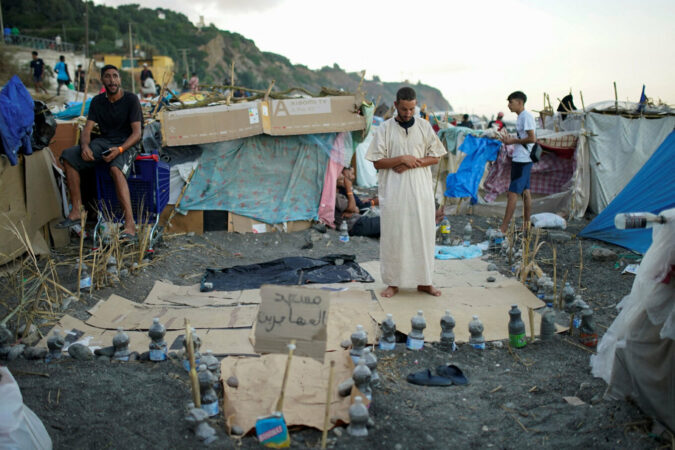



Scenes from Playa del Trampolín, one of Ceuta's popular beaches, show a completely different reality after the massive arrival of migrants in the Spanish enclave in North Africa. Makeshift tents made of plastic and fabric have been erected along the shore, while suitcases, mattresses and garbage are scattered around them. According to reports from the field, men are sleeping on the beach or bathing in the sea, while children are begging passersby for money. Due to overcrowding, some spaces have even been turned into makeshift toilets.
The situation has worsened after the massive arrival of around 80 migrants in Ceuta in two days, around five weeks ago. Despite statements by the Spanish authorities that the new arrivals would leave the enclave, thousands of them continue to remain there. Figures on the number of people remaining in Ceuta vary. The Spanish police union CEP estimates the number at around 10, including 1,400 to 1,600 minors, while the Confederation of Ceuta Employers puts the figure at around 15 people. According to the latter's estimates, only around 20% of them are sheltered in organized structures. The rest are staying on beaches, streets and makeshift camps in the small territory of Ceuta, which normally has around 85 inhabitants.
Pressure on authorities increases
The arrival of such a large number of people has put pressure on local infrastructure and security structures. According to the head of the CEP police union in Madrid, Sebastian Sutzl, crime in Ceuta has increased significantly compared to the period before the mass arrival. Reports of sexual assaults are also of particular concern. According to the chief prosecutor Silvia Rojas, 23 sexual assaults were recorded in August, nine of which involved children.
The suspects reportedly include Moroccan, Spanish and a Belgian national. One of the people who spoke out about the situation is 18-year-old Hasnaa Ramsi, from Casablanca. She reported an incident to authorities but declined to give details. Hasnaa arrived in Ceuta after swimming for about half an hour in the waters that separate Morocco from the Spanish enclave. She says she wants to move to Zaragoza and continue her accounting studies.
Other migrants tell similar stories. Fares Haroun, 21, a computer science student from Sudan, swam to Ceuta on July 31 after a friend told him “the borders are open.” Meanwhile, 23-year-old Rayame Boutalia, from Algeria, says he is a boxer and intends to go to mainland Spain to continue training. “Everyone is here because they want a better life for themselves and their families,” he said. Mohammed Achaoui, 21, from Tangier, also says he left Morocco for economic reasons. He claims he had no job and was living on the streets.
However, the reality he found in Ceuta, according to him, is far from expectations. "I came for a better life, but I'm starting to lose hope," he said, claiming that he was attacked and robbed. Playa del Trampolín has become one of the symbols of the crisis. Dozens of makeshift structures have been erected on the shore, while migrants sleep on mattresses and use public spaces for basic needs. Some fish on the rocks, others bathe in the sea, while in one part of the area improvised prayer spaces have also been created.
Meanwhile, authorities have increased the presence of security forces. About 500 Guardia Civil officers have been sent as reinforcements, bringing the number of police and military personnel in the enclave to about 1,100. The crisis has also caused strong political reactions. Ceuta residents have expressed concern about their safety and the conditions in which they are living, while local authorities are facing great pressure to manage the situation. The issue has become a major problem for the government of Prime Minister Pedro Sánchez. The opposition has accused the government of failing to manage the crisis, while Sánchez has denied that there is evidence that Morocco has organized the mass crossing of migrants. According to him, no Spanish or European agency or international organization has presented the government with solid evidence of such a plan.
Five weeks after the mass arrival, Ceuta continues to face a dire situation, with thousands of migrants living in makeshift conditions, overcrowded facilities and an increased security presence. While beyond the crisis figures lie people who have undertaken dangerous journeys in the hope of starting a new life in Europe.