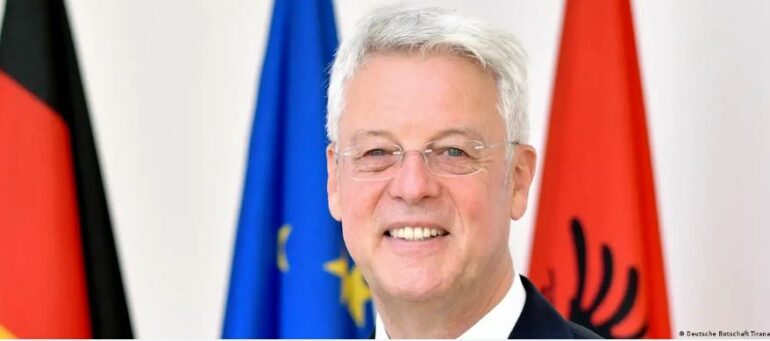



Germany's Ambassador to Albania, Karl Bergner, told DW that judicial independence and unhindered efforts against corruption, including high-level corruption, are non-negotiable prerequisites for EU membership.
Karl Bergner: Albania and Germany cooperate closely in various political areas, including foreign policy and security. As European countries and NATO partners, we face the same challenges stemming from changes in the world order and the threat posed by Russia's war of aggression against Ukraine.
Economic cooperation also plays a significant role. Germany is Albania's largest bilateral donor and aims to improve the daily lives of Albanian citizens by strengthening infrastructure (water and energy supply, wastewater treatment and waste management) and by supporting sustainable economic development in cities and, to an even greater extent, in rural areas. In addition, as part of our bilateral cooperation, we work to combat climate change by greening the economy and to support the country in adapting to increasingly extreme weather conditions caused by climate change.
Interest in Albania is growing in Germany, especially as a tourist destination. At the same time, the Albanian diaspora in Germany is gaining in importance. Among them are a number of creative and successful entrepreneurs, who are building new bridges between Germany and Albania. Both of these trends strengthen the ties between the citizens of our two countries and give a boost to our economic and cultural relations.
DW: Does Germany support the ambitions of Albania and neighboring countries to join the EU? How realistic do you consider Albania's goal of completing membership negotiations by the end of 2027?
Karl Bergner: Albania and the other Western Balkan countries are part of the European family. For this reason, we strongly support their membership in the European Union.
Germany's long-standing position is that EU membership of all candidate countries should be based on merit. The deadlines therefore depend on the speed and comprehensiveness of their reforms. In this context, we recognize Albania's ambition to conclude accession negotiations by the end of 2027. On the path to full membership, the country has made tangible progress, while important tasks still remain.
In addition to improving the daily lives of many Albanians, the extensive technical and financial assistance mentioned above is always intended to support Albania's EU membership. This ranges from financing the construction of wastewater treatment plants in a number of Albanian cities (as a prerequisite for the environment-related chapters) to supporting various ministries in approximating legislation to EU standards. But, in the end, what is crucial is Albania's determination to undertake and implement these reforms, even when they are difficult or affect important economic interests.
One example is the adoption of a unified law on investments, instead of the current law on strategic investments. Albania has pledged in its Reform Agenda to do this by the end of this year, while the European Parliament, in its latest resolution, has reiterated previous EU demands. In my opinion, this would be a very important step to guarantee transparency and a level playing field for all businesses.
Achieving the goal of EU membership also depends on the ability of the public administration, but also of the business community, to adopt EU standards. The fact that Germany is Albania's largest bilateral donor once again demonstrates our strong commitment to helping Albania every step of the way.
DW: The justice reform has entered a crucial phase. What are Germany's concrete expectations from the justice institutions in Albania for the next two years?
Karl Bergner : A strong rule of law, the protection of fundamental rights and a pluralistic democracy are at the core of European values. Respect for the independence of the judiciary and unhindered efforts against corruption, including high-level corruption cases, are non-negotiable prerequisites for Albania's progress in the EU accession process.
In this regard, the reform of the judiciary has been a key factor that has enabled the advancement of Albania's EU accession process. For the future, Albania is committed to further reforms related to the rule of law. This has been Germany's main focus on Albania's path to EU membership for many years and will remain so. We believe that Albania will continue and increase its efforts to strengthen the rule of law and the independence of the judiciary, as well as to fight corruption and organized crime, to name a few of the most important areas. Changing laws is not enough: both the EU and Albanian citizens expect to see real and tangible changes in practice, as well as the creation of the necessary capacities in public administration and independent institutions. /DW/