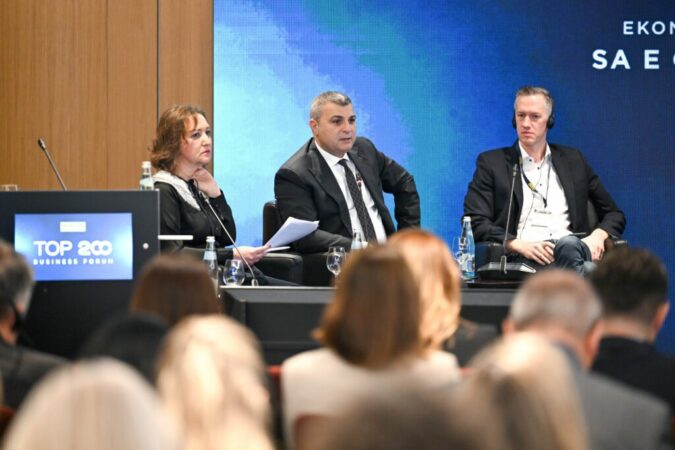



The Governor of the Bank of Albania, Gent Sejko, responded to businesses' interest in the fall of the euro, during today's conference "The Future of the Economy", organized by Monitor magazine.
"First, I want to clarify that the exchange rate is determined by the market and not by the Bank of Albania. This is a misunderstanding that is constantly repeated, even in the discussions we have had with large businesses. The exchange rate is determined by supply and demand, while the Bank of Albania publishes the average rate."
The governor said that the country operates in a free exchange rate regime. "For this reason, we have appreciation or depreciation of the national currency, depending on market developments. If we had a fixed regime, as some countries have, or a managed regime, as is the case in North Macedonia, we would not have the same exposure to exchange rate losses or gains. But this effect would be transferred to inflation and, consequently, to higher prices.
So, either you will absorb the impact of economic shocks, whether coming from abroad or from within the country, through the exchange rate, which we consider as an automatic shock absorber, or you will absorb it through prices. There is no perfect theoretical solution that allows you to fix the exchange rate and at the same time have no impact on prices, said Sejko.
He explained that the Central Bank does not set the exchange rate. "Of course, we intervene in the foreign exchange market, but we do this in function of the objectives that the law sets for us: price stability, i.e. inflation control, and financial stability, which means the safety and sustainability of banks."
"The aim is that the exchange rate level and the fluctuations related to the appreciation or depreciation of the local currency against the euro do not negatively affect the capital of banks and, indirectly, also businesses. Our interventions aim to curb speculation and slow down the speed of appreciation or depreciation. This gives businesses and other economic actors time to adapt to the course of the exchange rate, close their foreign exchange positions and enter into forward or swap contracts. Otherwise, large fluctuations in the exchange rate, both upward and downward, can cause shocks and losses, as is the case in other countries."
Governor Sejko said that this exchange rate trend in Albania is related to the large inflows of euros. “There are often debates on this issue, and I want to be realistic and open, especially when we talk about money of illegal origin. As a Central Bank, we cannot directly measure these flows, as the balance of payments gives us other data. They do not result in being cleared through the banking system. There may be isolated elements, but in general the banking system is well controlled and supervised, not only by Albanian institutions, but also by international ones.
"Also, it is not the role of the Central Bank to deal with all these issues. There are many other law enforcement agencies that have the responsibility to stop these flows. The powers of the Central Bank are clearly defined by law."
Mr. Sejko said that for several years he has been explaining the role of the Bank, the reasons for the strengthening of the exchange rate and all the factors that influence this process. “As the saying goes, repetition is the mother of knowledge, but also the father of boredom. However, it is important that we all be clear about the division of responsibilities: give to Caesar what is Caesar's.”
"In a free exchange rate regime, if an economy has a growth of 4% per year, which could be even higher, and this growth is accompanied by formalization and large foreign exchange inflows from various sources and channels, of course the local currency will appreciate."
"I have been asked this question repeatedly: how will the exchange rate behave? It has been addressed to me in Parliament, in business forums and in many other discussions. But I do not know how the exchange rate will move, just as no one can know for sure. If someone knew its performance in advance, they would become a billionaire, acting as a businessman or analyst and not as a regulator."
However, one thing is certain, said the governor, based on theoretical principles and fundamentals: if the economy continues to grow sustainably and long-term at these rates, through foreign exchange inflows, which in this case are mainly in euros, the local currency will tend to appreciate, as the supply of foreign exchange will be greater.
"I understand very well the concern of businesses. It is a serious and real concern, as the losses and shocks that the exchange rate brings are concrete, especially for exporters, but also for other businesses. However, the Bank of Albania cannot solve this problem alone. Ultimately, the Central Bank has as its objective price stability and not direct support for specific sectors of the economy.
The exchange rate helps us curb inflation, while fiscal policies are what can support certain sectors and industries. It is not the role of the Central Bank, in Albania or in any other country, to intervene to favor specific industries or sectors.
The role of the Central Bank is to guarantee financial stability, to ensure that banks are sound and continue to lend to the economy. Another objective is to maintain price stability.
Another question often arises: if the exchange rate is overvalued, why do prices continue to rise? But it is not correct to conclude that the appreciation of the currency must lead to a decrease in prices. Prices may continue to rise, but they would be even higher if the opposite were to happen, that is, if the national currency were to depreciate. We try to keep inflation at a controlled level, but there are other instruments to curb price increases.
So, the concern of businesses is completely justified and we are ready to discuss it. However, the interventions that we have made as the Central Bank have not been intended to help certain sectors of the economy. They have been carried out at the macroeconomic level, to stabilize markets, to influence the level of inflation and to maintain financial stability.
Although this was not our intention, these interventions have also slowed the rate of exchange rate appreciation. Indirectly, this has given businesses more time to adapt to exchange rate developments, through contracts or changes in the way they manage their activity.
If we continue to have these economic growth rates, theoretically the trend towards appreciation of the local currency could continue. But this does not mean that we can predict with certainty how the exchange rate will behave in the future.
I want to emphasize that this is an ongoing debate, but the Central Bank cannot do more than its legal and institutional role allows. We can constantly discuss this issue and we will continue to give the same explanations, but we cannot change our competences. Often, for this reason, misunderstandings also arise.
In fact, there is a broader problem related to the level of financial education. The roles and functions of various institutions are often not properly understood. The word money is mentioned and we immediately turn to the bank. But not every issue related to money should be addressed to the Central Bank. There are many other institutions that have the relevant responsibility and powers to solve certain problems.
We coordinate efforts with other institutions and intervene within our mandate. Even indirectly, through our interventions, we have helped businesses, although this was not the direct objective. The interventions have also helped limit the appreciation, as without them the exchange rate could have strengthened even more.
However, businesses must also adapt their business model. We cannot focus only on the exchange rate. The entire business model must be reviewed, technology must be invested in, and the entire financial structure must be analyzed, including the profit and loss account, business strategies, focus, and ways to compensate for losses.
Businesses should also make greater use of foreign exchange risk management instruments, such as forward and swap contracts, as well as other contracts for protection against exchange rate fluctuations, which are currently underutilized. Negotiations with banks are also needed to reduce risk exposure.
European integration and economic growth also bring risks. As with the exchange rate, businesses will also face significant competitiveness challenges. The loss and departure of the workforce, i.e. the emigration of people, are also challenges similar to those brought by the exchange rate.
"When you open up to markets, you win in some ways and lose in others. What is required is the continuous adaptation of business to the new conditions of competition," the governor concluded./ Monitor