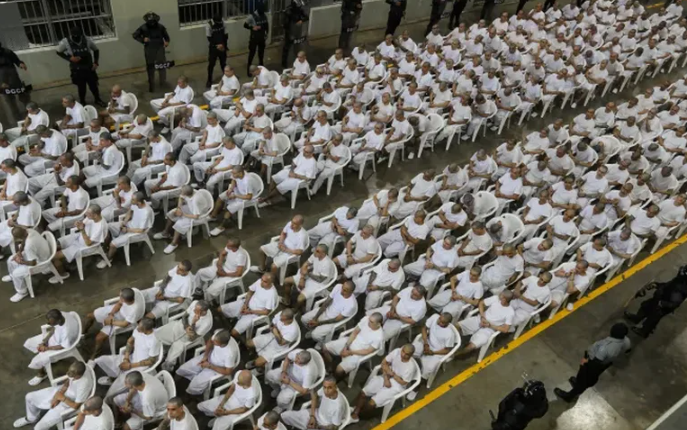



President Nayib Bukele's war on criminal gangs in El Salvador has entered a new phase. After more than four years of mass arrests, hundreds of suspects are now facing trial at the same time, in trials where lawyers say they have only a few minutes to defend dozens or even hundreds of people.
A new report by Human Rights Watch raises serious questions about the way these trials are being conducted. The organization says it reviewed four indictments involving more than 600 defendants and one court decision in which more than 120 people were convicted in the same trial. It also interviewed 15 defense lawyers for the report.
Their testimonies describe a system where defense attorneys face obstacles from the very beginning. Lawyers claim that in certain cases they were not given copies of files, were unable to communicate privately with clients, and were given very little time to present their arguments.
In one documented case, a public defender had only 10 minutes to defend 102 people. In another trial, a defense attorney had 20 to 30 minutes for 200 defendants, while a private attorney stated that he had only 30-40 seconds to defend his client.
“The mass trials in El Salvador are a mockery of justice,” said Juanita Goebertus, Americas director at Human Rights Watch. According to her, the trials are designed to produce guilty verdicts rather than individually weighing the evidence against each accused.
One of the decisions analyzed by the organization shows the scale of the system. More than 120 people were found guilty of “illegal membership” and sentenced to 30 or 45 years in prison. None of the defendants were found innocent.
According to HRW, for the vast majority of people sentenced to 30 years in prison, the connection to gangs was based mainly on the testimony of one of two anonymous witnesses, who had reached an agreement with the prosecution, along with police documentation and criminal profiles compiled by it.
Lawyers claim that police reports may be based on information that the defense cannot verify. In some cases, they say, prosecution witnesses testify behind screens, with their identities hidden and their voices distorted.
Even the judges who preside over the trials remain anonymous. Cases are heard before the Organized Crime Tribunals, and, according to HRW, the judges' identities are not disclosed even to lawyers. Salvadoran law allows for the name of the judge hearing a case to be withheld.
The mass trials are the latest chapter in Bukele's offensive against gangs that once controlled entire areas of El Salvador.
The state of emergency was imposed in March 2022 after a wave of killings, suspending some constitutional guarantees and significantly expanding the powers of the security forces. Since then, more than 93 people have been arrested, including more than 3 minors.
According to estimates cited by Human Rights Watch, around 120 people are currently in El Salvador's prisons, or roughly 2 percent of the country's population, placing it among the countries with the highest incarceration rates in the world.
Bukele's government has defended the offensive as a necessary tool to dismantle criminal organizations that have exercised violence and territorial control for decades. Authorities attribute the security policy to a sharp reduction in gang violence and homicides in the country.
But Human Rights Watch argues that the fight against gangs cannot eliminate the obligation to prove the guilt of each accused individually. The organization calls for the creation of an independent mechanism to review the cases of people arrested during the state of emergency and the release of those held without credible evidence.
After arresting tens of thousands of people, the debate over Bukele's offensive is thus shifting from how suspects end up behind bars to what happens when hundreds of them are brought before a court at once.