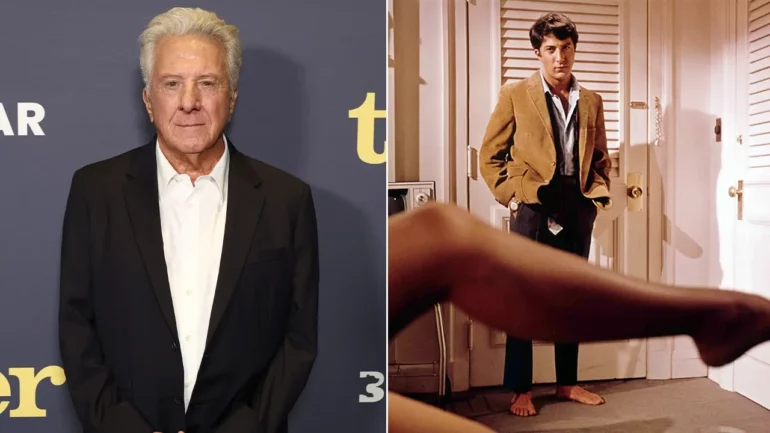



Two Oscars, dozens of memorable roles and nearly six decades at the top of world cinema. However, at the age of 89, legendary actor Dustin Hoffman admits that he has not yet fully enjoyed success and that negative reviews remain in his mind much longer than positive reviews. In his new autobiography, “Look at Me,” he returns to the difficult childhood, personal insecurities, conflicts in Hollywood, friendships with movie stars and the accusations that have accompanied his career.
The book, written in collaboration with journalist Ariel Levy and published on November 10, has attracted international critical attention. The British newspaper "The Times", in a review titled "Dustin Hoffman's memoirs reveal his fatal weakness", dwells on the contradiction between his extraordinary professional success and the insecurity that the actor seems never to have been able to overcome.
From the child who was not believed to achieve success, to the Hollywood star
Born in Los Angeles in 1937, Hoffman did not grow up with the belief that he was destined for a great career. On the contrary, he was often seen in his family as the boy who would not achieve much in life.
His father, Harry Hoffman, had worked in the film industry, but his ambitions to become a director were not realized. After leaving Hollywood, he tried his hand at business, facing constant financial difficulties.
Their relationship was complicated, and the actor's childhood was marked by criticism, tension, and a sense of not being good enough. When he was about 12, his mother even suggested that he have plastic surgery on his nose. His appearance, which would later set him apart from traditional Hollywood protagonists, was initially a source of insecurity for him.
Everything changed when he discovered acting. For the first time, the young man who had not excelled in school found a space where he could attract attention and gain the appreciation of others.
The road to success, however, was long. In New York, Hoffman spent years of economic hardship, sharing ambitions and disappointments with other young actors, including Gene Hackman and Robert Duvall.
A kitchen accident, which caused severe burns, cost him a major opportunity on Broadway in 1964. But another theater role would later pave the way for him to film.
"The Graduate" turned him into an international star
In 1967, director Mike Nichols cast him for the lead role in the film The Graduate. Hoffman was 30 years old, although the character he played was only 21.
The choice was unusual by Hollywood standards of the time. Unlike the traditional, tall, classically-looking protagonists, Hoffman brought to the screen a nervous, insecure character, far from the image of the American hero.
The film turned him into an international star almost overnight. Memorable performances followed in “Midnight Cowboy,” “Kramer vs. Kramer,” “Tootsie,” and “Rain Man,” establishing him among the most important actors in the history of cinema.
But success did not alleviate conflicts with directors and colleagues. In his autobiography, he recalls clashes with Mike Nichols, Sydney Pollack and Steve McQueen, as well as his insistence on not accepting directions he considered inappropriate for the characters he played.
Hoffman was a strong proponent of method acting, believing that an actor should fully understand the inner world of his character. This philosophy earned him acclaimed performances, but also a reputation as a difficult man on set.
One of the episodes that stands out is the meeting with British actor Laurence Olivier during the filming of the film “Marathon Man.” Hoffman remembers that Olivier explained to him that acting, beyond technique and artistic ambition, was also related to the human desire to be the center of attention.
It was from this idea that the title of the autobiography, "Look at Me", was born.
#MeToo allegations and the controversies that accompany the memoirs
A significant portion of the book also addresses the allegations of sexual misconduct leveled against Hoffman during the #MeToo movement in 2017.
Several women have accused the actor of harassment and inappropriate behavior over the past decades. Hoffman has denied the allegations of sexual abuse, while admitting that some of his behavior may have made women feel uncomfortable.
In his autobiography, he acknowledges the possibility that he may have shown a lack of sensitivity towards those around him, but disputes claims that he forced anyone to perform sexual acts against their will.
The way he handles these accusations has also divided critics. Some appreciate his willingness to speak openly about difficult episodes in life, while others think the actor does not sufficiently analyze the allegations made against him.
Friendships with movie stars and the fear of passing time
Beyond the controversy, the autobiography also brings back memories of a life spent among the greatest figures of cinema. Hoffman recounts his friendships with Gene Hackman and Robert Duvall, his collaboration with Tom Cruise, the talent of Robin Williams, and his relationships with other colleagues who have left their mark on Hollywood.
He dwells with special respect on friends of his generation who are no longer alive, acknowledging that their loss has made him increasingly aware of the passage of time.
However, at 89 years old, Hoffman has no intention of retiring from acting. He believes he still has characters to play and stories to tell.
Perhaps the most significant part of the story is precisely how he experiences success. Despite two Oscars and a career that changed the way Hollywood conceived of protagonists, the actor admits that he has never felt fully worthy of the accolades he has received.
In the end, “Look at Me” is not only the story of one of cinema's greatest actors, but also the story of a man who, despite fame, awards, and decades on the stage, continues to face his own insecurities and the need to be seen, heard, and accepted.