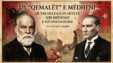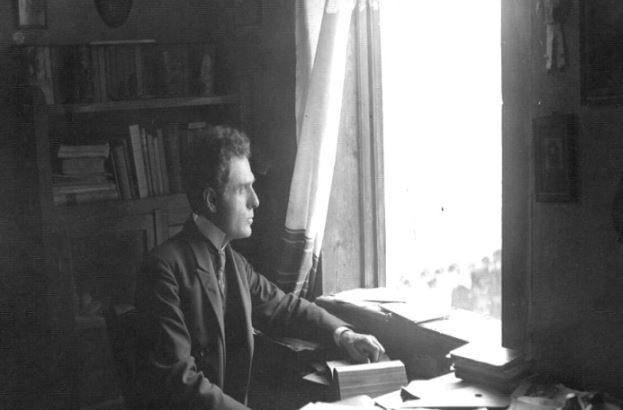



The leader of the 'Ball Kombëtar', Mid'hat Frashëri, submitted a very interesting memorandum to the British in April 1945, after the end of the war in Albania. In it, he confirms that the 'Ball Kombëtar' has never been a collaborator of the occupiers and has fought against them. Meanwhile, Frashëri criticizes the British policy of supporting the communists during the war and their seizure of power. Mid'hat Frashëri's memorandum, addressed to the British government, was addressed to Dr. Okley Hill, chairman of the UNRRA Commission for Albania.
Frashëri provides very interesting details about the activities of the 'Ballit Kombëtar', but also the reasons why the communists started the civil war. He says that the communists had a secret agreement with the Germans and this was reflected in several key moments during the war. Specifically, in the spring of 1944, for several months there was no battle between the parties, while many 'Ballit Kombëtar' detachments were found between German and communist fire. This rare memorandum sheds light on the positions of the 'Ballit Kombëtar' during the war.
FULL DOCUMENT
It has been suggested to us to present this memorandum on the issue of Allied radio propaganda against the 'Ball Kombëtar', in connection with our so-called collaboration with the occupiers. We, of the 'Ball Kombëtar', have been and still are firmly convinced that, in defending Albanian Nationalism against the communists and in the fight against communism, we have worked not only for the good of our country, but also for that of the two great democracies and thus we have done our part of the duty, to serve all of humanity.
In addition, we have been well aware of the hostile attitude of the communists towards Great Britain and the United States. The two democracies have been openly accused by the Reds in Albania as capitalists, plutocrats and reactionaries, and therefore enemies.
Ignoring this fact, the Albanian section of the BBC took it upon itself not only to favor, but also to exalt communism in the eyes of Albanians, trying to make them believe that the red ideology was not dangerous for them, especially Radio Bari, which attacked and denounced the 'Ball Kombëtar' (which is Albanian Nationalism), in a very unfair way and with no concrete facts.
It was so pro-communist that it occasionally used the red motto “Death to fascism, Freedom of the people.” And this was at a time when secret circulars of the Central Committee of the Communist Party in Albania had already been made public, denouncing the Anglo-Americans and ordering its members to maintain a hostile stance towards British military missions!
The pro-communist, and consequently anti-Albanian propaganda of the BBC and especially Radio-Bar, was then and still is a mystery to Albanian nationalists, who thought that it was then (as it is now), more in the interest of Great Britain, to be an ally of the right, than to cooperate with the communists.
The nationalists are more sincere and reliable allies not only because of their conviction and love for Democracy, but also for the simple reason that the interests of the Albanians go together and coincide with those of Great Britain and the USA. While the communists, being the tools of Pan-Slavism in Albania, have interests quite different from those of Great Britain and the USA and will naturally not be friends, but enemies of these two countries. Recent events in Greece have best proven our point of view.
So it is with Albania. If the Allies had helped Albanian Nationalism and organized its forces, as we had repeatedly requested from the British Mission in Albania and especially General Davis, in November 1943 (giving him a written statement) that we would have been of more effective value in the direction of the war against the Germans, than the National Liberation War was and in the direction of preserving the cause of democracy in the Balkans.
Even though the communists openly showed their hostility towards us and planned their attacks against us, we did our best to be tolerant, thinking and saying that they, too, were sons of Albania and that a day would come when they would feel and act with more reason.
The main goal of the 'Ball Kombëtar' was the war against the Italians and the Germans. But the communists not only attacked us with all the means they had, but also dared to cooperate with the enemies of Albania in their attacks against the 'Ball Kombëtar'. There are numerous cases in which the communists attacked us, precisely at the time when we were engaged in fighting the Germans.
And British military missions have been aware of this. It was only when we were attacked on both sides that we were forced to suspend hostilities against the Germans and defend ourselves against the Communists. Sometimes, during this period, the Germans also attacked the communists according to their account. This situation made the Reds try to present to the public opinion in Albania and abroad as "cooperation between Albanian nationalists and Germans".
But, if it will be called cooperation, then the communists themselves cooperated with the Germans, when it is judged that they attacked us and fought at the same time, that the Germans were attacking us. In the battle of Preza, for example, on September 14 and October 15, 1944, the Germans attacked our positions with grenades, while the Communists attacked us from three sides. So the argument of "collaboration" works very well in reverse against the communists themselves.
In addition, the communists were several times in direct contact and understanding with the Germans during the Nazi occupation of Albania. One case is when the communists entered the city of Berat, in September 1943, after the capitulation of Italy: they were on very good terms with the Germans, who moved freely through the city without being touched by the reds. This agreement was made by Gjin Mark, the commander of the reds and the Germans, through Iljaz Sevran, the red commissar of Berat, who acted as a mediator and this situation lasted for three weeks.
(The President of the Special Court of Tirana, Bedri Spahiu, accepted this fact and tried to justify it to some extent). Another very important example of the day is the visit that German Major Hanz made to the Communist headquarters in Skrapar, March 1944. They reached an agreement there and it is a fact that for three or four months after that visit, the Communists did not attack them either neither the Germans nor the latter undertook any operations against the Reds.
If this cannot be called collaboration, nothing else can be called it. By mid-summer 1944, the 'Balli Kombëtar' decided to resume the suspended fighting against the Germans, based on the encouragement, prodding and threats of the BBC and Radio-Bar, which were attractive, not only to the organization as a whole, but also personally to its president Mid'hat Frashëri (BBC, 9 September 1944).
The fighting began in the first week of September and took place in the village of Prezë and the surrounding area. But even then, the 'Balli Kombëtar' had been twice savagely attacked by the communists, as we have already mentioned, even though the Allied Military Mission, which was staying with us, was not far away.
In the operations that the Germans undertook against the communists in Albania, the militia as a popular force, belonging to the surrounding villages, also participated. But it is needless to say that these forces had nothing to do with our organization: the only thing they had in common with the 'Ballin Kombëtar' was that they were anti-communists. As a typical example of these popular forces, we can mention here, those of Dibra where the 'Balli Kombëtar' did not have any guerrilla group of its own.
These popular forces of Dibra fought fiercely against the communists and held them off for a long time; the communists managed to get out of the situation in the Dibra region only when they brought in Tito's Macedonian brigades, composed of Slavs, to help them.
Another example is that of Elbasan, where the only guerrilla force of the 'Ball Kombëtar' was that of the Polis region under the command of Nezir Muzhaqi, the other groups were only popular forces that fought the communists, but had nothing to do with our organization.
In order to get us into trouble with the Allies, the communists, as well as the Germans, tried to make public opinion believe that Irfan Ohri, Nuredin Dino, Vizhdan Risilia, Halil Alia and others were members and commanders of the 'Ball Kombëtar'. But in fact, these people and their sympathizers were never members of our organization, nor did they command any of our forces.
We have categorically denied this several times in our newspaper "Flamuri" and in the leaflets we have issued. We especially emphasize here the fact that even though we had suspended our hostile actions against the Germans because of the communist attacks, we have always had a hostile attitude towards them.
The fact that we were not fighting them at the moment did not make us their friends. The harsh leaflets that the 'Balli Kombëtar' issued in November 1943, against Irfan Ohri and the Germans, speak for themselves and need no comment. So, the Germans knew very well that the reason for the suspension of our fighting was communist pressure: as a result, they were very suspicious of our pro-Allied tendencies and feelings and fought our organization.
It is enough to mention here the infiltration and internment in Serbia and Germany of hundreds of members of the 'National Front' from the prefecture of Vlora (1943-1944); and the murders (early August 1944) of lawyer Skënder Muço, a member of our Central Committee, and professors Yzeir Ismail and Zako Mezini, members of the Vlora Zonal Committee.
All three were arrested by the Germans near Vlora and killed by them near the city of Lushnja. The German view regarding the National Front is also expressed in the confidential brochure, issued by the German command on the use of its troops in the Balkans.
On its cover we read: “Nur für Dienstgebrauch Troopenmerkblatt -Nordest-Balkanit-Herausgegeben von der Dienststelle der Feldpostnummer 00.049. On page 26 of this brochure we have: “The National Front ('Balli Kombëtar') is a national democratic party, which is more inclined towards England than Germany. Its leader is Mitat Bey Fraschery”.
“This means: The National Front ('Balli Kombëtar') is a national democratic party, which extends more towards England than towards Germany. Its leader is Mid'hat bey Frashëri.”
It is true, it is surprising how the radio propaganda, especially Radio-“Bari” and the newspaper “Mundimi”, never ceased accusing us of collaborating with the enemy, using the term “Nazi-ballist” and other offensive and undeserved phrases against the ‘Ball Kombëtar’. It is true that we did not attack the Albanian government when it was fighting the communists, but it is ridiculous to call that collaboration.
Also, we were forced for several months to allow the participation in the government of three of our members, who later withdrew and cut off all relations with us. On the other hand, there are numerous cases, which we have mentioned in a previous document of our policy, when the government has openly shown its mistrust and hostile attitude towards the National Front. Some of our members have been persecuted and imprisoned by the Tirana government.
The Minister of the Interior also issued a circular letter (May 1944), ordering the prefects to take measures against the 'Ball Kombëtar'. In conclusion, we must also mention another important point. It must be borne in mind, if one sincerely tries to present oneself in the place of the Albanian nationalists, that the Germans were not the only enemies of Albania.
Ultimately, when the Germans leave Albania, the danger will not be over: another dangerous phase will emerge, that of our northern neighbor, Yugoslavia, which had worked closely with the communists in our country.
We were more confident about Greece, although we now see that it has cast a covetous eye on Korça and Gjirokastra, which the Greeks call "Northern Epirus". Albania had, therefore, to preserve its main forces for the final struggle for its ethnic existence, as we had understood, that no guarantees and no security of any kind had been given regarding our borders, except for some promises unclear about preserving our independence.
Faced with this situation, the 'Balli Kombëtar' examined it and saw that the forces of the nation were preserved. But even with that preoccupation in mind, even with the anxiety of the final war with our neighbors, we would have thrown ourselves heart and soul into the fight against the Germans, if the communists had not attacked us and if the Allied Missions had supported the nationalist forces, which we placed entirely at their disposal, as we told General Davis in Shëngjergj, November 1943. Our opponents have not brought specific facts regarding our so-called collaboration: we have been accused in general terms.
And this makes you think: we have been accused of collaborating with the enemy, simply because we fought the communists. But it is known to everyone that it was the communists who started the war against the 'National Front' and we had to defend ourselves. And it was their attacks that made us suspend hostile actions against the Germans. So, that kind of suspension, if it can be called such, was imposed on us by the Reds.
When we resumed our war against the Germans, September 1944, the communists tried the same method: they attacked and tried to deactivate us, so that we would not have the opportunity to fight the invader. This is the “collaboration” of the 'National Front'!/ Memorie.al