





The Free Trade Agreement between the EFTA countries and Kosovo will enter into force on 1 October 2026, opening up new opportunities for businesses and strengthening economic relations between the parties.
The Swiss Embassy in Kosovo has announced that on October 1, the EFTA Free Trade Agreement between Switzerland, Iceland, Liechtenstein and Norway and Kosovo will enter into force.
The embassy has indicated that this agreement will create new opportunities for businesses and strengthen economic ties.
"The Free Trade Agreement between EFTA (Switzerland, Iceland, Liechtenstein and Norway) and Kosovo will enter into force on 1 October 2026, creating new opportunities for businesses and strengthening economic ties. Today, the Swiss Federal Council approved the necessary amendments to implement the agreement, an important step towards strengthening trade relations and creating new opportunities for businesses," the embassy said in a statement.
The Free Trade Agreement between Kosovo and EFTA marks an important step in expanding Kosovo's trade and economic relations with European markets. Specifically, the agreement aims to facilitate trade and strengthen economic cooperation between Kosovo and EFTA member countries.
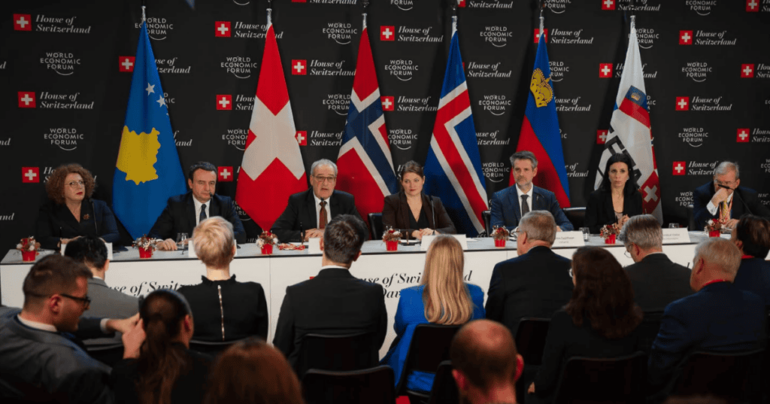
The Prime Minister of Kosovo, Albin Kurti, on the day of the signing of the agreement, said that this agreement opens the chapter of strengthening economic relations, but also of advancing trade relations between his country and the members of EFTA.
"The agreement we are signing today establishes a framework for trade relations between the EFTA States and Kosovo and will create new opportunities by giving Kosovo access to EFTA markets. This opens up new export opportunities for our businesses and deeper integration into the European economic framework, enabling us to compete on a larger scale."
Meanwhile, the chairwoman of EFTA, Cecilie Myrseth, had indicated that this agreement is a great achievement for Kosovo's integration into the global system.
"I am convinced that this will drive economic growth, creating opportunities for new businesses and citizens on both sides."
But what is EFTA, which countries are part of it and what is its role?
EFTA ((European Free Trade Association) or the European Free Trade Association is a European economic organization, which was established with the aim of promoting free trade and economic cooperation between member countries.
It was founded in 1960 by seven then member states, with the aim of promoting free trade and economic integration between member countries. (Austria, Denmark, Norway, Portugal, Sweden, Switzerland and the United Kingdom – founded EFTA by signing the Convention in Stockholm on 4 January 1960)
Today EFTA has 4 member states: Switzerland, Norway, Iceland and Liechtenstein.
It maintains and develops the EFTA Convention, which regulates economic relations between the four member states: Switzerland, Norway, Iceland and Liechtenstein.
It manages the Agreement on the European Economic Area (EEA). Through this agreement, three EFTA countries – Iceland, Liechtenstein and Norway – participate in the EU common market, alongside the EU Member States. Switzerland is not part of the EEA.
It develops the global network of EFTA free trade agreements. So, EFTA has trade agreements with different countries and regions in the world. This also includes the Free Trade Agreement with Kosovo.
So, the European Free Trade Association (EFTA) is an intergovernmental organization established to promote free trade and economic integration, for the benefit of the four member states – Iceland, Liechtenstein, Norway and Switzerland – as well as their trading partners around the world.
The EFTA Council is the highest governing body of EFTA. It usually meets seven times a year at ambassadorial level in Geneva, and once a year at ministerial level in one of the member states, on a rotating basis.
During these meetings, the Council discusses issues related to the EFTA Convention, as well as the development and management of EFTA's trade relations with third countries, including free trade agreements.
Each of the four member states is represented in the Council and decisions are made by consensus, that is, with the agreement of all member states.
The EFTA Secretariat provides member states with high-quality expertise and advice in promoting free trade and economic integration.
EFTA has one of the world's largest networks of free trade agreements, with 31 agreements covering 42 partner countries outside the European Union.
Currently, more than 80% of EFTA's trade in goods is covered by preferential trade agreements. EFTA continues to expand this coverage through new negotiations for free trade agreements with various countries.
In addition to free trade agreements, EFTA has also signed joint declarations of cooperation with several countries. These can serve as a stepping stone towards negotiating future free trade agreements.
Kosovo signed an agreement with the European Free Trade Association (EFTA) on January 22, after negotiations that lasted more than two and a half years./ Monitor