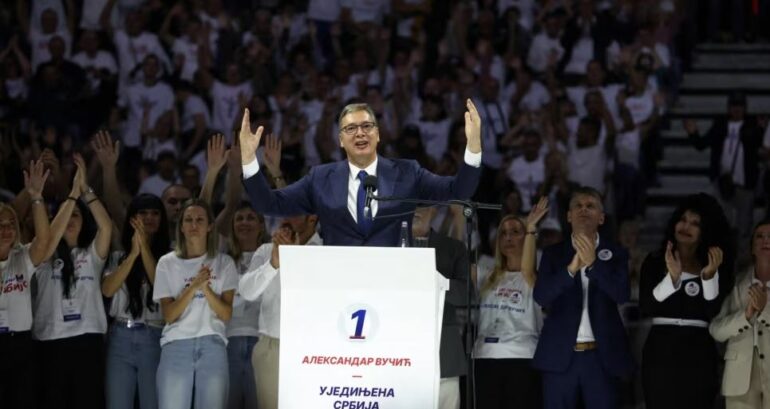



From promises that Serbia will never recognize Kosovo to messages that the Serbian flag will fly in Prizren – these are some of the narratives that can be heard in the campaign of various political parties in Serbia, on the eve of the parliamentary elections scheduled for October 25.
Politicians compete with their stances, but behind the nationalist rhetoric and mutual accusations, it is difficult to find concrete answers to the question of what they offer for future relations between Belgrade and Pristina.
Kosovo declared independence from Serbia in 2008, but official Belgrade does not recognize it.
Since 2011, Kosovo and Serbia have been conducting dialogue to normalize relations, mediated by the European Union. As part of this process, dozens of agreements have been signed – from judicial integration, freedom of movement and birth certificates, to electricity, telecommunications, recognition of diplomas and state symbols.
Serbia has pledged, among other things, to respect Kosovo's territorial integrity and not to impede its membership in international organizations.
What do they say in Kosovo and does the government's approach differ from that of the opposition?
Kosovo's Minister of Foreign Affairs, Glauk Konjufca, assessed that during the pre-election campaign in Serbia "renewed territorial ambitions towards Kosovo came to the fore."
"Serbia cannot claim to be committed to peace and European integration while its highest officials openly contest the sovereignty of the Republic of Kosovo," he wrote on his X network account.
Political analysts who follow relations between Pristina and Belgrade, Aleksandar Shluka and Ognjen Gogić, told Radio Free Europe (RFE/RL) that Kosovo is present as a topic in the pre-election campaign in Serbia, but that concrete solutions are lacking.
The government, says Shluka, “justifies its policy through a populist-nationalist narrative.” While the opposition, he adds, leaves Kosovo aside or approaches it through general promises with strong symbolic weight.
"Instead of presenting viable political alternatives, Kosovo is mainly used as an instrument of political criticism. The opposition uses it to oppose the government's policies, while the government warns that the opposition's coming to power would further worsen the situation - claiming that its representatives would recognize Kosovo's independence or make even greater concessions to Pristina," he says.
On the other hand, Ognjen Gogić considers that such messages during the campaign are not relevant, because "words are one thing and actions are another."
He also recalls that the government, including Ivica Dacic, the leader of the Socialist Party, has accepted agreements in previous years that, according to his interpretation, mean "de facto recognition of Kosovo."
Are the campaign messages realistic?
Political scientist Ognjen Gogić assesses that Kosovo, as a topic in Serbian politics, "has long since fallen outside the framework of reality."
"This has long been a topic that is more virtual than a matter of any real policy that they pursue or could pursue. They pursue policy towards Kosovo because of circumstances; in fact, it is the circumstances that determine their relations with Kosovo," he told REL.
According to Aleksandar Shluka from the non-governmental organization New Social Initiative, members of the Serbian community in Kosovo do not benefit much from nationalist messages.
This is especially true, as he says, if there is no concrete and feasible policy behind them, as well as mechanisms for protecting their rights.
“Symbolism in itself is not insignificant, but it cannot replace strategy. Over the past three to four years, Serbs in Kosovo have faced a series of unilateral actions by Pristina, including the removal of the possibility of using the dinar in cash transactions, the closure of institutions operating within the Serbian system, and warnings about the further integration of health and education into the institutional framework of Kosovo,” he says.
The Kosovo Government, led by Albin Kurti, has been implementing these measures over the past few years, while representatives of the Serbian community in Kosovo, in general, consider them discriminatory.
Criticism has also come from the international community, which has asked Pristina to consult with the Serbian community on these issues and that solutions be sought through dialogue between Belgrade and Pristina.
"Nobody is talking about normalizing relations"
Ognjen Gogić also notes that during the election campaign in Serbia, no one talks about normalizing relations with Kosovo.
"The future government in Serbia will not be able to withdraw from the dialogue, because in that case relations with the European Union would be jeopardized. No government can afford this," he considers.
The commitments made within the framework of the dialogue are part of the broader process of Serbia's European integration, say REL's interlocutors, emphasizing that the future government will face these obligations.
However, Shluka adds that it is important to distinguish between the implementation of agreed agreements and “unilateral actions of the Kosovo authorities,” such as the closure of institutions operating in Kosovo within the Serbian system.
"As a result, such an approach could further weaken Belgrade's incentive to engage constructively in dialogue and contribute to further stalling the normalization process," Shljuka considers.
Kosovo and Serbia accepted the Agreement on the Path to Normalization of Relations in 2023, and later the Annex for its implementation was also agreed upon.
Although the agreement has not been signed, the European Union has declared it legally binding on both parties./REL