





Six MPs, a rejected deal and a party facing one of the most serious internal clashes in recent years.
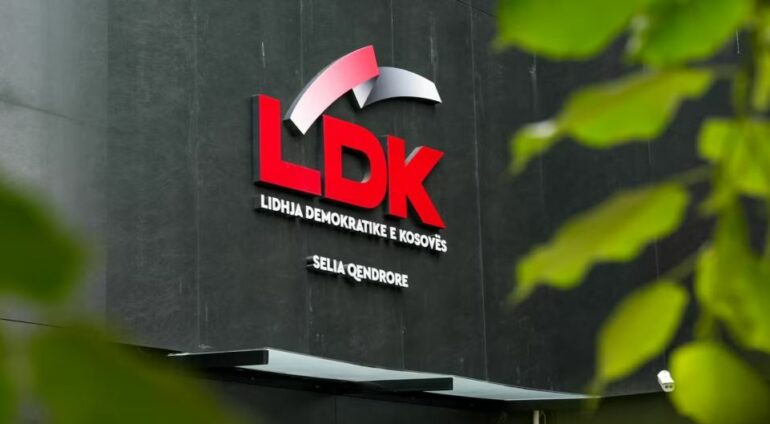
The decision of six members of parliament from the Democratic League of Kosovo (LDK) not to support their party's agreement with the Self-Determination Movement (LVV) for the election of Bekim Sejdiu as president has not only called into question the fate of this agreement.
It has exposed divisions within the LDK, increased the possibility that Kosovo will end up in elections again, and raised a larger question for the party itself: how united can it emerge from this crisis?
Political observers are not sure whether the clash could end in a formal split of the LDK. But they agree on one thing: the political damage to the party is already real.
MPs Avdullah Hoti, Hykmete Bajrami, Kujtim Shala, Armend Zemaj, Arben Gashi and Janina Ymeri refused to support the agreement with LVV, opposing the position of the LDK Presidency.
The party's chairman, Lumir Abdixhiku, described their decision as "irreparable damage to the entire process" and warned that it could lead the country to early parliamentary elections.
Despite the opposition of six MPs, the leader of the LVV, Albin Kurti, has said that the agreement with the LDK remains in force.
One party, two camps?
For analyst Artan Muhaxhiri, the division in LDK already exists – even if it has not yet been formalized.
"LDK is already ideologically divided. There are two evident ways of political thinking, opposite in terms of the relationship to responsibility for the party's legacy and future trajectory," Muhaxhiri tells Radio Free Europe.
He attributes the main responsibility for this situation to Abdixhiku.
According to Muhaxhir, before reaching an agreement with the LVV, the LDK leader should have included the MPs who thought differently in the discussions and sought "unifying modalities", instead of putting them before a fait accompli.
Even analyst Yll Hoxha sees the latest clash as a symptom of a deeper problem.
He recalls that Abdixhiku's leadership was challenged twice by vote within the party in less than a year and that, despite surviving both challenges, he failed to restore cohesion in the LDK.
After the elections of December 28, 2025, in which LDK received 13 percent of the vote and came third, Abdixhiku requested the party's vote of confidence in January 2026 and received it.
In July, following demands from a group of LDK members for his resignation following the June 7 elections, Abdixhiku's position was put to the test again. This time, he retained the party leadership.
But, for Hoxha, the latest clash shows that the conflict has not been overcome.
He does not believe that the opposition of the six MPs is only related to Bekim Sejdiu's candidacy. According to him, it is, first and foremost, a rejection of the LDK leadership itself.
"I am not sure that these divisions will divide the LDK, but I am sure that they will damage it. Something that could be in the interest of the LDK is being denied [by the six MPs], giving primacy to internal rivalry," Hoxha tells Radio Free Europe.
From internal conflict to public accusations
The conflict has not remained only within the party structures.
After the agreement was rejected, Abdixhiku and some of the opposing MPs came out publicly with opposing positions.
Abdixhiku said that with the non-support of the candidacy proposed by the LDK, "the fate of the country - new elections" has been determined.
Avdullah Hoti, meanwhile, said that Sejdiu's candidacy "does not reflect the political and principled interests of the Democratic League of Kosovo and its electorate."
Hykmete Bajrami opposed the agreement from another angle.
"For me, it is unacceptable that today, in the name of resolving the institutional crisis, we become part of an agreement that extends Albin Kurti's concentrated power," she said.
Radio Free Europe attempted to contact the six MPs on Wednesday to ask whether their refusal could lead the country to new elections and who would bear responsibility for this, but none responded.
Does the clash lead the country to elections?
The consequences of the crisis in the LDK may go beyond the party itself.
The participation of at least 80 out of 120 members of the Assembly of Kosovo in the vote is required for the election of the president.
In the first two rounds, 80 votes are needed, while in the third, 61, with at least 80 deputies present in the hall. If the president is not elected in the third round, the Assembly is dissolved and new elections must be held within 45 days.
LVV has 53 mandates, while LDK has 18.
But, after the opposition of six MPs, according to Abdixhiku, only 12 LDK MPs are willing to support Sejdiu.
Even if the MPs from non-Serb communities who have collaborated with the LVV are added to this count, the number remains below the necessary threshold.
The Democratic Party of Kosovo has declared that it will remain in opposition and will not support the agreement with Kurti, while the Alliance has set conditions for the support of the institutions.
Abdixhiku has gone even further in his criticism of the six MPs.
He said that those who did not respect the decision of the LDK Presidency, "if nothing else, should surrender their mandate as MPs," although he added that he did not ask them to do so.
For Muhaxhir, responsibility for the risk of the process failing cannot be attributed to just six MPs.
He attributes it to LVV and the leader of LDK.
"Their irresponsibility for making public an agreement that is not based on reality is the final stage of the journey towards new elections," says Muhaxhiri.
Hoxha sees responsibility more broadly.
According to him, the current impasse is just one in a series of political and institutional crises that Kosovo has faced over the last two years.
"The responsibility for this impasse and this inability to find solutions lies with the entire political scene, without exception, based on the hierarchy, based on the powers and support they have," he says.
However, Hoxha agrees that the clash within the LDK may be precisely the cause that is pushing the country towards early elections.
With which LDK are you in the elections?
If this happens, the next battle for the LDK will not be just against political rivals.
She will have to enter the election carrying her own internal conflict.
Hoxha believes that a new electoral process, triggered by the failure to elect a president, would damage the entire political establishment.
But the LDK, according to him, would enter it particularly handicapped.
"This time, it will also be handicapped by the narrative of how it enters the elections, because it would enter as quite guilty for a process that it itself initiated. The election of Bekim Sejdiu was an initiative of the LDK. The failure of this process due to internal divisions places a greater burden of guilt on the LDK," says Hoxha.
Muhaxhiri is even more critical of the way Abdixhiku has managed the crisis.
According to him, "Abdixhik brutally hurt the LDK, giving political enemies ample arguments to take advantage of the rift created."
He warns that if Kosovo goes to the polls and Abdixhiku "chooses stubbornness" in relation to the MPs who opposed the agreement, the LDK risks turning into a "party with single-digit electorates."
"LDK would be almost non-existent, would have minimal influence on the political scene and would serve other parties to increase their electorate," says Muhaxhiri.
Such a weakening, according to him, would have consequences beyond the LDK itself.
"This would be disappointing not only for the electorate, but would also damage the political spectrum in Kosovo, because it has been part of all state-building processes, has held and can hold a special role in the political spectrum as a balancer. But, this remains in the will of its leadership, especially of President Abdixhiku," says Muhaxhiri.
A precedent that the LDK recognizes
For the LDK, an internal conflict that ends in division is not an unknown scenario.
Muhaxhiri says the party should take into account what he calls "the lesson from 2006."
After the death of the LDK's historic leader, Ibrahim Rugova, the party was embroiled in a fierce battle for its leadership.
The race between Fatmir Sejdiu and Nexhat Daci culminated in December 2006 with the election of Sejdiu as mayor.
But the clashes between the two camps did not end there.
Daci, now deceased, left the LDK and in 2007 created the Democratic League of Dardania.
Almost two decades later, no one can say whether today's clash will lead the LDK to a new split.
But, even without getting there, the party faces a more immediate dilemma: how to seek unity from the electorate if it cannot find it within itself?!/REL