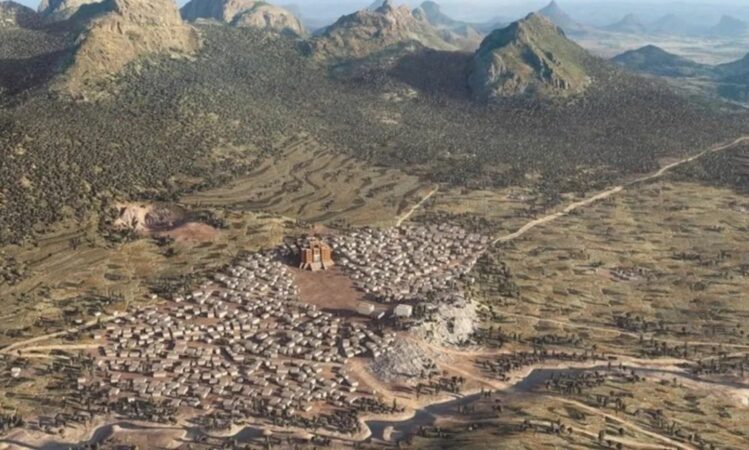



Today, only ruins, stone steps, and a few columns remain, but about 2,800 years ago, in the highlands of northern Ethiopia, a building that was extremely impressive for its time may have been erected. It is the Grat Be'al Gibri Palace, in the ancient city of Yeha, a magnificent structure whose height remains unknown. A new study by archaeologists and civil engineers from Germany has used the building's remaining data and 3D models to calculate how tall it may have been.
The results are surprising: depending on the materials and construction techniques used, the simulations suggest that the palace could theoretically have reached between 16 and 19 floors. The researchers relied on parts of the structure that have survived to the present day. The columns at the entrance are thought to have been around 10 meters high, while the remains of the stairs indicate that the building had at least three floors.
The actual height of the palace cannot be determined, as much of it was destroyed by fire. For this reason, researchers used modeling techniques to test how high the structure could have been without losing stability. One of the most interesting elements is the combination of stone and wood. Wooden beams appear to have been placed horizontally within the walls, serving as structural reinforcement. Such a technique has also been documented in areas of southern Arabia and northeastern Africa during the same period.
The researchers took measurements from preserved sections of the walls, including a corner and an entrance to the palace, and used this data to create a three-dimensional model of the structure. In simulations, the team gradually increased the height of the model until the structure reached the point of losing stability. Since it is not known for sure what type of wood and other materials were used thousands of years ago, the researchers tested several scenarios. In the most favorable scenario, the model theoretically reached up to 19 stories, while in a less favorable scenario, the structure could reach about 16 stories before becoming unstable.
However, this is not proof that Grat Be'al Gibri was actually a 19-story building. The figures represent theoretical limits determined through simulations and not the archaeologically proven height of the palace. Nevertheless, the study suggests that the knowledge and building skills of the societies that lived in this area about 2,800 years ago may have been much more advanced than previously thought. Yeha, one of the important archaeological centers of northern Ethiopia, still preserves traces of a rich history that goes back thousands of years. The ruins of Grat Be'al Gibri may be only a part of what was once a monumental complex, raising new questions about architecture and building techniques in the ancient world.