


*First territorial reform expert
The end of the Administrative-Territorial Reform process is rapidly approaching.
On October 8, the Assembly is expected to review and decide on a new territorial map, which foresees the transition from 61 to 46 municipalities, directly merging 15 existing municipalities, which, according to the 2023 Census, number around 225,000 inhabitants in total, while the official number of people registered in these units exceeds 400,000 inhabitants.
A considerable number to make hasty decisions…!
This is a change that directly affects local representation, territorial organization and the relationship of citizens with their local institutions.
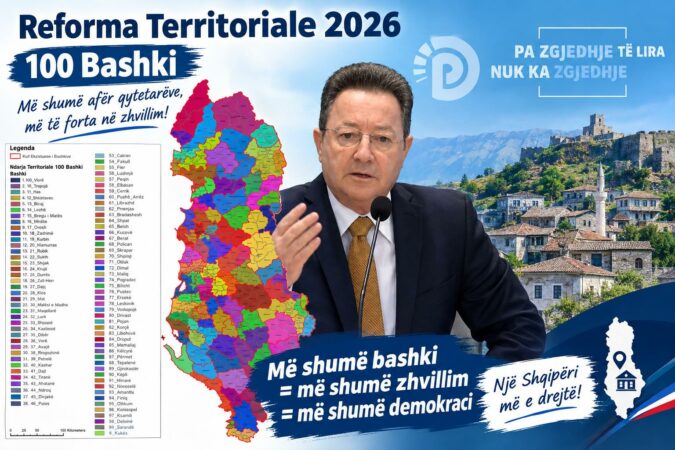
The history of leaving only the majority variant in the race is repeating itself. The Laws Committee of the Albanian Parliament is absurdly blocking the debate and consideration of the opposition's project for the new territorial division with 100 municipalities!
Beyond the loss of political legitimacy of the process, this stance also shows a lack of will to confront the arguments, alternatives, and ideas of the opposition.
The parliamentary majority has the necessary number of votes to approve the draft law, but the parliamentary majority cannot avoid the constitutional obligation to obtain the opinion of the population.
Meanwhile, opposition from residents is growing in the territory! Even 15 mayors together with citizens are expected to demonstrate in front of the assembly…
Protests, petitions, hearings and, above all, the positions of municipal councils of municipalities that risk losing their status, are creating concrete institutional and civic evidence.
In these circumstances, one thing is certain: above the Assembly's votes stand the Constitution, the law, and European standards — and, above all, the obligation to listen to citizens.
Here's what is happening to the citizens and the Councils of the 15 municipalities that are merging:
A considerable institutional and civic evidence is being created in the territory, while their objections are being recorded and forwarded to the Assembly.
All municipal councils have voted against the merger; so have citizens, in public hearings, consultations, petitions and protests.
According to the data collected so far:
Field-Arrëz
The Fushë-Arrëz Municipal Council is reported to have expressed a unanimous position, 13:0, against merging with Puka.
In addition to the institutional stance, citizen opposition has also been reported through a petition, where, out of the 8,900 voters in Fushë-Arrëzi, 7,000 are against.
5 hearings were also organized, where around 2,000 participants expressed their opposition to the merger with Puka.
What is special is that the Puka Municipal Council has also expressed its decision against the merger, as well as in 3 hearings held in this municipality.
Klos
On August 31, 13 out of 21 councilors attended the Klos Municipal Council.
The reported result was 12 votes against and 1 abstention, with no votes in favor.
A petition was organized by citizens, in which, out of about 6,500 voters, 5,040 are against.
The process was accompanied by 4 public hearings and a documented stance against merging with Mati.
Rug
Rrogozhina has expressed opposition to the merger with Kavaja through a draft decision/position of the Municipal Council.
Published sources describe it as a unanimous position, but do not yet provide a verifiable numerical result of the vote.
Dimal
On August 10, the Municipal Council of Dimal met on the issue of unification with Berat.
Published sources report 18 votes against from 18 councilors present, out of 21 total, with no votes in favor or abstentions reported.
This is one of the cases where the opposition is clearly documented with a numerical result.
The policeman
On August 21, all 15 councilors present voted against the merger of Poliçan with Berat.
The reported result is 15 against, 0 in favor and 0 abstentions.
The citizens' petition against has exceeded 2,000 signatures, a qualified majority in relation to the voters in the municipality.
The process was accompanied by 3 public hearings and expressed opposition in the community.
Pathos
For Patos, the Municipal Council's decision against it, 18:0 by 18 councilors present, is documented.
5 hearings and consultations have been held and public positions have been expressed against the merger with Fier, including institutional communications.
DIVJAKA
In Divjaka, 20 councilors have signed twice against the merger with Lushnja and hearings have been reported in the administrative units.
Particularly important for Divjaka is the citizens' protest, which has lasted 53 days in the city square.
Likewise, a petition signed by a significant majority of citizens has also been organized.
SELENICE
On August 14, 19 out of 21 councilors participated in the Selenica Municipal Council and the reported result was 19 votes against unification with Vlora, with no votes in favor or abstentions.
The opposition continued with 6 public consultations in 6 administrative units and institutional opposition from over 500 citizens in the petition.
Malik
On September 28, the Maliq Municipal Council, with 22 out of 31 councilors present, voted 21 against and 1 in favor of unification with Korça.
The result shows a majority of participants opposed, while there is also one vote in favor.
Këlcyra
On August 6, all 13 Këlcyra councilors present at the meeting voted against unification with Përmet.
The opposition has been accompanied by residents' positions and public consultation.
Memaliaj
On September 28, out of a total of 15 councilors, 10 participated.
The result was 9 against merging with Tepelena, 0 in favor and 1 abstention.
The process was accompanied by 6 hearings in administrative units, all against!
The petition is rapidly approaching a qualified majority.
Libohova
On August 3, 13 out of 15 councilors participated in the Libohova Municipal Council and all 13 voted against unification with Gjirokastra.
In addition to the vote, a petition signed by over 1,000 citizens was also organized, reported as a documented opposition and follow-up to the institutional position.
cerrik
On September 30, the Cërrik Municipal Council voted to merge with Elbasan.
Out of 20 attendees, 2 votes were reported in favor, 7 against, and 11 abstentions.
For legal purposes, it is important to obtain the official minutes to determine the formal effect of this result.
Belsh
On September 28, all 21 Belsh councilors participated in the vote.
The reported result is 4 in favor, 7 against unification with Elbasan and 10 abstentions.
Prrenjas
On September 24, 17 out of 21 councilors participated and all 17 voted against merging with Librazhd.
400 participants were reported in the citizen consultation, of which 398 were against and 2 were in favor.
Meanwhile, the number of petition signatories is exceeding 8.
This data does not all have the same legal weight and official decisions must be clearly distinguished from petitions, hearings, and protests.
But, together, they create evidence that deserves to be part of the reform dossier.
And here lies the crux of the matter:
The Assembly can vote on a law.
But a territorial reform that affects the borders, representation and institutional identity of communities must also confront the Constitution, the law and European standards of local consultation.
The Council of Europe considers the consultation of local authorities by the highest levels of government a fundamental principle of the Charter, while the Congress of Local and Regional Authorities has a mandate to monitor local democracy and the implementation of these principles.
Therefore, in the face of any limitation of parliamentary debate, the strongest response is the full documentation of the facts.
Not just what was said in Parliament.
But what have the municipal councils said, what have the citizens signed, what has been discussed in hearings, and what has been recorded in official documents?
Because in the legal hearings that will follow this process, the question will not only be:
How many votes did the new map receive?
There will also be:
How much was the citizen listened to before their municipality was changed?
And this is an issue that must remain documented, in Albania and in any European institution where the process's compliance with local self-government standards can be reviewed.