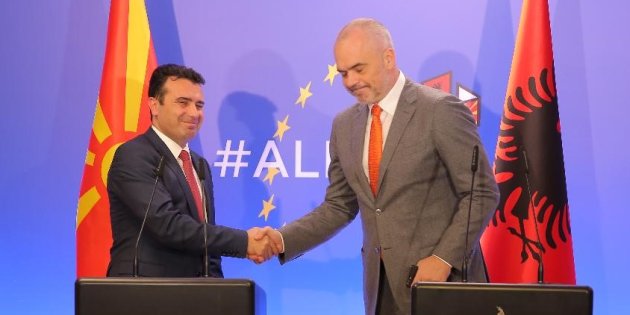



Albania and North Macedonia face the risk of rising nationalism and the destruction of economic reforms after the European Union closed the door to their hopes for a long time, the leaders of both countries have warned, writes Valerie Hopkins of the renowned British newspaper "The Financial Times" today.
Zoran Zaev, the prime minister of North Macedonia, stated in an interview that he feared a return to his ethnically divided country's bad past, including an averted civil war in 2001.
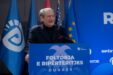
Edi Rama, the prime minister of Albania, stated in a special interview that his country risks becoming collateral damage from the EU's disintegration in relation to the enlargement.
The warnings from both Balkan leaders highlight analysts' fears that the two countries' refusal to open membership negotiations will destabilize a geopolitically delicate region where the influence of other countries, including Russia and China, is growing.
French President Emmanuel Macron blocked the opening of accession talks with North Macedonia and Albania. Both countries have complained that the EU is not fulfilling its side of the tacit agreement, as both Tirana and Skopje acted to try to meet Brussels' demands. The Netherlands and Denmark were also against talks with Albania.
Zaev expressed concern that the deal with Greece, signed last year to rename his country, could be reopened amid a resurgence of nationalist sentiment. The name change was an important step on the road to EU membership, but it was controversial in both countries and Zaev warned that further implementation of the agreement reached with Athens was at risk.
"Part of the process is irreversible, but I worry that there may be a return to the bad past we had," he declared, citing the multi-ethnic nature of his country, divided between the Macedonian majority and ethnic Albanians.
"If there is enough nationalist rhetoric, radical actions and speeches in North Macedonia, it will give Greek politicians arguments to use the same kind of rhetoric. This could lead to the undertaking of concrete steps by everyone, which will not be in the best interests of the region or my country", declared Zaev.
Zaev has already announced that he will resign, taking the country to early elections next year, after rejecting the EU. He has said that the name agreement with Greece, known as the Prespa Agreement, could be in jeopardy if his party does not win.
Rama stated in Tirana that the decision not to open accession negotiations was a serious psychological shock in the country and damaged the credibility of the union in the region.
"We have been brutally separated from Europe twice, the first time for five centuries under the rule of the Ottoman Empire and then for half a century under the brutal communist regime. "No one can live with the idea that there could be a third time and that this time it could be Europe that brutally separates us from ourselves," he declared.
Rama and Zaev stated that they understood the concerns of the EU member states, that they had blocked the negotiations because they want to pursue reforms in the union and its enlargement policies.
But they both agreed that possible membership would be at least a decade away, and that their countries and the EU itself could continue their reforms in the meantime.
Rama stated that the need for an internal reform of the EU was not really a constant alibi for what can be considered an essential issue.
"Europe is at a time when it can get worse before it gets better, and we are just the collateral damage of that," said Rama.
Judy Dempsey, a senior non-resident fellow at the Berlin-based Carnegie Europe, stated that the EU's credibility had been damaged because leaders had been told since 2003 that, if they met the EU's criteria, they would be accepted , and now that at least Skopje had done so, the country was rejected on the grounds that the EU must first be reformed.
"The promises were not kept. Now the Western Balkans can easily be influenced by China or Russia", she declared.
Zaev has expressed his concern about efforts to fill the gap.
"This decision creates space for third forces, which are not very useful, which do not offer us democracy, freedom and the rule of law," Zaev declared./ ATA