



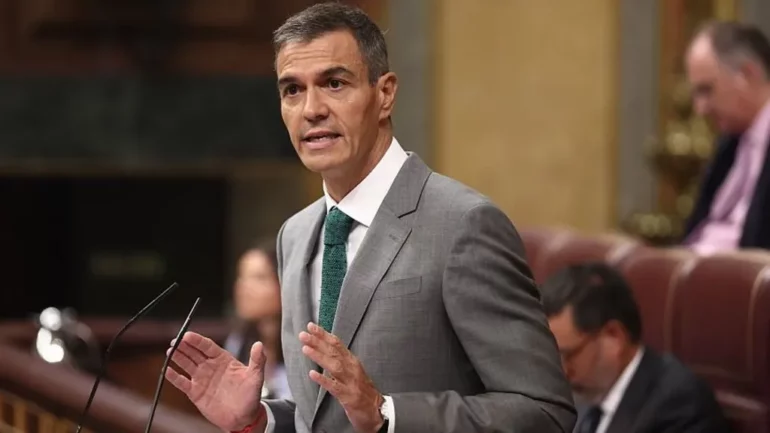



Spanish Prime Minister Pedro Sánchez has denied that the government was warned about the massive influx of migrants into the Spanish enclave of Ceuta, as he faces mounting political pressure over his handling of the crisis.
Speaking in parliament, Sánchez called claims that the government knew what was being prepared and failed to take action "absurd." His comments came hours after tens of thousands of people took part in protests in cities across Spain, supported by opposition parties.
Sánchez also said there was no evidence that Morocco was behind the mass landing of migrants and stressed that there had been close coordination between Madrid and Rabat. However, a Spanish police report cited “total permissiveness” by Moroccan security forces during the crisis, although Spanish officials have insisted that the report does not directly accuse Morocco.
Most of the migrants who entered Ceuta have returned to Morocco, but around 5,000 people remain on the streets and beaches of the enclave. Among them are around 1,400 children.
The crisis erupted after a huge influx of migrants crossed the sea border into Ceuta. According to some reports, Spanish officials had been warned in advance of the increase in arrivals by sea. The situation was further exacerbated by the misinterpretation of a Spanish court ruling, which many migrants understood as a guarantee that they would not be turned back if they managed to swim across the border.
Sánchez, who has so far avoided direct criticism of Morocco, criticized “unacceptable” statements made by two Moroccan ministers about Ceuta and Melilla. Both enclaves are Spanish territories in North Africa and represent the European Union’s only land borders on the African continent.
The Spanish prime minister defended the actions of Spanish authorities during the crisis, praising Ceuta police for their efforts to protect the lives of migrants. He also stressed that more than 90% of those who entered irregularly were returned to Morocco within 72 hours.
Sánchez described the incident as a humanitarian crisis and a major administrative challenge for Ceuta. He also repeated the claim that migrant smuggling networks, along with fake news and rumors spread on social media, had contributed to the escalation of the situation.