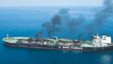







The German government wants to act more decisively against the Russian "shadow fleet," accusing Moscow of circumventing sanctions and committing sabotage. Other European countries are already taking much more decisive measures.
When the German federal government publicly accused Russia of the failed drone attack on Leipzig airport on September 1, it also announced a series of countermeasures. Among them is more decisive action against the so-called Russian “shadow fleet.”
These are mostly old, poorly maintained and insufficiently insured ships, mainly oil tankers, with unclear ownership structures, with which Russia is trying to circumvent international sanctions.
However, maintaining such ships is not at all simple, Julian Pavlak, a maritime security expert from the Foundation for Science and Policy (SWP) in Berlin, told DW.
“International maritime law in principle protects the freedom of commercial navigation,” he explains. “The transport of such goods on the high seas is not in itself illegal. The problem arises when parts of that fleet are associated with so-called hybrid activities, that is, with sabotage, espionage, the possible operation of drones and other similar activities.”
German Green politician responsible for security issues, Sara Nani, believes that Germany has done too little so far: "The Russians are financing the war against Ukraine and their aggressive behavior towards Europe with the help of a shadow fleet," she recently told DW.
According to her, a decisive action against that fleet could force Moscow to return to negotiations.
At the same time, the opposition politician accuses the German federal government of inaction: “Other countries are doing this in the Baltics, but Germany is not. I hear from the Interior Minister that it is technically or legally difficult. I think it is a political decision not to take any action. And that is wrong.”
By “other countries,” Sara Nani means, among other things, Finland. In late 2024, the tanker Eagle S pulled up anchor at the bottom of the Gulf of Finland and damaged the power cable of the Estlink 2 submarine. The Finnish border guard then stopped the ship.
Although the Finnish court later dismissed the charges of serious property damage, security expert Senke Mararens from the University of Kiel considers the response successful.
"A clear message was sent to the other side: we know what you are doing and we will stop you," he told DW. "After that, it was seen that the other side changed its behavior."
In addition to Finland, the United Kingdom, France and Sweden have taken stricter measures against suspicious ships in recent years.
The Swedish Coast Guard is targeting tankers and cargo ships suspected of belonging to the shadow fleet.
If they use forged documentation, are not sufficiently insured, or pose a risk to safety and the environment, ships are detained.
However, the checks on Russian ships carry certain risks. Julian Pavlak warns that Russian warships sometimes pursue ships suspected of belonging to the shadow fleet. In addition, there are increasingly recorded cases of the presence of armed groups linked to Russian mercenary organizations.
Estonia experienced this in May 2025. Then, the tanker Jaguar ignored the orders of Estonian authorities while in their territorial waters.
When the Estonians tried to stop it for inspection, Russia scrambled a fighter jet. Estonia eventually gave up the action and the tanker continued its journey.
“It is important to consider where such activities take place,” Pavlak says. “In the Baltics, Russia is geographically much closer and has additional capabilities, including the deployment of military units.”
However, he adds that the situation is different in the English Channel between France and the UK. “Russia cannot track and protect every ship in its fleet in the shadows.”