


A Syrian family who have been trying to build a life in Scotland for years have been faced with an unusual offer from British authorities: to receive £3 in financial assistance and start a new life in Albania, a country with which they have no connection. The proposal was made through an official letter from the British Home Office, raising serious questions about the accuracy of decisions that determine the fate of thousands of asylum seekers in the United Kingdom.
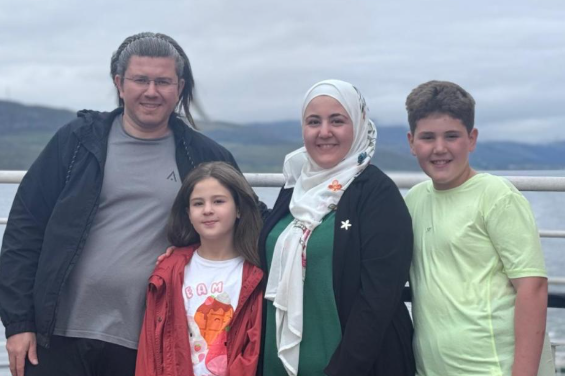
The document, obtained by Scottish newspaper The Sunday National , was sent to 39-year-old Syrian Fadi Alsakka, who lives in Glasgow with his wife Lojain and their two children, Ayman, 11, and Ayla, 10.
"This significant assistance could help you build your long-term future, or that of your family, in Albania," the Home Office letter states.
For the Syrian family, the mention of Albania was an incomprehensible surprise, as none of them have family, social ties, or any life history in our country.
"Such mistakes cannot be tolerated when you control people's lives and futures. Such a mistake could be fatal," Alsakka told the Scottish newspaper.
The case has highlighted concerns about the way the Home Office handles asylum seekers' files, particularly at a time when British authorities are trying to speed up the processing of thousands of pending applications.
The family suspects the error may be related to the use of artificial intelligence in administrative processes. These suspicions were heightened after a report in The Independent newspaper, according to which the artificial intelligence systems used by the Home Office had failed to meet the required accuracy standards in 22% of the cases reviewed.
"Relying on artificial intelligence in such cases is unacceptable," Alsakka said.
However, The Sunday National clarifies that, according to information it has obtained, artificial intelligence was not used to draft the letter mentioning Albania as a destination for the Syrian family.
Alsakka himself is pursuing his second master's degree at the University of St Andrews, while his wife is studying for a master's degree in artificial intelligence at the University of Glasgow.
The Albania mistake is not the first administrative incident the family has faced. According to Alsakka, British authorities were forced to send them identification cards six times after they incorrectly included the family's son's photo on the first five attempts.
But the biggest concern is related to the rejection of the asylum request, a decision that the family has appealed in court.
Alsakka claims that the Home Office has made another mistake, this time much more serious, by confusing the year of an incident he says he experienced in Syria and using this inaccuracy as an argument for refusing international protection.
"I had an incident in Syria in 2025. In the rejection decision they write that the incident happened in 2023 and that my family had visited Syria that year to meet a relative on the verge of death, without facing any danger. But the incident happened in 2025. This makes no sense," he explained.
In addition to the offer to relocate to Albania in exchange for financial assistance of 3 thousand pounds, the British document also suggests that the family could start a new life in a Syrian city, such as Aleppo.
But the 39-year-old says he no longer has lasting ties to his homeland and that returning to Syria would mean relocating his family to an unfamiliar and potentially dangerous environment.
"I have lived more than half of my life outside Syria. I have only spent ten years in Syria. I am now 39 years old. I have no connections, no relatives there. My children were born outside Syria. For me, Syria is the same as Albania," he declared.
Alsakka also points out what he considers a major contradiction in British policy: while the government warns its citizens against traveling to Syria for security reasons, Syrian asylum seekers are suggested to return to the country.
"They are warning all British citizens not to travel to Syria, but in the meantime they can return refugees and asylum seekers there," he said.
The British government advises against any travel to Syria, citing the unpredictable security situation and the risk of terrorist attacks.
His wife, Lojain, still has her parents in Damascus, but explains that the family cannot afford to live with them. Meanwhile, other relatives have found protection and built lives in various European countries.
Lojain's brother has received German citizenship, her sister has been granted asylum in Turkey, while Fadi's brother has become a Belgian citizen after seeking international protection in Belgium.
The comparison with the lives of their relatives makes the situation even more difficult for the couple, who have long lived in uncertainty about the future.
"Our families tell us that we live in a big and beautiful prison. But from the beginning we were forced to follow this path. It was not a choice. We had no other option," Alsakka confessed.
The ongoing uncertainty has also affected the health of his wife, who currently works as a community translator for the Glasgow Life organization.
Lojain indicated that he has experienced pain in various parts of his body and that doctors have constantly advised him to rest and take care of his health.
Meanwhile, the couple's children, 11 and 10 years old, have grown up outside Syria and have built their lives in a completely different reality than that of their parents' country of origin.
The family expects the appeal against the asylum refusal to be heard by the court in early 2027. If the Home Office decision remains in force, the parents say they have no clear alternative for the future.
"I don't know what I'm going to do, but I'm not going back to Syria. I can't go back there. I'm not going to put my children and my family at risk," Alsakka stressed.
Despite the difficult experience with the British administration, he hopes that the court will review the case independently, relying on the law and the principles of human rights protection.
"I believe that the court decides on the basis of human rights. It does not use politics and debates to reject asylum applications," he concluded.
The Alsakka family case raises an issue that goes beyond the unusual mistake with Albania: how reliable are the administrative procedures of an institution that decides whether a family can stay in the place where they have built their lives, or must leave for an uncertain future?