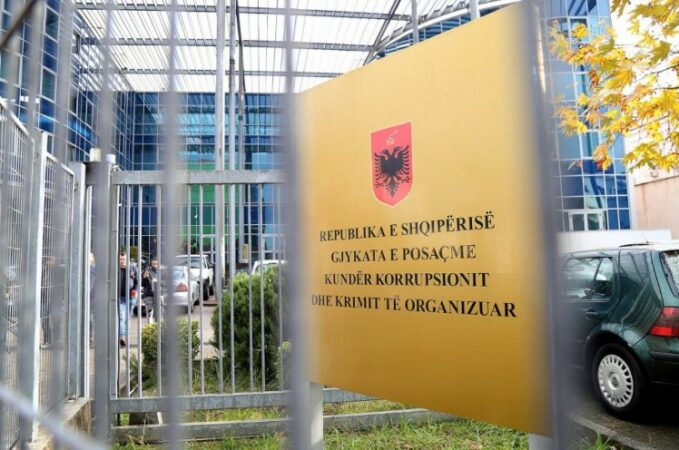



The boycott of court hearings by lawyers, in defiance of the new regulation banning mobile phones in courtrooms, has paralyzed the activity of the Special Court of First Instance for more than a month. While the court and the National Chamber of Advocates do not back down from their positions, the impasse jeopardizes the respect of detention deadlines and violates the defendants' right to a fair trial.
Greta Gjoci, mother of a three-month-old baby, was sent to Pojska Prison in Pogradec on October 5, after the Special Court of Appeal upheld her conviction for involvement in a call center fraud scheme, in which 15 other people were also accused.
Gjoci must serve about three and a half more years in prison from the sentence given to her, but the law provides for the possibility of postponing the execution of the decision for pregnant women or mothers with children under the age of one.
After spending about 24 hours in prison with the baby, her defense attorneys approached the Special Court of First Instance with a request to postpone the execution of the sentence.
But the consideration of the request faced an unforeseen obstacle in the law – the boycott of court hearings announced by the Chamber of Advocates, in violation of a new regulation of the Special Court prohibiting the entry of lawyers with mobile phones.
The General Council of the Chamber of Advocates had warned that any lawyer who broke the boycott would face disciplinary proceedings, placing Gjoci's defense attorneys face a difficult choice between respecting the professional organization's decision and protecting the interests of a three-month-old baby.
On Thursday morning, one of the two defense attorneys, Jurgen Gjoci, decided to attend the hearing, despite the risk of a disciplinary measure that could violate his right to practice law.
During the hearing, the lawyer explained that he had decided to break the boycott for humanitarian reasons, emphasizing that the interest of a three-month-old baby was at stake in this case. He added that the convict was also his relative and that he could not give up representing her.
The Chamber's Disciplinary Committee decided to take into consideration the humanitarian reasons for attorney Gjoci's participation in the hearing, giving him only a warning and a recommendation.
Unlike Gjoci's case, the Chamber of Advocates was strict with his colleague Lefter Xhengo, after the latter participated in a security measure session at the GJKKO. The Disciplinary Council decided to punish him with a two-year license suspension for violating the boycott.
The conflict between the Special Court and the National Chamber of Advocates over the ban on mobile phones in courtrooms has paralyzed judicial processes for more than a month, jeopardizing respect for procedural deadlines and the right of defendants to a trial within a reasonable time.
While the court has begun fining lawyers who fail to appear at hearings, the Chamber of Advocates is punishing those who break the boycott with license suspension. Despite the consequences for the administration of justice, both sides stand by their positions, with no solution in sight.
The contested regulation
The conflict between the Special Court of First Instance and the National Chamber of Advocates began on September 1, when a new regulation on security and conduct in court premises came into effect, which prohibits the possession and use of mobile phones in courtrooms.
That same day, the National Chamber of Advocates asked the court to review several provisions of the regulation, particularly those restricting the use of mobile phones, arguing that the ban violated the practice of the legal profession.
In the absence of a solution, on September 8, the General Council of the Chamber of Advocates decided to indefinitely boycott court proceedings at the GJKKO, initially excluding hearings on the assignment, replacement or termination of security measures, as well as amnesty-related issues.
Two weeks after the initial request, the Special Court rejected the change in the regulation, arguing that the ban on cell phones applied equally to judges, prosecutors, journalists, and all persons present in the courtroom.
According to the court, lawyers could use laptops to consult files and had legal means at their disposal to challenge the regulation.
The court's refusal was followed by an escalation of the boycott. In a second decision, the Chamber of Advocates extended it to hearings on personal security measures and matters related to preliminary investigations, warning of disciplinary proceedings for lawyers who did not respect the decision.
On the other hand, the Special Court began imposing fines on lawyers who failed to appear at hearings. In a decision fining 15 lawyers, the court argued that the boycott did not constitute a strike in the constitutional sense, as the Chamber of Advocates is not a union and the obligation of defense attorneys to appear at trial stems from procedural law and the authorization of clients.
According to the court, the boycott also conflicts with the public function of the Chamber of Advocates, which is to guarantee effective legal protection.
Even the High Judicial Council, KLGJ, in a written response said that the regulation was already an approved act, which could only be overturned through an appeal.
"Any claim regarding its content is subject to appeal procedures, in accordance with applicable legislation," the Supreme Court states.
The President of the National Chamber of Advocates, Maksim Haxhia, opposed this position, calling the regulation contrary to the Constitution and international standards for the protection of the legal profession.
He claimed that the ban on mobile phones was not based on concrete problems raised by lawyers during the hearings and that the regulation was adopted without consultation.
Haxhia said that the Chamber had also sought the mediation of the Supreme Court of Kosovo to organize a joint roundtable, but to no avail. He criticized the fines imposed by the court and warned that lawyers who broke the boycott risked even having their licenses revoked.
"We are open to dialogue and to solving the problem, but not to imposition and submission," Haxhia told BIRN, insisting that the decision to boycott would be implemented without compromise.
On October 6, BIRN asked the Special Court for information on the consequences of the boycott on the conduct of court proceedings and respect for procedural deadlines, but the court requested more time to respond.
After more than a month of conflict, the parties remain in their initial positions.
The Special Court does not accept the change in the regulation, while the Chamber of Advocates does not withdraw from the boycott, leaving the judicial processes blocked and passing the cost of the dispute on to the defendants and citizens waiting for justice.
Boycott jeopardizes detention terms
The consequences of the boycott were also reflected in the criminal trial against the leader of the Freedom Party and former President, Ilir Meta. During the September 24 session, his lawyer, Bujar Musta, was present in the courtroom, but remained in the seats reserved for the public, refusing to take on the defense due to the boycott.
Asked by the court about his reasons for not representing his client, Musta explained that he risked losing his license if he violated the decision of the National Bar Association.
On the other hand, the presiding judge and at the same time the president of the GJKKO, Erion Bani, drew attention to the fact that the situation could constitute a criminal offense under Article 264 of the Criminal Code, which sanctions the obligation to participate or not in a strike.
On October 7, Meta reacted through a Facebook post, describing the escalation of the conflict between the Special Court and the Chamber of Advocates as unnecessary and avoidable.
According to him, the postponement of dozens of court hearings is violating the right to a fair legal process, while creating financial costs for lawyers, defendants and their families, as well as for the state, which must bear the costs of transporting detainees from prisons to Tirana.
But the consequences of the boycott go beyond postponing court proceedings, raising questions about the respect of procedural deadlines and the legality of keeping people in detention.
Article 6 of the European Convention on Human Rights and Article 42 of the Constitution guarantee the right of every person to a fair and public trial within a reasonable time. Meanwhile, Article 342 of the Code of Criminal Procedure provides that the judicial examination may be interrupted only for special reasons and for a period of up to 15 days.
The situation becomes particularly problematic in the case of persons arrested during preliminary investigations, for whom the law sets strict deadlines for judicial review of the security measure.
According to Article 248 of the Code of Criminal Procedure, the interrogation of the arrested person must be carried out no later than three days from the execution of the measure. Article 261 provides that the detention measure loses its force if the court does not carry out this procedure within the legal deadline.
Due to the boycott and the inability to provide legal protection, including the appointment of lawyers, these hearings risk becoming impossible. This could lead to the loss of security measures even for persons arrested at the request of SPAK in the context of investigations into organized crime and corruption.
Over the last two weeks, no such hearings have been held at the Special Court of First Instance.
Meanwhile, lawyers say they are caught between two punitive measures. On the one hand, the National Chamber of Advocates threatens them with disciplinary proceedings and revocation of their licenses if they participate in hearings, while on the other hand, the Special Court has begun fining them for failing to appear and represent their clients.
In this institutional clash, the cost of the boycott is weighing on the development of judicial processes and the rights of persons awaiting trial./ BIRN