


A new and more complex maritime risk map is emerging in the Red Sea and the Bab el-Mandeb Strait, as the Houthis appear to be shifting from a blanket threat to merchant shipping to a more selective policy. The risk to any given ship is increasingly determined by ownership, management, charter, cargo and trade ties, making passage through one of the world’s most important shipping arteries more complex for shipping companies and insurers. At one extreme are ships with ties to the United States, which the Houthis have declared they will not attack unless Washington resumes military operations against them. At the other are ships with ties to Saudi Arabia, against which the group has declared a blockade in the Bab el-Mandeb and the Red Sea.
Mohammed al-Buhaiti, a member of the Houthi politburo, told the Associated Press that the group does not aim for a general closure of the Bab el-Mandeb Strait or the prevention of freedom of navigation. However, he made a clear exception for Saudi Arabia, signaling that ships affiliated with the kingdom are now considered a special category. The position towards the United States is also different. According to Reuters, US officials met with Houthi representatives in Oman in mid-September, while the group reiterated its commitment to a 2025 ceasefire and to avoid attacks on US ships.
This approach is changing the way shipping companies should assess a voyage through the Bab el-Mandeb. The question is no longer just which country the ship belongs to, but also who owns it, who manages it, who chartered it, what cargo it carries and with which trading partners it is connected. In this situation, even a Greek-owned ship can have a different risk profile depending on the charterer, the cargo, the ports of origin and destination. The developments are also accompanied by changes in maritime traffic. According to Kpler data cited by Reuters, on September 17 only 23 cargo ships passed through the Bab el-Mandeb, compared to an average of 26 ships over the previous ten days.
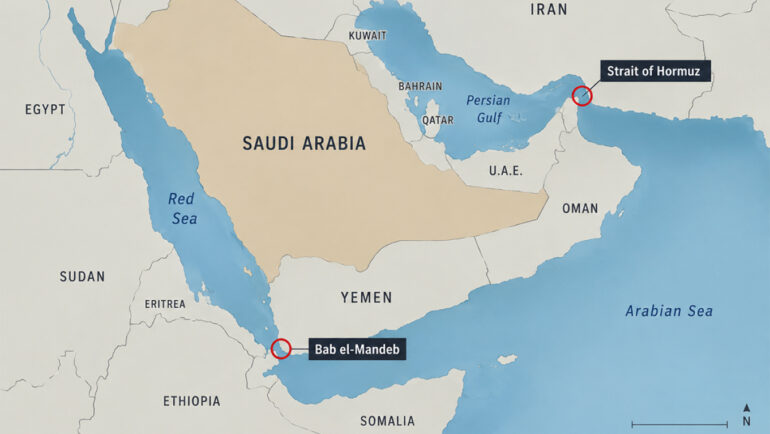
Meanwhile, the Houthis’ expanding presence in areas such as Mocha, Dubab and islands near the Bab el-Mandeb, including Perim, gives them more opportunities to exert pressure on maritime traffic. For Saudi Arabia, the situation is particularly complicated, as pressure in the west is being matched by difficulties in the east. Problems with the East-West pipeline, which connects Saudi Arabia’s eastern oil fields to the Red Sea port of Yanbu, have forced a much larger share of Saudi exports back into the Persian Gulf and through the Strait of Hormuz. Kpler data cited by Reuters show that total Saudi exports rose in September to more than 4 million barrels per day, up from about 2.4 million barrels per day in August.
The change is even more pronounced in Hormuz. Saudi oil passing through the strait has averaged about 2.9 million barrels per day over a six-day period, up from about 700 barrels per day in August. Saudi Aramco is also looking at alternatives for transporting cargo. About 60 million barrels are scheduled to be exported from Ras Tanura in September and October, with some cargoes being transported to Sohar in Oman and then transferred from one ship to another before continuing on to Asia, according to trade sources cited by Reuters.
Saudi Arabia is thus facing pressure on both major shipping lanes. To the west, ships linked to the kingdom face a declared threat from the Houthis in the Bab el-Mandeb Strait. To the east, the increased use of Hormuz makes the Saudi economy more dependent on another strategic shipping point. On September 17, only four cargo ships were recorded passing through Hormuz, compared with an average of 16 over the previous ten days, according to Kpler. For the tanker market, this creates a unique situation: the increase in Saudi oil shipments through Hormuz increases dependence on this strait, while the alternative through the Red Sea faces the threat of the Houthis. In these conditions, the risk of war is increasingly shifting from a general assessment of the area to the individual profile of each ship and voyage. This could also directly impact marine insurance, as companies must assess not only the itinerary, but also the ownership, charterer, cargo, and destination of the ship.
However, the Houthis’ guarantees for American ships do not constitute a permanent security. They depend on continued US military non-intervention and could change in the event of a new escalation. Thus, the Bab el-Mandeb is moving from an area of general risk to a corridor where each ship may have a different exposure profile. For Saudi Arabia, the pressure is even greater: to the west is Bab el-Mandeb, where the Houthis have declared a blockade on ships affiliated with the kingdom, while to the east is Hormuz, through which an increasing share of its oil exports is passing.