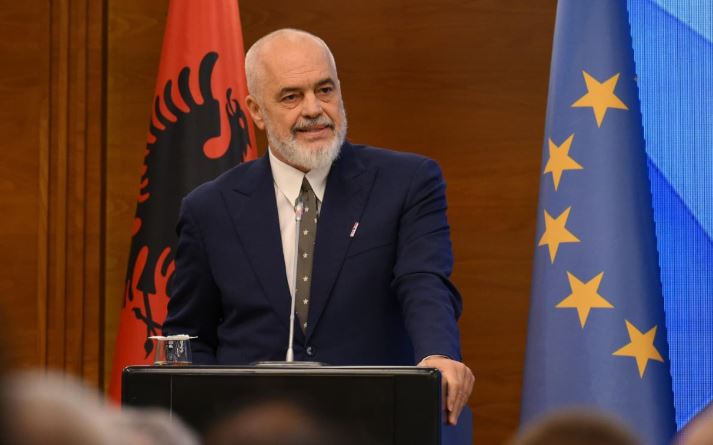



The draft law proposed by the government for amendments to the Criminal Procedure Code drastically limits media reporting on investigative files, risking, according to experts, the establishment of a preliminary censorship regime in violation of the Constitution, hitting independent journalism and the public's right to be informed.
After every sensational investigation by the Special Prosecution Office involving senior officials in his government, Prime Minister Edi Rama has always found a way to accuse the media.
In February of this year, Rama came to the defense of the former director under indictment of the National Agency for the Information Society, Mirlinda Karçanaj, considering the media reporting on her criminal case as "a massacre with homemade bombs, pot by pot."
In early March, the scene was repeated in an even more aggressive manner when the Prime Minister announced to the parliamentary group the majority's decision against lifting the immunity of former Deputy Prime Minister and former Minister of Infrastructure and Energy, Belinda Balluku.
Faced with data from the investigative file published by the media on how tenders worth hundreds of millions of euros were dictated, Rama accused journalists of being used by the prosecution "as a paramilitary force for the public condemnation and annihilation of their subjects."
The Prime Minister reduced the unraveling of suspected corruption cases to a noise that "boils ceaselessly in the 700 pots of our media and political bazaar" and to "perverse fantasies of social networks."
At the end of September, the prime minister again criticized the media leak of fragments from the investigative file against the head of the secret service, Vlora Hyseni, who is accused of leaking state secrets and supporting the perpetrator of the crime in favor of Ergys Agas.
"It took the investigative file data to flood through social channels and media outlets before the court ordered, like a coffin after a harvest, the restriction of their publication," he said in a recorded message from Mother Teresa Airport.
But now, the prime minister's rhetoric against the publication of data from investigative files has been translated into a legal initiative as part of proposed changes to the Criminal Procedure Code.
Article 103 of the draft law provides for a ban on the publication of court decisions on security measures as well as a ban on the transmission of images of persons deprived of liberty while they are subject to physical restraint measures, without their express consent.
The same article also stipulates that the publication of telephone intercepts is always prohibited, even partial, “with the exception of the part of the transcript that is cited in the reasoning of a decision or that is used during the trial.”
The ban on reporting on preliminary investigation acts is significantly extended “up to one year after the dismissal decision” or “until the start of the first session of the judicial review of the merits”.
The report even states that "even making public the very fact that a person is under investigation is prohibited."
In addition to these provisions, in point 14 the article establishes prior control over editorial offices, sanctioning that for journalists and media outlets that already have in their possession materials mentioned in this article, publication is only possible with the permission of the court. “In any case, publication cannot be carried out without judicial authorization,” the draft states.
These predictions are met with concern by freedom of expression experts, who told BIRN that if approved, the draft risks creating prior censorship in violation of Article 22 of the country's Constitution, creating additional barriers to investigative journalism, and exposing journalists to lawsuits, even when they refer to prosecutorial or court documents.
“Ultimately, it is a draft that promotes censorship, which especially hits investigative journalism,” Koloreto Cukali, head of the Albanian Media Council, KSHM, told BIRN.
The judge, a former news editor
Current legislation protects preliminary investigations and balances the right to information with the protection of investigative secrecy. The Law “On the Right to Information” places restrictions on access to documents that are considered investigative secrets and related to the preliminary phase of investigations.
Blerjana Bino, director of the Center for Science and Innovation for Development, SCiDEV, acknowledges that protecting investigative secrecy and the presumption of innocence are legitimate state interests. However, Bino notes that the draft law crosses into an unconstitutional regime.
According to her, the main problem "is the shift from protecting secrecy within the justice system to prior control over what the media can publish", a shift that requires serious constitutional review and in relation to Article 10 of the European Convention on Human Rights.
Bino emphasizes that point 14 of article 103 turns the judge into a preliminary editor of the news.
"Here we do not simply have responsibility after publication, according to the draft, the judge's permission becomes a condition for publication. In practice, this could delay investigations, lose the relevance of the news and produce self-censorship in the editorial office. The Constitution expressly guarantees freedom of the press and prohibits prior censorship," Bino told BIRN.
Along the same lines, Koloreto Cukali considers the request for judicial authorization, even when the documents do not constitute an investigative secret, as a direct violation of Article 22, point 3 of the Constitution, which prohibits prior censorship. According to him, this procedure brings about substantial delays and serves as a means “to prevent editorial offices from publishing information that is essential for the accountability of the government”, becoming “a barrier to investigative journalism”.
The clash with the constitutional pillars that protect freedom of expression and the media is also noted by lawyers. Former Constitutional Court judge Përparim Kalo told BIRN that this concern about the legal draft of the amendments to the Criminal Procedure Code remained.
"Although the provision is limited only to materials obtained within the framework of the investigative process, it can be said that it interferes to some extent in the area of constitutional rights," said Kalo.
Meanwhile, the draft also prohibits the distribution of materials or “acts of preliminary investigations, which are no longer protected by investigative secrecy”. Article 308/a prohibits the proceeding body from publishing that a person is under investigation, without distinguishing between a citizen and a high-ranking public official. The draft also bypasses the Commissioner for the Right to Information.
Cukali warns that blocking decisions and data until the case goes to court or is dismissed creates a dangerous information blackout on abuses of power and completely undermines transparency.
“It is a long period of silence, a blackout,” says Cukali, adding that this situation deprives citizens of the opportunity to observe public interventions, “creates space for pressure” on justice, and removes the media's ability to exert pressure for public accountability.
"So where is the transparency here then?" he asks, emphasizing that for political and leadership figures, the moment they appear at the prosecutor's office or at SPAK "is vital information for the public."
According to him, the ban on reporting creates a shield where news only comes out when investigative institutions want it to, killing independent journalism.
Bino also expresses concern about the long-term withholding of information from investigations, which she says strikes at the very core of public oversight.
"The extension of the ban even after the investigative secrecy is lifted seriously affects the 'watchdog' function of the media, especially in corruption cases and in files that are dismissed and never reach a public trial," she assesses.
The license trap and opening the door to SLAPP lawsuits
While the articles above provide for prohibitions, Article 104 reformulates who is responsible for publishing a secret by making the journalist co-responsible with the officials administering the process and opening the door for him to be sued for causing damage, even when he has simply referred to court and prosecutorial documents.
The draft provides for "civil liability for compensation for the damage caused", "criminal liability of the person when the violation also constitutes a criminal offense", and qualifies the action as "a disciplinary violation" when committed by a public servant or "persons exercising a profession for which a license is required".
The accompanying report of the draft law expressly clarifies that this provision extends liability beyond public servants. “Recognizing that the violation could equally come from a journalist, lawyer or other regulated professional,” the report states.
Point 2 of this article removes the prosecutor's monopoly on action in cases of breach of secrecy and stipulates that in addition to him, "the accused, victim, complainant or any party to the proceedings, whose rights have been affected by the breach (publication), may notify the body conducting the disciplinary proceedings, file a lawsuit for compensation for damage or file a criminal report when the fact constitutes a criminal offense."
For Blerjana Bino, this formulation in the report restores attempts at state control over the profession, following the January 2026 debate on the Criminal Code, when the notion of a "registered/known" journalist was introduced.
“This is problematic because journalism in Albania is not today a licensed profession in the sense of the law on regulated professions,” says Bino, raising questions about who will grant or revoke the license and what will happen to independent and investigative journalists. She recalls that European standards link the protection of Article 10 to the function of journalism and not to “possession of a license or status granted by the state,” warning that such an approach creates legal uncertainty and “an indirect risk for the regulation of the journalistic profession by the state.”
On the other hand, Koloreto Cukali warns that arming people under investigation with the right to sue journalists opens the door to strategic lawsuits against public participation, known as SLAPPs. In this case, creating lawsuits against them even for referencing or partial publication of materials or content of materials produced by the court and the prosecution.
"Businessmen and officials can use lawsuits to instill fear in newsrooms, threatening them with substantial legal costs, not to mention the stress in life and at work, even when journalists are right," Cukali concluded./BIRN