





The Office of the Specialist Prosecutor (OSP) has requested that former Kosovo President Hashim Thaçi be found guilty and sentenced to six years in prison in the obstruction of justice case before the Kosovo Specialist Chambers in The Hague. Thaçi’s defense, on the other hand, has argued that the OSP has not presented evidence to justify the sentence sought against him and has said that he should be acquitted of all charges.
Special prosecutor Joshua Hafetz said during his closing arguments that “the charges that the SPO has brought and proven are crimes.” “The attempt to interfere and obstruct the judicial process in this court poses a threat to the proper administration of justice,” prosecutor Hafetz said. But Thaçi’s defense attorney, Sophie Menegon, disputed Hafetz’s claims, saying the SPO is seeking a conviction for Thaçi “because it needs to cover up and justify the extremely intrusive measures that have been taken against Mr. Thaçi for months.”
"So the secret recording of all his conversations and phone conversations and non-privileged conversations, including with his wife and son."
She emphasized that "the evidence is weak, their accusations are weak, whether legally or factually, and these justify Thaçi's acquittal from all charges brought."
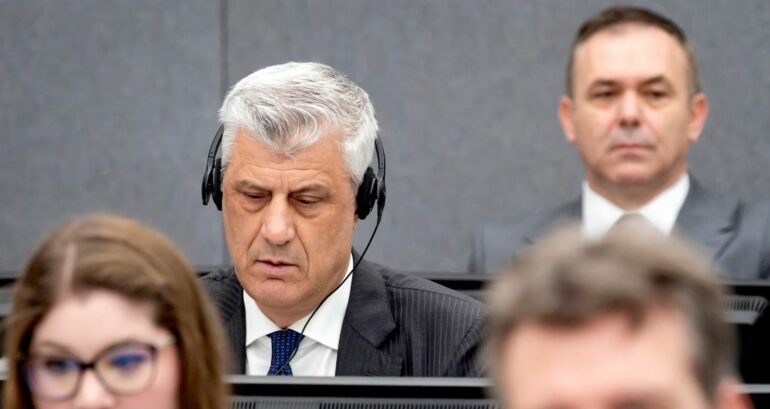
In the first session of the presentation of closing statements, only Thaçi is present in the courtroom, while the other defendants are following the session via video link.
The defense and prosecutors will have three days to present their closing arguments in the case, which is related to the trial of Thaçi and three other former KLA leaders. The prosecution said that if Thaçi is found guilty, the sentence for this case would be served “in addition to any other sentence to be imposed in case 6, if any.” For the other defendants in the case, the prosecution requested that they all be found guilty and sentenced to prison.
The prosecution requested that Hajredin Kuçi be sentenced to nine months in prison, while Fadil Fazliu, Isni Kilaj and Bashkim Smakaj be sentenced to three years in prison each.
Closing statements will be held today, tomorrow and on Monday, September 14. Two days after the closing statements, Thaçi, along with Kadri Veseli, Jakup Krasniqi and Rexhep Selimi, will appear before the court to face the verdict for war crimes during the 1998-99 war in Kosovo. For each of them, the Prosecution has requested 45 years in prison. The four have denied all charges.
Prosecution: Recordings and documents confirm attempts to influence witnesses
Specialist prosecutor Kimberly West, at the start of the SPO's closing arguments, said that Thaçi and his co-defendants attempted for months to influence the testimony of witnesses in the trial for war crimes and crimes against humanity.
"Together with his collaborators in this process, he attempted to obstruct this process by interfering with the testimonies of these witnesses and was caught. He was caught with many hours of recordings and documents confirming the recordings in question," she said.
West described Thaçi's other co-defendants as his collaborators, devoted friends, loyalists, and former subordinates, whom, according to her, Thaçi instructed "to target witnesses whose testimony, according to him, was crucial to the war crimes trial."
West claimed that the instructions varied, from requesting the change of testimony, or for Thaçi to be placed or not placed in a place where crimes were allegedly committed.
According to her, by creating small groups, Thaçi instructed his co-accused on how to fit the witnesses' testimonies into "his narrative."
The prosecutor said that the evidence was printed at the detention center and discussed during visits to the same center.
She also claimed that Thaçi had talked with the other defendants about the KLA hierarchy and how the witnesses, with their testimony, as she said, could diminish his commanding role.
The prosecution brings back parts of the recordings
Then, the specialized prosecutor, Joshua Hafetz, presented parts of the recordings between Thaçi and the other co-defendants, accusing the defense of attempting to "discredit" the evidence, which, according to him, has great weight.
Hafetz said that the parts that were not heard well, the Prosecution did not use, while adding that Thaçi whispered during the instructions. Parts of Thaçi's conversations with Fazliu were shown in the courtroom regarding the testimony of Rrustem Mustafa - Remi. The Prosecution claims that Thaçi, through Faziu and his son, instructed Mustafa on how to testify a few days later in The Hague for case number 6 - for war crimes and crimes against humanity.
The prosecution also said that just one day after Thaçi's instruction, Fazliu returned to Kosovo and contacted Mustafa, through his son Fahri Fazliu, and a few days later informed Thaçi about the conversation and Thaçi instructed him again about Mustafa's testimony.
"Twelve hours without slipping up somewhere, it's impossible. Say it briefly, 'yes', 'no'. He's good at making statements, but he can slip up, but not long. Tell him to shorten them," Thaçi is heard telling Fazliu in the recording released in court.
Prosecutor Hafetz alleged that during Fazliu's visits to the detention center in The Hague, Thaçi also revealed confidential information, namely identifying a piece of evidence that Mustafa would be asked about during his testimony and a book that prosecutors would question him about. According to the prosecutor, Thaçi gave instructions on how Mustafa should testify.
The prosecutor also mentioned a visit Hajredin Kuçi had with Thaçi in The Hague, at the time Kuçi was part of Veseli's defense. He said Kuçi contacted Mustafa via text message, knowing that it is prohibited to contact witnesses without prior authorization from the court.
The prosecution said that with this, Kuçi did not obey the court. In fact, to describe the close relationship that, according to the prosecution, exists between Thaçi and Kuçi, during the visit to The Hague, the prosecution said that Kuçi referred to Thaçi 90 times with the word "boss [chief]", while Thaçi called him "Hajro" over 50 times.
The prosecution alleges that Thaçi targeted three witnesses through Kuçi, two former KLA members and an alleged victim of KLA members. “The targeting of the witnesses was so that he [Thaci] could prepare his preferred narrative that he had no criminal responsibility for the acts alleged in Case 6,” said Prosecutor Hafetz. Hafetz said that one of the targeted witnesses was Sylejman Selimi, also known as Witness Number 5. According to the prosecutor, during the meeting on September 3, 2023, Thaçi instructed Kuçi to have Selimi say that the KLA zone commanders had sole power.
“Tell him that the diaspora brought the satellite phone… [Adem] Demaçi has made some regulations,” Thaçi is heard whispering in the recording played in the courtroom. The book that Mustafa would be questioned about was also discussed with Kuçi, and, according to the Prosecution, through Kuçi, Thaçi sent instructions on how Selimi should testify. The other witness, who, according to the Prosecution, Thaçi instructed Kuçi on how to testify, was Bislim Zyrapi, known as witness number 2.
According to the prosecution, in the recordings, Thaçi demanded that Zyrapi change his testimony – after previously presenting him as an authority on the General Staff – and say that he, Thaçi and other people, including Veseli, became members of the KLA General Staff in November 1998. “Thaci needs to give accurate answers about the structure of the General Staff, in order to minimize his criminal responsibility before November ’98,” the prosecutor said. As for the third witness, he was identified only as witness 6, as he is a protected witness. The prosecutor said he could not publicly provide details about him, but Thaçi’s instructions, according to him, were that he not be directly implicated by this witness in any crime.
The prosecution then went on to implicate Kilaj in the case. The prosecutor said Kilaj first visited Thaçi in February 2023 – a few days after Thaçi had accepted the identities of the protected witnesses.
Other people were also present at the visit. The Prosecution alleges that at that meeting Thaçi instructed Kilaj on how the witnesses should testify. Namely, this is the protected witness number 4. Kilaj then visited Thaçi again in October, when according to the Prosecution, Thaçi gave him the witness's testimony and asked him exactly what to change. In the recordings, according to the Prosecution, Thaçi requests that section six, page seven and line 9 be corrected. The witness, according to the Prosecution, had implicated Thaçi in the alleged mistreatment.
Witness testimony materials and confidential materials, the Prosecution said, were found in Kilaj's possession, as well as instructions on how he should testify. At the end of the closing arguments, the Prosecution spoke about Bashkim Smakaj's involvement in this case. According to the Prosecution, he was instructed by Thaçi on how Bislim Zyrapi should testify. P
The prosecutor said that Smakaj was also found in his personal car with a confidential document, which he claimed he had received from the detention center in The Hague from Thaçi. The ZPS also said that Smakaj had met and communicated with Zyrap after the visit to The Hague. The prosecutor said that the recordings show the pattern followed by Thaçi, demanding that Zyrap be asked to testify briefly and answer “I don’t remember” or “I don’t know” on certain topics.
Accusations of obstruction of justice
Thaçi, as well as Smakaj, Kilaj, Fazliu and Kuçi, are accused of having, between April and November 2023, influenced the testimonies of witnesses called by prosecutors in the war crimes trial against Thaçi himself and other former KLA leaders.
Thaçi faces three charges of attempted obstruction of official persons in the performance of official duties and eight charges of breach of procedural secrecy and disobedience to the court. Smakaj, Kilaj and Fazliu each face one charge of attempted obstruction of official persons in the performance of official duties and one charge of disobedience to the court. Kuçi, meanwhile, faces two charges of disobedience to the court. All five have pleaded not guilty. Their trial began on February 27, and on March 13, the Prosecution completed the presentation of evidence.
If Thaçi is found not guilty of war crimes, will he be released immediately?
Questions have been raised in Kosovo about whether the former president could return to the country immediately if the court acquits him of charges of war crimes and crimes against humanity. According to the Rules of Procedure and Evidence of the Special Court, “when a detained defendant is found not guilty, he shall be released immediately, unless he is being held in detention lawfully, or is serving a sentence for criminal offences other than those for which he was acquitted.”
"In the case of Mr. Thaçi, detention was ordered by the trial panel in his trial for war crimes and crimes against humanity, as well as by the single judge in his separate trial for obstruction of justice. Therefore, if Mr. Thaçi is found not guilty in the trial for war crimes and crimes against humanity, the question of whether he will continue to be held in detention will be decided by the single judge hearing the obstruction of justice case," Specialist Chambers spokesman Michael Doyle told Radio Free Europe in August.
The single judge must review every two months whether the detention continues to be reasonable. “He may also review this matter at the request of the accused, if there has been a change in circumstances,” Doyle added. The last decision, the tenth in a row to continue the detention, was issued by the single judge on July 31, assessing that there is still a risk that Thaçi will obstruct proceedings or commit other criminal offenses.
In the same decision, the judge also set deadlines for the next detention review: Thaçi can submit his submissions by September 7. If he does not do so, the Prosecution must submit its position by September 14, while Thaçi can respond by September 21.
Thaçi has been in the detention center in The Hague since November 2020, when he was arrested on charges of war crimes. Since then, Thaçi's defense has rejected all requests for release from detention. He was even denied a bail of 50 euros, along with several conditions that Thaçi pledged to adhere to, in exchange for his release from detention.
Allegations of war crimes
Thaçi, Veseli, Krasniqi and Selimi are accused of acts such as murder, torture and persecution, allegedly committed during the years 1998-99 during the war for Kosovo's independence from Serbia.
All four have denied the charges and have pleaded not guilty to charges involving about 155 victims. Prosecutors have asked for them to be found guilty and sentenced to 45 years in prison each for the alleged crimes. More than 130 witnesses testified, and 160 written statements from other witnesses were taken in the trial over three years of sessions. Their trial ended in February. The Special Court is formally part of the Kosovo court system but is staffed by international judges and prosecutors.
The trial of the former KLA leaders has faced widespread opposition in Kosovo, as it is seen as biased, as it does not include crimes committed by Serbs on the territory of Kosovo. Since then, large banners and posters with the message “Freedom has a name” and photographs of the former KLA leaders have been placed throughout Kosovo.
There have also been protests against this process in The Hague, Pristina and other cities. Thousands of citizens participated in the "Justice, Not Politics" protest on Kosovo Independence Day on February 17 this year in Pristina, in support of Thaçi, Veseli, Selim and Krasniqi./REL