





Following the news of the death of Ratko Mladic, one of the main figures of the Bosnian war and the convicted perpetrator of the Srebrenica genocide, the tragic story of his daughter, Ana, is also being brought back into focus. A story filled with the love of a father for his daughter, but also with the painful clash between the family figure she knew and the dark reality of the crimes for which her father would later be tried.
Ana Mladic, the favorite daughter of the Serbian general, committed suicide in 1994, at the age of 23, with her father's gun. The exact reasons for her decision were never proven, but her story has been interpreted over the years as a family tragedy related to facing the reality of war and her father's actions.
Spanish writer Clara Usón has reconstructed this story in the book La hija ("The Daughter"), looking at the relationship between Ana and Mladić through the drama of a girl who faces the weight of her surname and the truth that was hidden behind the figure of her father.
A personal story that touches on one of the darkest chapters of Balkan history. Corriere della Sera reprints this article by Francesco Battistini, previously published in the magazine "7", on the story of Mladic's daughter.
THE ARTICLE
Father's heart. The light of my eyes. My life.
Even criminals know how to say these words.
Father Ratko called his Ana. The eldest child. The favorite. He called her “my son,” as was the custom in Krajina. Son, even though she was a girl, because in some environments there was no stronger way to show love for the firstborn daughter than by considering her a son.
The general and the girl. Ratko would pet her and Ana would hug her. He would let her disassemble and clean his Zastava, his pistol from the military academy, and tell her that one day he would give it to her, so that she could then give it to her son, his grandson. Ana would clean the weapon with dedication, with oil and solvent, happy to obey her father.
Then Ana grew up. She was no longer so blind to reality. She was no longer so happy. She saw another, darker side of her father. Her life also took a different direction. Ana dreamed of becoming a surgeon, because that had also been her father's unrealized dream in his youth. But one night it all ended.
It was March 24, 1994. Ana was 23 years old. She opened her closet, took out her Zastava, and shot herself in the head. She took the exact reason for her decision with her to the grave. However, the circumstances of her death have been the subject of many interpretations.
Catalan writer Clara Usón read documents, heard testimonies and traveled for 40 months before telling the story in the novel La hija (“The Daughter”), published by Sellerio. In Spain, the book was declared the book of the year and critics compared the work to Shakespearean tragedy and Chekhov’s prose. Adriano Sofri called it one of the best books on the period of the Balkan wars.
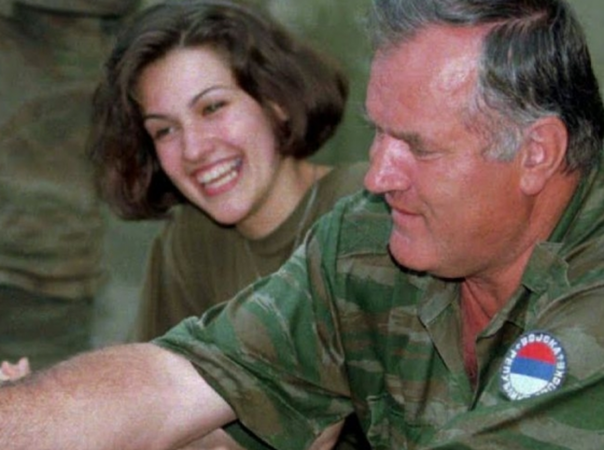
“When I read this story in The Times, I immediately thought it had an extraordinary power. It was a Greek tragedy. Or a Russian one,” says Usón, who previously worked as a lawyer. According to her, there was nothing Oedipal about Ana’s relationship with her father. She mentions a video found on YouTube: in one scene, Ana and Ratko Mladić joke around during a picnic. Then the screen goes black. In the next scene, Mladić appears despondent next to a coffin.
“I wanted to deal with that darkness,” the writer says. According to the story reconstructed by Usón, a decisive moment was a trip Anna took to Moscow with her friends. There she heard and discussed torture and rape. Anna began to realize that the man who had been her main point of reference might not be the hero she had believed. She returned home changed and more withdrawn. She didn’t tell anyone what she was thinking.
“There are many possible interpretations. Ana could have been killed to kill, in a symbolic sense, her father. Or because she felt the weight of guilt and could not live with it. Or it could have been a kind of sacrifice: I kill myself so that you understand; I am the person you love most in the world and you must understand the suffering you are causing others,” says Usón. These remain the writer’s interpretations, not proven motives for Ana’s suicide. The location of Ana’s grave was known in Belgrade. Ratko Mladić secretly visited her during the 16 years he spent on the run.
On the day he was arrested, he asked to place six roses on her grave before authorities sent him to The Hague, where he would stand trial for crimes during the siege of Sarajevo, ethnic cleansing in Bosnia and the Srebrenica genocide. “Whatever his daughter’s message was, he never accepted it,” says Usón.
Mladic spoke of murder and conspiracy. He claimed that Ana would never have killed herself with the Zastava, because she knew how much that weapon meant to her. For the writer, this is where a symbolic meaning can be found: the weapon that was supposed to represent the continuity of the family was used to interrupt it.
The burden of the surname
Battistini places Anna's story alongside other cases of children and descendants of historical figures responsible for crimes.
Joseph Goebbels' children did not have time to deal with the weight of their surname, as their mother killed them with cyanide in the final days of Nazi Germany. Bettina Göring, the granddaughter of Hermann Göring, decided to be sterilized so as not to have children.
“The sins of the fathers, however unjust, weigh more heavily on the children than the sins of the children on the parents,” argues Usón. “If the monster is your parent, you have two choices: either deny everything, or deny him.” Even Stalin’s son, Yakov Dzhugashvili, captured by the Wehrmacht during World War II, died in a German camp after Stalin rejected a possible exchange of him with Field Marshal Friedrich Paulus.
Other descendants have dealt with the family legacy differently. Alina Fernández, Fidel Castro's daughter, voiced criticism of her father in a book, while Katrin Himmler, a descendant of Heinrich Himmler's family, has publicly addressed her family's history. Anna's brother, Darko, continued to defend his father and refute accusations of genocide. He did not like Clara Usón's book and did not allow the publisher to use photographs of the family.
“There are many honest consciences in Serbia, but you still hear claims that Serbian concentration camps were created in Hollywood studios, with anorexic models,” says Usón. She also recalls the denials that have been made in Serbia about Srebrenica. The story of Ratko and Ana Mladić is then linked to the worst episode of mass murder in Europe since World War II: the Srebrenica massacre. A few weeks after the death of Ana, whom Mladić called “The Star,” Bosnian Serb forces intensified their offensive against Gorazde. According to the article, the operation was codenamed “The Star.”
A year later, in July 1995, Bosnian Serb forces killed an estimated 8.000 Bosnian Muslim men and boys in Srebrenica. Clara Usón sees a psychological connection between Ana's death and Mladić's subsequent behavior.
"There is a Mladic before and another after Ana's death. A man crazy with grief, desperate. I am convinced that Srebrenica was his revenge on the world. Military experts say that killing all those people made no sense, not even in a strategic sense," she says.
This is also Usón's interpretation, not a judicial conclusion on the motive for the massacre. At the time the article was originally written, Mladic was in custody in The Hague and his trial was ongoing. He spoke of a threatened Europe and the need, in his view, to stop Islam by any means necessary.
“I read it and I’m scared, because I know those arguments,” Usón said. He was drawn to a parallel between the history of Spain and that of the former Yugoslavia: civil war, dictatorship, ethnic division, and the idea of defending Christianity, in the Spanish case against the Moors and in the Balkans against the Ottomans.
According to the writer, even though Europe was not seeing “new Mladic”, some of the old ideas were resurfacing. She cited as an example the rhetoric about the growth of the Turkish population in Germany and the claims that this threatened German identity. “That’s what was said about the Albanians in Kosovo. And we saw how it ended…”, Usón said. Ana, however, understood what was happening too late and was unable to cope with the weight of what she had discovered.