


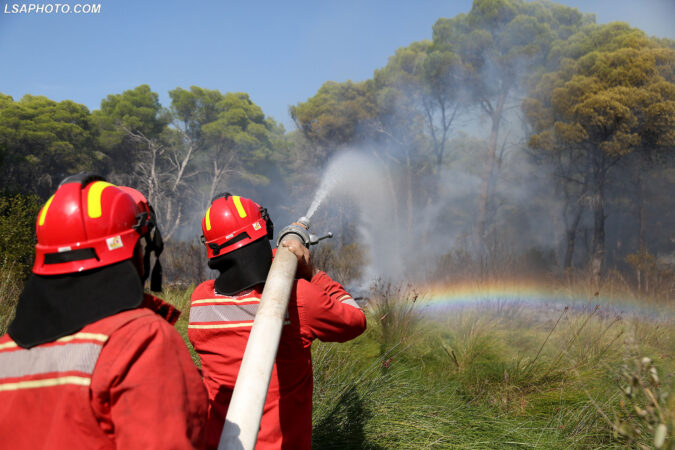



Albania has identified for years the increased risk of fires due to climate change, but experts raise questions about measures to prevent and manage them, as well as weaknesses in institutional cooperation.
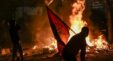
In early September, the coastal town of Himara was engulfed by flames burning olive groves in the hills of the Potami area. Tourists and residents were urgently evacuated as smoke engulfed the town.
A preliminary assessment by local authorities indicates dozens of centuries-old olive tree roots burned, as well as several completely destroyed houses.
Other hotbeds of fires appeared earlier this month in several areas of the country, mainly in pastures and forests, while official figures speak of thousands of hectares of land affected by fires during the summer.
During the months of July-August alone, the State Authority for Geospatial Information (ASIG) has identified 5,210.4 hectares of land affected by fires across the country.
According to data provided to BIRN, the largest area was recorded in the Shkodër region with 2,416 hectares, followed by Lezha with 1,278 hectares, Dibra with 642.4 hectares and Tirana with 631 hectares. In the Durrës, Fier and Elbasan regions, 105, 97 and 41 hectares of affected land were recorded, respectively.
However, this area does not constitute the final balance of fires nationwide.
ASIG clarifies that this figure refers only to 14 areas measured at the request of the National Civil Protection Agency, while the measurement process is continuing for other areas affected by the fires.
In an independent measurement using a similar methodology, spatial expert at the Food and Agriculture Organization, FAO, Flavio Vata discovered over 6200 hectares of burned land by August 18.
The difference does not necessarily mean that one measurement is wrong and that the results may vary depending on the satellite images, the period analyzed, the minimum fire area and the land categories included in the calculation.
But what is important, according to Vata, is that the figures are treated by institutions "as a serious signal about how we manage forests and the territory."
Environmental expert Ornela Çuçi also warns that the size of the fires should not be read only through a single figure, but as a recurring risk that requires measures to be taken to prevent them.
"The alarm signal is not just the number 5,200. It is the fact that we have a recurring risk, with great variability and the potential for extreme seasons," Çuçi said.
For environmental expert Mihallaq Qirjo, observations on the occurrence and rate of spread of fires show that they have intensified in the second half of August.
"The drought of the land has increased and its temperature has increased, thus creating favorable conditions for the occurrence and spread of fires, and despite the worsening situation, there are new arsons," Qirjo concluded.
Unprepared for climate change

The Albanian government has identified increased fire risk as an expected consequence of climate change in several official documents. The National Strategy for Disaster Risk Reduction 2023–2030 highlights the fact that climate models predict higher temperatures, longer periods of drought and less rainfall, especially during summer, increasing the frequency and severity of fires and extending their season.
Other documents on climate change and national adaptation plans foresee measures related to prevention, monitoring, early warning, strengthening institutional capacities and risk management.
Experts also believe that climate change is a significant factor in causing fires or in their high spread, even when they are caused by humans. However, they believe that institutions have failed to take measures to prevent and manage the situation.
Based on his analysis as an expert, Vata says that rising temperatures, drought, and moisture deficit are creating more favorable conditions for extreme fires.
“ We are entering a period where extreme anomalies may become increasingly important for risk management,” he says.
It questions the country's ability to use the capacities it has at its disposal, such as satellite technologies and access to the European Copernicus/EFFIS systems, in integrating a single operational system that links prevention, monitoring, early warning, response and post-fire rehabilitation.
In this sense, adds Vata, "I think the objective should not simply be to know how many hectares have burned after the season is over, but to know as quickly as possible where a fire is starting, how quickly it is spreading, what it is affecting, who is exposed and where intervention should be made."
He notes that the main weaknesses are related to the need for a more integrated approach to fires: risk prevention through the identification of high-risk areas and vegetation management, real-time monitoring through the integration of optical and thermal satellite data, the establishment of early warning systems and the connection of satellite information with decision-making and intervention structures on the ground.
Ornela Çuçi poses the same problem in terms of institutional functioning.
According to her, Albania does not lack institutions, but the connection between them as a single risk management system.
"If our institutions meet for the first time at the stake, then they have met too late."
says Chuçi.
She argues that the management of a forest fire should not begin with the mobilization of firefighters, municipalities, Civil Protection or Armed Forces after the fire appears, but rather begins with the identification of high-risk areas, the state of vegetation, potentially flammable material, access routes and preventive measures.
According to her, the National Forestry Agency and local government forestry structures should intervene before the emergency, while satellite information and civil protection structures should be linked to decision-making and intervention on the ground.
" The problem is that the institutions we have still do not function sufficiently as a single risk management system," she adds.
On the other hand, Mihallaq Qirjo speaks of the need for concrete measures on the ground, from the creation of protective infrastructure and the preliminary positioning of vehicles near risk areas, to the involvement of communities in the prevention and management of burned areas.
"The awareness of communities, specifically rural populations living near forests, is weak, disorganized, and of poor quality. The infrastructure to protect forests from fires requires improvement, protective equipment to be stationed in forests, and water reservoirs to be created in forests," he says.
Qirjo also highlights the lack of a technical document for the treatment of burned forest areas, which according to him should be based on the revitalization of nature itself in the first few years and then the process should be assisted with interventions that imitate nature./ BIRN