


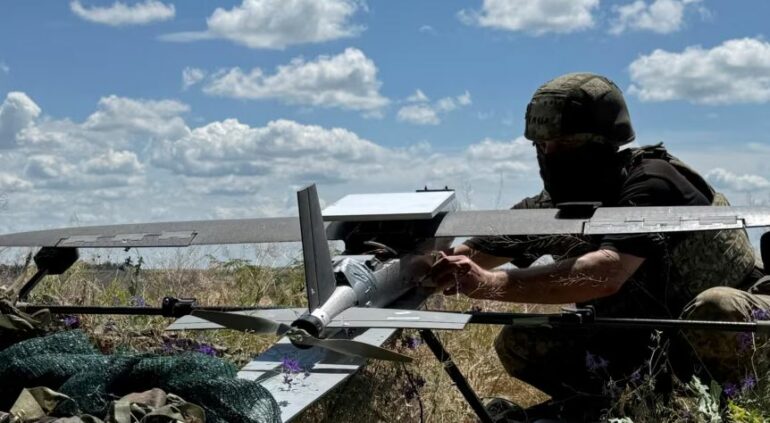



While the European Union is investing around €6 billion in Ukraine's drone capabilities, Kiev has secured an exemption from procurement rules that could allow it to continue using critical Chinese components – highlighting an uncomfortable dependence on a country closely aligned with Russia.
The drone industry in Ukraine has expanded significantly since Moscow launched a full-scale invasion of the neighboring country in February 2022.
However, Kiev continues to depend on cheaper Chinese components to meet frontline demand. Relations between Beijing and Kiev have deteriorated in recent years, and have been accompanied by concerns about China's ties with Russia.
The latest exception is part of a €60 billion loan for defense procurement, which focuses on components that are reportedly not available in sufficient quantities in Europe.
Vita Holod, a researcher at the National Academy of Sciences of Ukraine, told Radio Free Europe (RFE/RL) that "the EU's exclusion is quite significant. It shows that neither Ukraine nor Europe can yet replace Chinese suppliers at the scale, speed, and price necessary."
While Kiev has reduced its purchases of ready-made drones from China, components such as engines, lithium batteries, and optical fibers remain in high demand.
Ukrainian President Volodymyr Zelensky, during a speech on July 15, on the occasion of Ukraine's Statehood Day, said that his country is producing 10 million drones per year.
In the first six months of 2026, imports of Chinese parts have already reached about 76 percent of the total recorded during the previous year.
A report by the Ukrainian Defense Industry Council and the Snake Island Institute, a Kiev-based think tank, said that 38 percent of the value of drone components imported by Ukraine in the first half of 2025 came from China.
“The world is witnessing China’s drone war in Ukraine, where both sides are using many of the same technologies against each other,” Holod said. “As Ukraine builds greater self-reliance and explores alternative supply channels, Kiev must be cautious, measured, and pragmatic in its dealings with Beijing.”
Such pragmatic relations between Beijing and Kiev have become increasingly uncomfortable as the war continues.
Experts are not convinced that an expected visit to Beijing by Ukrainian Foreign Minister Andriy Sybiha will have much of an impact on changing the situation.
China has avoided openly condemning Russia's war on Ukraine, while at the same time maintaining Moscow as a close ally.
Michal Bogusz, senior researcher at the Warsaw-based Center for Eastern Studies, said it is unlikely that Beijing will change its stance on the war and take a stronger stance on a ceasefire.
He said that "continuing the conflict in a controlled manner, without escalating, is in Beijing's interest," referring to an increasingly isolated Russia's growing dependence on China as a buyer of its oil exports, as well as the possibility that a prolonged war would weaken unity among Western allies.
Diplomatic exchanges between Kiev and Beijing have been few.
Zelensky and Chinese leader Xi Jinping have spoken directly only once since 2022. A planned visit by Sybiha to China, following an invitation from Chinese top diplomat Wang Yi in February 2026, did not materialize, while a new invitation has yet to result in a date being set for the visit.
Bogusz said relations have cooled as Kiev has become more “insistent” in how it handles China’s relations with Russia. On the other hand, he added that “this is something that [Beijing] had anticipated, because it knew it wouldn’t give Kiev what Kiev wanted” in terms of openly pressuring Moscow to end the war.
Since the war began, Ukraine has sanctioned several Chinese companies for alleged support for the Russian military.
Vladyslav Vlasiuk, Ukraine's commissioner for sanctions policy, said on July 28 that the latest round of EU sanctions on Chinese companies for their assistance to Moscow's defense industry is "a necessary and justified step."
Beijing denies supplying lethal weapons to any party in the conflict.
China’s ambassador to Ukraine, Ma Shengkun, wrote in a letter published by Ukrainian media on June 30 that bilateral relations require a “clear understanding of [Beijing’s] objective and impartial stance in promoting peace talks.” Ma also said that China respects “the territorial integrity of all countries, including Ukraine.”
Ukraine also arrested two Chinese citizens in July 2025 on suspicion of espionage. Ukrainian authorities accused them of collecting information about the Ukrainian-made Neptune anti-ship missile for Chinese intelligence services.
Tim Ruhlig, senior China analyst at the European Union Institute for Security Studies in Paris, described the bilateral relationship between the countries as a "hostile interdependence."
Beijing remains Kiev's largest trading partner, while Ukraine is an important supplier of agricultural products to China.
“[This is] an asymmetrical relationship in favor of Beijing, but both [parties] have an interest in continuing some form of economic relations,” Ruhlig said.
Speaking about the future, he also noted that "Ukrainians will try, wherever they can, to become more independent."/REL