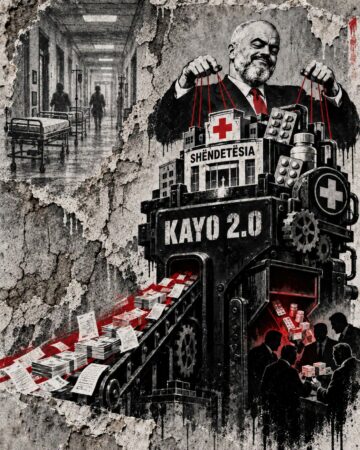



Democratic Party MP Jorida Tabaku opposes the establishment of a new structure for medicines and hospital services, warning that it will concentrate more power and public funds in the hands of the Prime Minister.
Democratic Party MP and Chairwoman of the European Affairs Committee, Jorida Tabaku, has reacted to the government's initiative to establish a new structure in the pharmaceutical and hospital services sector.
In a post on social media, Tabaku states that the proposed mechanism follows the "KAYO" model, removing the administration of public funds and contracts from competition, transparency, and full accountability.
According to the Democratic MP, the government is preparing to concentrate more powers and billions of lek in the hands of a narrow circle, at a time when Albanian citizens continue to bear a significant portion of healthcare costs themselves.
Tabaku emphasizes that Albanian families pay 48,3% of the total healthcare bill directly out of pocket, while the public budget for this sector for 2026 remains at 2,9% of Gross Domestic Product.
"Instead of reducing the burden on families, providing medicines in hospitals, and guaranteeing quality service, the government seeks to concentrate even more power and billions of lek in the hands of a narrow circle," writes Tabaku.
She describes this mode of action as a now familiar formula of government: creating a state structure, selecting preferred partners, and concentrating assets, privileges, and public contracts in a few hands.
According to Tabaku, in this model the main capital is not experience, competition or investment, but proximity to the Prime Minister. She warns that the new structure risks functioning without real competition, without transparency and without full control over the way partners are selected and public money is spent.
"This is not healthcare modernization. It is the 'KAYO' model extended to the health of Albanians," declares the DP MP.
In conclusion, Tabaku links the initiative to what she calls the personalization of institutions and the use of public power in the service of a minority. According to her, Edi Rama and the Socialist Party constitute the main obstacle to building a state that works for the citizens and not for the clients of power.
"Our battle begins here: together against a system that uses the majority to serve the minority," Tabaku concludes.