


The Audiovisual Media Authority (AMA) held a meeting with representatives of retransmission operators, where the focus was on the fight against audiovisual piracy and strengthening cooperation between institutions and legal market entities.
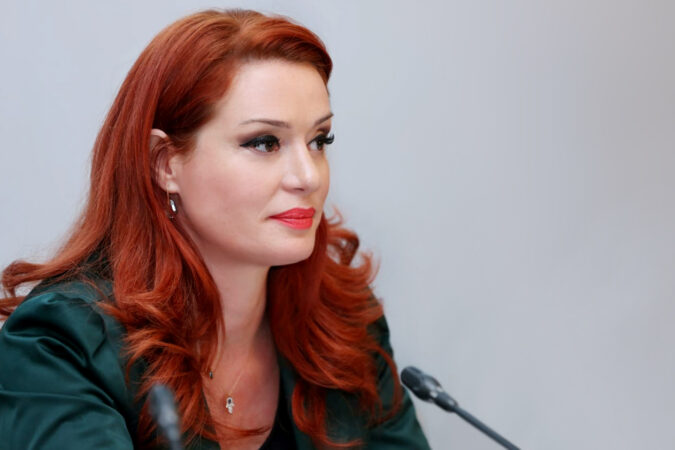
The President of the AMA, Armela Krasniqi, has called on operators to join a Coalition against Audiovisual Piracy, proposing the formalization of cooperation through a Memorandum, with the aim of protecting broadcasting rights and responding more quickly to unauthorized broadcasts.
In her speech, Krasniqi emphasized that audiovisual piracy directly harms the legal market, as pirated services benefit from the investments of operators who pay for broadcasting rights, competing unfairly.
She announced that during 2026, AMA has conducted 222 field inspections and imposed 11 fines, five of them for non-compliance with broadcasting rights. Also, following reports from the institution's structures, 32 unauthorized servers have been closed, three applications have been removed and three seizures of equipment used for pirated activities have been carried out. Krasniqi announced that, from February 4 to November 16, TikTok has removed 2,776 videos and photos that promoted television piracy, following reports from AMA.
She also touched on the cooperation with AKEP, stating that during this year AMA has referred 399 connections, domains and IP addresses for blocking. However, according to her, inspections have identified discrepancies between operators' confirmations of the implementation of the blocks and the results of on-site verifications.
The AMA Chairwoman requested that operators document any interference, report the time and result of the blocking for each connection, and designate specific contacts for communication with the institution and technical teams. The proposed memorandum provides for cooperation between rights holders, operators, and the AMA, with rapid reporting of cases, verification of complaints, and monitoring of the implementation of measures to block unauthorized transmissions.
Speech by the President of the Albanian Association of Medical Associations: Armela Krasniqi
Dear broadcasting rights holders,
Thank you for being here today.
When a family sits down to watch a game, they see the game on the screen. You who are in this room know what it took for that game to get there. Someone invested in producing the broadcast. Someone paid for the rights. Someone built the network and is responsible for the service that the subscriber receives. When a pirate operator takes the same broadcast and sells it without authorization, he competes for the same subscriber by avoiding the very cost that you have borne.
This is unfair competition and it affects you directly. Every subscription that switches to a pirate service takes revenue away from the legitimate market. This is the revenue that buys rights for the next season, funds production and improves service to the public. When piracy undermines the ability to recoup these investments, it also undermines the decision to make them tomorrow.
Think about the decision you make when you buy the rights to an entire season. The financial commitment is made before you know how many subscribers you will have. The same goes for a producer starting work on a film, or an operator expanding its network into a new area. Each takes on a risk and covers it with the revenue it expects from the market. The pirate service enters this market after others have taken the risk, made the investment, and brought the product to the public. It then competes for the revenue that should sustain that investment.
While a subscriber is presented with a lower-priced offer, the real cost of that offer falls on someone else. It falls on the rights holder who loses value from their license, the operator who has to finance the service with less revenue, and, ultimately, the public, when the industry has less opportunity to purchase quality content. This is the harm that we must consider when deciding how quickly to react.
Some of you compete every day for the same customer. But you have a common interest in ensuring that no illegal competitor sells that customer the content you paid for.
In this interest, I invite you to establish the Coalition against Audiovisual Piracy and formalize it with a Memorandum of Cooperation. This is a coalition of the AMA with legal and honest market entities. In this room are both those who can document the violation as soon as they notice it, and those who can implement the measure on their network.
According to the data compiled by the AMA Inspection and Monitoring Directorate for 2026, we have so far conducted 222 field inspections and imposed 11 fines, five of them for non-compliance with broadcasting rights. Following reports from our structures, 32 unauthorized servers have been closed and three applications have been removed. Three seizures of equipment used for pirated activities have also been carried out.
On-site inspection allows us to see how a service is actually provided. Reporting on online platforms allows us to intervene even where pirated services are advertised and find customers. For a market that already operates simultaneously on our networks and on international platforms, work must be carried out in both directions.
According to the same AMA data, from February 4 to November 16, TikTok removed 2,776 videos and photos that promoted TV piracy, following AMA reports. The platform shows a willingness to cooperate. For our part, each report is accompanied by full documentation. We identify the material and document who holds the rights to the relevant content. This gives the platform the basis to review the case and take action.
When one or two international platforms, outside the jurisdiction of the AMA, outside the territory of the Republic of Albania, act voluntarily on the basis of our documented reports, I expect the same willingness from local operators. We have a direct institutional relationship with you due to the authorization for retransmission. As an internet provider, you have the teams that can implement the measure on your networks. As a retransmitter, you are among the first to be affected when a pirate service takes subscribers to your legal offers.
We have also learned a lesson for our work from the collaboration with TikTok. A report that properly and accurately explains what has been found and who owns the right results in reducing the time the other party spends seeking clarification. Therefore, in this coalition, AMA will also require the same standard of documentation, starting with itself. When we forward a case to the operator, he must have clear data that he can immediately pass on to the technical team.
This year, AMA has referred 399 links, domains and IP addresses to AKEP for blocking. Within the framework of the Inter-institutional Task Force, AMA and AKEP conducted joint inspections. According to confirmations forwarded by AKEP, the inspected entities had declared that they had implemented the blocking. The AMA inspection report shows that a significant number of them had not yet implemented the measure.
This discrepancy is unacceptable.
When we have confirmation that contradicts what we find on the ground, we must return to the specific case.
Which connection was checked? At what time was the measure implemented? Did any other connections remain accessible? These are questions that can only be answered if each operator documents their work as they perform it. Therefore, reporting on each connection will be part of how we will track implementation.
On July 1 of this year, I reported to the Assembly, to the National Council for European Integration, on the fight against piracy and on the work ahead in the framework of the negotiations with the European Union. In implementation of the Council’s recommendation, on July 13, the AMA gathered the institutions to discuss the establishment and functioning of the Task Force against Digital and Audiovisual Piracy. The request for more cooperation and supervision was also raised by the Committee for Civic Initiatives, Cooperation and Institutional Supervision. The protection of broadcasts has an international basis. The Rome Convention of 1961, which entered into force for Albania in September 2000, recognizes broadcasting organizations, in Article 13, the right to authorize or prohibit the retransmission of their broadcasts. For events that are followed live, the European Commission has also provided practical guidance. In Recommendation 2023/1018 of 4 May 2023 on combating online piracy of live sports and other events, the Commission encourages cooperation between rights holders and intermediaries, as well as the swift handling of reports of unauthorised broadcasts. For us, this means organising our work so that we can intervene while the event is still being broadcast.
Cooperation begins with the rights holder. As soon as you notice an unauthorized broadcast, provide AMA with the exact link, identify the content and time of the detection, and provide documentation proving your right. If the event is being broadcast live, note this in the first report. A complete complaint allows us to verify the case and take action while the broadcast is still in progress.
AMA verifies the complaint and, when the conditions are met, officially refers the case to AKEP. AKEP notifies the operators according to the relevant procedure. On the PENPA platform developed by AMA, participating operators can follow the cases forwarded to them, communicate directly with the institution and, after the official notification of AKEP, report what they have done on their network.
For each link, domain or IP address referred, we request a complete response. When the measure has been implemented, the operator records the date and time. When there is a technical obstacle or a clarification is needed, the operator reports it immediately and explains the reason. If the notification contains several links, we need to know what has been done for each one. With this information, AMA can verify the implementation and immediately follow up on open cases.
Let me give you an example. The rights holder notices during the first half of a match that the signal is being retransmitted on several links without authorization. He sends the data and proof of rights. AMA examines the case and officially refers it. After notifying AKEP, the contact person immediately forwards the case to the technical team. As soon as the measure is implemented, the operator records the time and the result for each link. If two links are blocked, while a third needs to be corrected, AMA immediately finds out which link it should follow. This is important precisely in those minutes when the broadcast is still ongoing.
For our part, I want this way of working to help us see where time is being wasted. There may be cases where documentation is completed late, cases where technical data needs to be clarified, and cases where the delay occurs after the official announcement. When each step is documented, we can intervene where obstacles have arisen and assess whether the work is improving from one case to the next.
Participation in the Memorandum is voluntary. By signing, rights holders commit to reporting quickly and with complete documentation. I expect operators to designate a contact who can mobilize the technical team, implement the measure according to AKEP's notification and accurately report the result. AMA undertakes to verify the complaint, refer it and follow it up until verification of implementation.
In this room you have the opportunity to protect a common interest even when you are competitors in the market. A rights holder who reports in time gives the operator the opportunity to intervene. An operator who implements the measure quickly protects the value of a right that someone else has invested in. And an institution that verifies the result gives both parties a basis for trust in cooperation. This is the commitment I ask you to make today.
I invite you to sign the Memorandum of Cooperation and become part of this Coalition.
When we meet again, we will see how quickly we intervened and how many cases we verified the blockage. With each timely intervention, we protect the right that someone in this room has invested in and we give more certainty to the subject who is making the decision to invest again.
I thank you.