


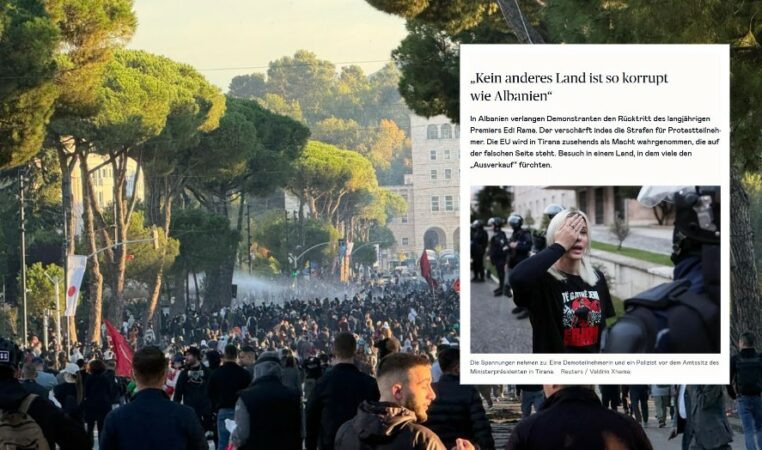



The Austrian media outlet "Die Presse" has dedicated an article to the protests taking place in Tirana, focusing on the escalation of clashes between protesters and the Police, the citizen dissatisfaction with Edi Rama's government, and the accusations of corruption that have accompanied his governance.
In the published article, the Austrian media writes that citizens have been taking to the streets since spring, demanding the prime minister's resignation. According to it, the dissatisfaction is related not only to the corruption scandals that have engulfed the government, but also to the social situation and the deep economic gap between the rich and the poor.
"Discontent with the social situation and the wide gap between the poor and the rich are pushing many people to take to the streets. In Tirana, however, it is difficult to find banners with written demands. But everyone agrees that Edi Rama must resign," writes "Die Presse."
A significant portion of the article is devoted to clashes between protesters and law enforcement. Austrian media mention the use of tear gas, rubber bullets, and water cannons during police interventions, as well as damage caused to businesses and urban infrastructure during the protests.
The article also focuses on Prime Minister Rama's warnings about toughening measures against protest participants, in cases where gatherings escalate into violence.
"The Prime Minister intends to toughen penalties for protest participants. All participants now risk fines of more than 5000 euros if the protests escalate into violence," the article states.
The coverage of the protests by "Die Presse" comes at a time when anti-government mobilization continues in the capital, while demands for Rama's resignation have been accompanied by student boycotts of classes and repeated clashes with the police. Social discontent, accusations of corruption and the way the protests were managed remain among the main issues that have fueled citizen reaction.
Full article:
A loud bang erupts. Moments later, clouds of tear gas spread across central Tirana. An elderly man puts a gas mask on his face. Other protesters have donned ski goggles, diving goggles or disposable masks. Otherwise, breathing becomes torture. When the police throw tear gas grenades, you have to run quickly in the opposite direction. The crowd disperses into the narrow, winding streets behind the central Skanderbeg Square.
A cat-and-mouse game between protesters and security forces is being repeated every day in the Albanian capital. In the afternoon, people gather for a peaceful march through the center. Police disperse the crowd with tear gas, rubber bullets and water cannons. Then, the violence escalates, often late into the night.
Protests since spring
Protest movements are currently shaking many European countries. In Albania, people have been taking to the streets since spring. It all started with rallies against a planned construction project in a protected natural area, which is supported by the government of Prime Minister Edi Rama. The investor is Jared Kushner, the son-in-law of US President Donald Trump. For some time now, the protests have been expanding.
Lea is one of the participants. She has just returned from a long stay abroad. “I see my future in Albania,” says the 26-year-old. But, according to her, many things here are not going well. “Living conditions, the health system, salaries, non-transparent agreements.” Lea is against “selling the country.”
The gap between the poor and the rich
Dissatisfaction with the social situation and the wide gap between the poor and the rich are pushing many people to take to the streets. In Tirana, however, it is difficult to find banners with written demands.
But everyone agrees that Edi Rama should resign.
Rama has been prime minister of this country of 2,4 million people since 2013. Before that, he was mayor of Tirana for many years. The sneaker-wearing politician became known for his unconventional style of policymaking and creative policies in the city's administration.
But during his term in office, several major corruption scandals have erupted, involving high-ranking members of the government and officials from his Socialist Party. More recently, these issues have been brought into focus by the anti-corruption agency SPAK, a structure whose successful functioning is one of the conditions for the country's EU membership.
“No other country is as corrupt as Albania,” says another protester, pointing through her sunglasses.
"There are plainclothes police officers photographing protesters," says the woman, who introduces herself as Ledi.
According to her, through photographs, participants and their families are put under pressure.
The 48-year-old also fears the consequences at her workplace, a public institution. She stands near the Ministry of Education with four other women. The chants begin in chorus and hundreds of people applaud. "Rama must resign," the crowd chants.
Will the prime minister back down? “I’m afraid not,” says Ledi. “But I’m here to defend my dignity.”
Burnt reception stations
After a long period of peaceful protests, street clashes are now occurring almost daily. Participants have been beaten and arrested; police officers have been injured. Along the protest route in the city center, shops have been burned. Bus stops and garbage containers have also been set on fire.
"We are on your side. Don't harm our business," is written on the windows of commercial establishments, which have lowered their shutters in advance for protection.
Rama has invited protesters to dialogue. In a sensational gesture, he has placed chairs on the sidewalk in front of the prime minister's office. But they have only been used by groups of tourists who stopped there during the day. Meanwhile, protesters say it is too late for dialogue. On Sunday, they set the chairs on fire.
Severe punishments planned for protesters
Meanwhile, the prime minister intends to toughen penalties for protest participants. All participants now risk fines of more than 5000 euros if the protests escalate into violence.
In Albania, where the average salary according to official data is just under 900 euros, this is a staggering sum. “Those who demand my resignation are mistaken if they think they can force it through violence or other means,” Rama said over the weekend in a video message.
"Rama's dialogue means monologue"
The prime minister accuses the protesters of wanting to sabotage the country's EU membership. Albania aims to become an EU member by 2030. However, many participants reject Rama's accusations.
In their view, the EU is supporting the wrong side and, in doing so, discrediting itself.
“Rama’s dialogue means monologue,” says one man. “He lives in his own world.”
Many of those taking to the streets here are not happy that Brussels is sparing Rama from criticism. “I am disappointed in the EU,” the man says. Abroad, the prime minister puts on a reasonable face, but at home he behaves like a “dictator.” “The EU needs to wake up,” the man adds. Then he continues on his way.