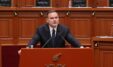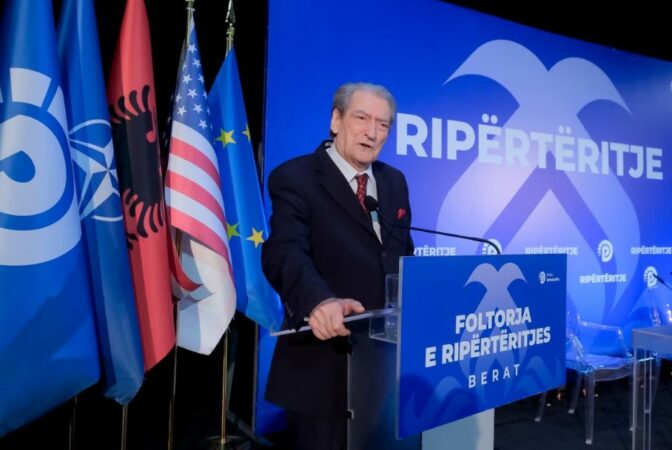



The leader of the Democratic Party, Sali Berisha, has accused Edi Rama's government of turning Albania into a narco-state, stating that drugs and crime have become the main force of evil in the country.
During the DP Renewal Speech in Berat, Berisha said that the impact of narco-euros has led to the depreciation of the euro, increased prices and hit domestic production. He stressed that in recent years, Albanian exports have fallen by 28 percent, industrial production by 15.3 percent, while agricultural production has suffered an even greater decline.
Berisha also raised concerns about the demographic situation, stating that the birth rate in Albania has returned to the levels of 100 years ago and that a large portion of Albanians have left the country.
According to him, Albania has become one of the most expensive countries in the region, with prices of food and basic products reaching 110 percent of the European Union average.
Excerpt from the speech of the leader of the Democratic Party, Sali Berisha, during the Democratic Party's speech in Berat
Good evening and a warm greeting to all of you democrats, citizens of Berat in this hall, in the city, in the region, and wherever you are tonight.
I express my greatest respect, my boundless gratitude to the citizens, the inhabitants of this city, of this region, their extraordinary heritage over centuries, over thousands of years, a heritage that makes every Albanian proud, but a heritage that makes every civilized person proud on all four corners of the globe.
Dear leaders of the DP branches in the district, dear deputies, Mr. Party Chairman, leaders of the DP, I come to you today in this conversation in a situation that is undoubtedly critical, but in a situation that is full of hope, which is hopeful.
Today, Albania is ruled by an authoritarian narco-dictatorship, unlike any other country in Europe and one of the few in the world.
For those of us who have known the communist dictatorship, it is a dictatorship that did not tolerate any form of pluralism, which is why it is called totalitarian.
But today's is authoritarian, where, much like the first, the dictator has all the power in one hand.
Enver Hoxha had in his hands the satire of Marxist-Leninist terrorist ideology, Edi Rama today has the satire of drugs and crime, which are a force of evil.
And an evil that, in some respects, the nation has never known.
Six days ago, I was talking to a prominent professor, one of the most prominent scholars in European politics, and I presented the situation in the country to him.
I informed him that as a result of this regime's narco-state, due to the world's largest euro devaluation, exports have suffered the most dramatic decline, 28 percent in 3-4 years.
Industrial production has declined by 15.3 percent.
Agricultural production even more.
But he was stunned when I told him that today the birth rate as a nation in Albania is the same as it was 100 years ago.
He ended the conversation with me by saying, Mr. Berisha, this is an existential risk.
And in fact, we have never in the memory of many centuries of history been in such existential danger as we are today.
Statistics show, some say 47, others say 54 percent of Albanians are no longer in Albania.
So, I focused only on one of the aspects, perhaps the most tragic, the most threatening to our existence, which is the demographic aspect, of this regime.
Without stopping, we rolled from an ascent and departure from poverty, and we returned to being the poorest in the region and Europe.
Drugs are a force of evil, my friends, because the 35 percent devaluation of the euro from the wagons and containers of narco-euro that enter Albania devalues all the remittances that family members send to Albania.
They have devalued euro savings by 250 billion lek.
Not only that. You should know that the Bank of Albania, from the 250 million euros it was buying four years ago, now buys over 1 billion and throws the banknotes into the market in bags.
Yes, it increases prices, increases inflation.
And herein lies the reason why prices in Macedonia, Kosovo, Montenegro are 60, 70 percent of the EU average prices for food and basic things.
And in Albania, how many are there? 110 percent.