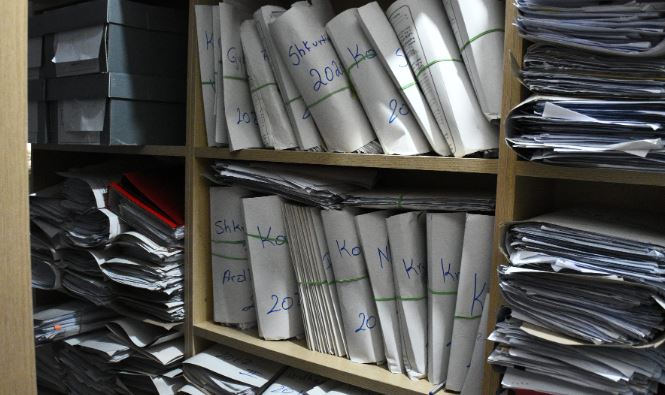



Journalists and media entities in Albania continue to face unfounded defamation lawsuits, known as SLAPPs, which are considered lawsuits that aim to intimidate them or encourage self-censorship in their work.
Of the 333 court decisions analyzed for the period 2022-2026, indicators of risk from strategic lawsuits against public participation were identified in 171 of them, while 50 cases, which constitute 15% of the sample, are classified as high risk as SLAPP lawsuits.
The data was published on Friday by the "Res Publica" Center during the presentation of the study "Freedom of Expression in Judicial Practice 2022–2026: How the ECHR Jurisprudence is Reflected by Albanian Courts", prepared by experts Dorian Matlija and Irena Dule.
The study includes 333 civil, criminal, administrative and constitutional decisions from 2022 to July 31 of this year. 190 of the decisions, or 57 percent of the total, involve journalists, media entities or other actors exercising a public information function.
The data makes the media the most exposed group among the parties identified in judicial conflicts related to freedom of expression. But the importance of the study also lies in the way these processes are used and what costs they can produce beyond the final outcome of the trial.
In cases considered as lawsuits with indicators such as SLAPP, the report highlights that defendants face high financial demands, multiple lawsuits against the same publication, and judicial delays that can produce self-censorship, even in cases where the media wins the case.
The report clarifies that classification as a potential SLAPP case does not prove that the plaintiff intended to silence the journalist or prevent publication. It identifies indicators that require individual consideration, assessing the nature of the case, the public interest, the measures sought, and the effect of the procedure on public participation.
Lawyer Dorian Matlija said that "there is no clear methodology to distinguish SLAPP lawsuits, but there are some indicators that categorize these types of lawsuits."
According to him, some of the indicators relate to the manner and extent of the use of lawsuits to create a disproportionate burden on those reporting on matters of public interest, high financial demands, multiple processes, and multi-year delays.
The analysis of the decisions highlights seven recurring patterns that, according to the authors, may signal SLAPP risk.
The first relates to claims for damages in amounts that significantly exceed the actual harm. In some cases, financial claims are not accompanied by a clear explanation of the connection between the amount claimed and the real consequences of the publication, the audience reached, the duration of the exposure or the economic situation of the defendant.
Another indicator is the combination of several measures against the journalist or media outlet. In addition to compensation, retraction, public apology, publication of the court decision, deletion of content and prohibition of future publications may be required. The report underlines that courts should assess not only each measure separately, but also their combined effect on freedom of expression.
The parallel or alternative use of criminal and civil proceedings for the same matter is also a concern. Even when it does not result in a conviction, the obligation to defend oneself in several processes can create financial, time and professional costs for the journalist.
One of the most significant indicators is the duration of the process, while the study highlights cases that last for many years, in one case up to 17 years.
“This can produce a deterrent effect and self-censorship even when it ends up in favor of the media, as the journalist is meanwhile faced with defense costs, uncertainty, and the ongoing burden of trial,” Matlija said.
The authors of the report highlighted the difficulty in defining a SLAPP lawsuit even in cases where the case ends with a dismissal, an element that, according to them, does not automatically prove the abusive nature of the lawsuit, but raises questions about the purpose of pursuing it, especially when the process has lasted for years.
Finally, the report mentions the lack of prior contact with the media or journalist, such as a request for correction, response, or other less restrictive remedy. This indicator is not sufficient on its own to identify a SLAPP lawsuit, but it can help assess the context in which the legal route was chosen.
According to lawyers Dule and Matlija, procedural mechanisms are lacking that would enable courts to identify lawsuits with potential SLAPP indicators from the outset and examine their effect on public participation.
The authors recommend at the end of the study that courts implement Article 10 of the European Convention on Human Rights in a structured manner, taking into account the cumulative effect of measures against journalists.
The report also addresses the High Court and the School of Magistrates to clarify jurisprudence standards and strengthen the training of judges on freedom of expression, protection of sources and lawsuits with potential SLAPP./ BIRN