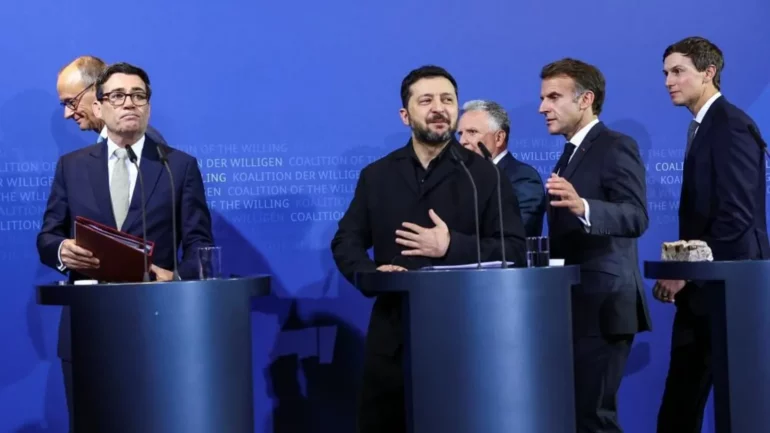



European leaders have expressed their willingness to start negotiations with Russia to end the war in Ukraine, reaffirming their strong support for Kiev. At the Berlin summit, known as the "Coalition of the Willing", European leaders stressed that Europe must have a direct role in any possible peace agreement.
British Prime Minister Andy Burnham stated that Europe has a clear, consistent and united position in the negotiations, while German Chancellor Friedrich Merz warned that Moscow's maximalist demands are unrealistic.
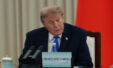
The summit in the German capital came at a crucial diplomatic moment, after US President Donald Trump held a historic trilateral meeting in Shenzhen, southeast China, with Russian President Vladimir Putin and Chinese President Xi Jinping. Trump then joined the leaders' discussions in Berlin by phone, while two US envoys, Steve Witkoff and Jared Kushner, were also present at the summit.
The latter stated that Trump wants to reach an agreement with Moscow, having Europe on his side. According to Kushner, the US president left the meeting in China convinced that peace in Ukraine is achievable.
Putin invites Europeans to Moscow
For his part, Vladimir Putin commented on the possibility of including European countries in the peace negotiations, claiming that the US is persistently asking Russia to accept their participation.
The Russian president said that Moscow is not against this idea, but first wants to understand what Europe will bring to the negotiating table.
"For this reason, through diplomatic channels, we have invited the Europeans to come to Moscow to determine their positions. After that, we will decide in what format we will continue the dialogue with Ukraine," Putin declared.
However, he criticized the continued warnings of European leaders about the possibility of a new war in 2030.
"Every day we hear that European leaders are talking about a war that could come in 2030. But we have no plans to attack anyone. Is this normal? I don't believe it," the Russian president said.
At the same time, Putin acknowledged that the discussion of issues related to European security cannot take place without the involvement of the continent's countries themselves.
Security guarantees for Ukraine, the difficult point of negotiations
One of the main issues of discussion in Berlin was Ukraine's security after the war. Jared Kushner said that Russia is now more open to the idea of Kiev receiving security guarantees based on the principle of NATO's Article 5.
This article stipulates that an attack on one member country is considered an attack on the entire alliance, obliging allies to assist the attacked country.
Ukrainian President Volodymyr Zelensky has long demanded such guarantees, equivalent to NATO's collective defense. However, so far there have been no clear signals that Vladimir Putin would accept such a condition.
Russia categorically opposes Ukraine's membership in NATO. Meanwhile, according to reports, American negotiators have considered the possibility of Kiev receiving Article 5-like guarantees, without becoming part of the Western alliance, in exchange for difficult territorial concessions.
Zelensky did not express the same optimism as the American representative. He noted that Putin has repeatedly rejected the proposals made so far.
"Putin has always said no," the Ukrainian president declared.
German Chancellor Friedrich Merz was also cautious, although he acknowledged that US involvement increases the chances of achieving peace.
He said that Europe is ready to enter into serious discussions with Russia about European security, but only if these are first accompanied by a serious peace agreement with Ukraine.
"These talks should start and we will accept them if the conditions are acceptable to Europe and Ukraine," Merz said.
Merz opposes dividing Europe into spheres of influence
The German Chancellor also warned against any attempt to divide Europe into spheres of influence controlled by major powers.
His statement comes at a time when concerns have increased on the continent that such an issue may have been discussed during the trilateral meeting between Trump, Putin and Xi Jinping in China.
"A Yalta format will not bring peace," Merz declared, referring to the 1945 agreement between the US, the Soviet Union and Great Britain, which determined the influence of the great powers in post-war Europe.
He also tried to downplay the significance of the meeting in Shenzhen, casting it mainly as a photo opportunity.
"The US understands that there can be no peace without us. We, for our part, know that with the United States at our side, the prospects for peace increase," the German chancellor added.
Along the same lines, Polish Prime Minister Donald Tusk objected to US President Trump's characterization of Putin as a "friend" during the meeting in China.
"Mr. Putin is not our friend and never will be," Tusk declared.
Meanwhile, French President Emmanuel Macron called on Ukraine's allies to do their utmost to provide the air defense systems Kiev needs to protect itself from deadly Russian attacks.
Macron also urged allies to reopen the discussion on Ukraine's NATO membership.
Moscow still reserved about Europe's involvement
Despite recent signals from Washington, Moscow's stance on Europe's involvement in the negotiations remains unclear.
Last week, after a visit to Moscow, US envoys Steve Witkoff and Jared Kushner appeared optimistic that Europe would soon have a seat at the negotiating table.
But Russian officials have been more reserved. This week, Putin's aide Yuri Ushakov said that much work still needs to be done before expanding the negotiating format.
He hinted that several more rounds of discussions would be needed before quadrilateral talks could take place.
Russia launched its full-scale invasion of Ukraine on February 24, 2022. Since then, diplomatic efforts to end the conflict have failed to produce an agreement, while the issues of occupied territories, security guarantees, and NATO's role remain the main obstacles to peace.