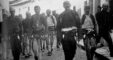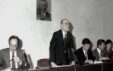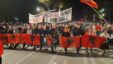






The CIA has shown the great role that the Soviet Union had in communist Albania. In some "Top Secret" documents but declassified for years, it is shown that the USSR built several important military bases, especially in the South of the country. There, the submarines that Moscow had on the island of Sazan and the Gulf of Vlora are shown in detail, as well as air bases, such as those of Rinas, Kuçova, etc. Then an overview of political developments is given, mentioning the dismissal of Defense Minister Beqir Balluku in the summer of 1974, from all functions in the army and party. Likewise, a special place in the documents that the CIA has declassified, are those that talk about Albanian political emigrants in Yugoslavia, who are included in the Prizren Committee initially headed by Apostol Tanef and under pressure from the UDB, which recruits them with coercive measures, such as returning to Albania, etc.
Internal situation in the first quarter of 1953
The number of Soviet citizens has increased significantly in recent months. The arrivals include male and female workers, drivers, and technicians. The technicians are employed in various activities of the country, including sanitary inspections. Sanitary inspectors have the power to close down places that do not comply with their orders.
Many of the Soviets brought their families with them. There was no particular reaction among them after Stalin's death, nor were there any sudden departures. After Stalin's death, the Albanian government took additional measures to maintain order, security, and borders.
The bridges and main roads were fortified with anti-tank weapons and heavy machine guns. There were no signs of unrest among the civilian population. In the first half of the year, the Albanian press announced with great fanfare the publication of an article by Enver Hoxha in the Russian daily "Pravda".
The leadership also made great efforts to assure the people of the strong friendship between Albania and the USSR. But in some cases a certain dependence was noticeable and it seemed that these assurances were sought. In this year, several trade and cultural agreements were signed with other communist countries.
These included agreements with Romania, Poland, Czechoslovakia, East Germany, and Hungary. Albania also maintains good relations with other communist countries, and several hundred officials and party members have left for the USSR and satellite countries for advanced training courses in the fields of mining, forestry, agriculture, construction, or other sciences.
State propaganda continues to portray Western countries as aggressors and war-mongers. It also attacks the recent Balkan Pact, as well as Yugoslavia for accusations of border violations and sending saboteurs and informants to Albania.
The government has reported the capture of a large number of spies and informants coming from Yugoslavia. Recently, authorities have reported the killing or elimination of about 50 such individuals in armed clashes.
Tensions were evident among the non-communist population over Tito's and Western countries' intentions to use Albania as a bargaining chip in Mediterranean politics. During this time, the communist authorities emphasized their media campaign to "protect state secrets." This was interpreted by some quarters as preparation for a major trial.
August 1950
Yugoslavia hinders Albanian repatriations
ATSH
Despite accusations by the state news agency Tanjug on March 1 that Albania has violated the agreement regarding the repatriation of Yugoslav citizens, our country has consistently issued visas to Yugoslav citizens. Since October 1949, Albania has issued visas to 28 Yugoslav families, totaling 56 people. Albanian authorities have even provided transportation for them to the border.
On the other hand, the Yugoslav government is constantly preventing the repatriation of Albanian citizens there, since until October 1949, the Yugoslav authorities had issued visas to only four Albanian citizens. The Yugoslav government is not only preventing repatriations, it is also working to convince Albanians in Yugoslavia to change their minds. The Albanian government has warned its counterparts about this on eight occasions.
November 1950
Albania's inclusion in Yugoslavia
A serious disagreement has arisen in the Yugoslav government regarding the Albanian problem. Representatives of the pro-Tito Albanian committee of Kosovo have offended the Serbs after their statements regarding the Albanians living in Albania. In them, special emphasis was placed on the future borders of Albania and the possibility of its inclusion in the Yugoslav federation.
Serbia claims that the future map of the country should include several Albanian localities that were historically and ethnically Serbian. The statements have also been opposed by Macedonian representatives. In the last week of July 1950, clashes occurred in Pristina between Serbs and Albanians of the region, during which two people were killed. In Ristovac, Serbs reportedly killed an Albanian who had mistreated Serbs during the war, when he had been with the German army.
February 1951
General Balluku's visit to the northern border
General Beqir Balluku, accompanied by three Soviet officers, arrived in Kukës on February 5, 1951, to inspect military border installations. Police operations in the area were slightly reduced during his visit, in order to provide the general with adequate protection.
1952
Yugoslavia denies unilateral intentions over Albania
The Yugoslav representative in Athens assured the Greek government yesterday that Yugoslavia would not disturb the current situation in Albania. He said that in the event of an internal revolt there, the Yugoslav government would act only in coordination with its other neighbors. The statement is believed to have been accepted by the Greek representatives.
Comment: Yugoslavia's dependence on US aid and its desire to conclude lucrative defense agreements with Greece and other NATO countries dictate that it respect the recommendations for Albania. But at the same time, Yugoslavia seeks to strengthen its capacities to overthrow the Hoxha regime, for a possible dominance in future anti-communist governments in Albania. Despite Greece's expression of confidence in Yugoslav goals, Albania remains, as always, a delicate point of interest between Greece, Yugoslavia, and Italy.
Albania's exports from Hungary
The “Orion” factory delivered on April 5, 1954, 2000 radio tubes for Albania, which departed from Debrecen aerodrome on April 10. The Hungarian optical factory “Magyar Optikai Muvek” has delivered 42 periscopes for Albania, which are expected at Debrecen aerodrome on April 15, 1954. The Beloyanisz factory has delivered 250 radio transmitters in thin metal boxes, for use both as batteries and for the main electrical network in Albania. They departed from Budapest on April 10, 1954 and arrived at Debrecen aerodrome on April 15.
The Chinoin Gyogyszerarugyar pharmaceutical factory has delivered several crates of medicines to Albania, which they lifted from Debrecen on April 10. The Egyesult Izzo factory has delivered 500 electric lamps of different voltages to Albania. The shipment left Budapest for Debrecen on April 10. The telephone factory in Budapest has delivered 400 CH46 type telephones to Albania, which left for Debrecen on April 10, 1954.
The Gamma factory has delivered 16 wooden crates of precision instruments to Albania, which departed for Debrecen on April 15. The Orvosi Muszergyar medical instrument factory has delivered 23 wooden crates to China, which departed for Debrecen on April 15.
The Baloianisz factory has shipped 54 radio transmitters to China, headed for Debrecen on April 14. The Orion factory has delivered radio receivers of the 3, 4 and 5 tube type, in 12 wooden crates to Albania. The cargo was shipped on April 15 to Debrecen. The Gamma factory has shipped 10 crates of precision instruments to China and 5 to Albania, headed for Debrecen aerodrome on April 20. The Beloianisz factory has shipped a complete radar installation in 24 crates, to China, on April 30, 1954. / Memorie.al