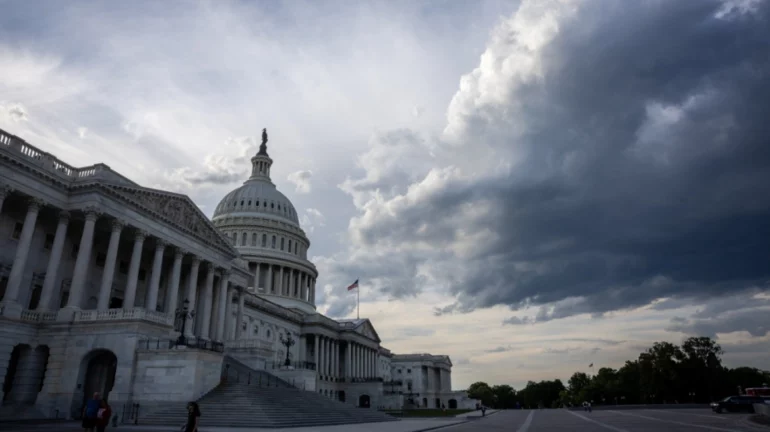



Organizations supporting Ukraine in the United States called on the US Congress, whose term ends soon, to impose stricter restrictions on easing sanctions on Russia and to accelerate military aid to Kiev.
They warned that delays could weaken Ukraine's position at a time when diplomatic contacts with Moscow have resumed.
The requests come during the US Congressional transition period, after the November elections and before new lawmakers take office in January.
Ukraine, meanwhile, is facing another wave of Russian attacks on its energy infrastructure.
The five organizations presented the demands in a letter addressed to the heads of the Armed Services committees in the Senate and House of Representatives, dated November 10.
They requested that these measures be included in the National Defense Authorization Act for fiscal year 2027 (NDAA), through which Congress determines US defense policies.
The letter, which was obtained by Radio Free Europe, was signed by the organizations "Razom for Ukraine", "Nova Ukraine", "Ukrainian Congress Committee of America (UCCA)", "American Coalition for Ukraine" and "FDD Action".
The initiative came as representatives of the US, Ukraine and Russia held talks on ending the war in Abu Dhabi on November 10 and 11, under the mediation of Washington.
They were the first trilateral talks since February.
The organizations demanded that Congress not allow President Donald Trump's administration to ease sanctions on Russia without the approval of American lawmakers.
They also demanded the acceleration of the delivery of air defense missiles to Ukraine and the allocation of additional funds for the protection of its energy infrastructure.
"This letter represents an important opportunity for Congressional support for Ukraine to be translated into concrete legislative action before the end of the 119th Congress," Michael Sawkiw, president of UCCA, told Radio Free Europe.
One of the main proposals aims to limit the validity of presidential waivers and general licenses, which ease sanctions on Russia, to 30 days, unless Congress approves their extension.
The coalition argued that existing rules give the US administration plenty of room to ease restrictions imposed on Moscow.
He cited an October 16 executive order, through which Trump suspended the implementation of several key sanctions and tariffs provided for by the Graham Act, named after the late Republican Senator Lindsey Graham – a known supporter of Ukraine.
The law, signed in September, aimed to increase economic pressure on Moscow, hitting its energy sector and countries that buy Russian oil and gas.
The organizations also called for European allies to make it easier to transfer US-made air defense interceptor missiles, spare parts, and other equipment to Ukraine, without having to seek separate US approval for each shipment included in these measures.
Eugene Goncharov, policy director at the American Coalition for Ukraine, said the Pentagon had refused for about a month to authorize the transfer from European countries of interceptor missiles for Patriot systems, which Ukraine, according to him, urgently needs to protect itself from ongoing Russian missile attacks.
The coalition also demanded continued funding for the Ukraine Security Assistance Initiative – a Pentagon program that funds military equipment and support for Ukraine – as well as monthly reporting to Congress on arms shipments.
The proposals also include delivering the promised interceptor missiles within ten days of a new production batch becoming available, allocating an additional $1 billion in fiscal year 2027 to protect and repair Ukraine's energy infrastructure, and transferring frozen Russian assets to a fund to support Ukraine.
The groups also demanded measures that would prevent the US from reducing intelligence sharing and support for satellite communications, which are important for Ukraine's military operations.
Mykola Murskyj, senior advisor for policy and strategy at the US-based nonprofit organization Razom for Ukraine, which supports Kiev, said the letter was sent at this very time to influence negotiations on the defense bill.
"Currently, members of both houses of Congress are conducting negotiations on the National Defense Authorization Act (NDAA)," Murskyj told Radio Free Europe.
He said lawmakers should preserve provisions in support of Ukraine, already included in the version approved by the Senate, as well as strengthen restrictions on easing sanctions on Russia.
"Easing sanctions only rewards the Kremlin. It doesn't encourage it to change its behavior, but it rewards it for its aggression," Murskyj said.
The US Congress began its final session on November 10, ahead of the January reshuffle, when Democrats are expected to take control of both chambers after convincing victories in the November 3 elections.
Representatives of organizations supporting Ukraine say the remaining weeks offer opportunities to secure commitments from both parties before the new Congress convenes.
Separately, 32 Republican and Democratic lawmakers demanded explanations from the Trump administration for delays in delivering $400 million in military aid to Ukraine, approved for the 2026 budget year.
In a letter to Defense Secretary Pete Hegseth and White House Budget Office Director Russell Vought, the lawmakers said the administration had waited until the final days of the fiscal year to formally allocate the funds.
According to the Pentagon's spending plan, deliveries could continue until fiscal year 2029, raising concerns about Ukraine's ability to timely secure the weapons already authorized by Congress.
Lawmakers warned that the delays harm U.S. credibility and Ukraine's ability to defend itself from Russian attacks.
They demanded a detailed plan for the deliveries, explanations as to why interceptor missiles for Patriot systems were reportedly excluded from the aid, as well as guarantees that future aid would be distributed without delay.
Among the signatories were Republican senators: Thom Tillis, Chuck Grassley and Joni Ernst, as well as Democratic senators: Dick Durbin, Mark Kelly and Adam Schiff.
Durbin, one of the Senate Democratic leaders and co-chair of the Senate Caucus on Ukraine, called for continued American support during a speech to the Senate floor on November 10.
"Don't give up on Ukraine," he said, addressing the incoming Congress and President Trump.
Durbin, who will not be in the next composition, stressed that the United States "must remain steadfast" in supporting its NATO allies, warning of the consequences that Washington's abandonment of the alliance would have, both for American security and that of its allies./ REL