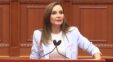
Democratic Party MP Jorida Tabaku has raised concerns about the way the government manages public properties and the agreements related to their development, demanding full transparency on the value of the assets, the terms of the contracts, and the benefits the state provides from these projects.
Tabaku focused in particular on the role of the Albanian Investment Corporation, which can take over property from central and local institutions for the implementation of investment projects. According to her, it is necessary that every step of this process be clear to the public, from the valuation of the property to the selection of partners and the determination of the obligations of the parties.
The opposition MP argued that decisions on public properties directly affect citizens' wealth and that the government should explain concretely what the public benefits from the agreements concluded. She also referred to the findings of the Supreme State Audit Office after the audit of the Albanian Investment Corporation, where, according to her, deficiencies in planning, a lack of standardized methodologies for projects and insufficient analysis of risks and benefits were identified.
TOBACCO REACTION
Full communication:
Today I want to talk to you about your property. About public land. About the space between buildings. About assets that have great value precisely because they belong to all Albanians.
Who decides on them? Who sets the price? Who chooses the beneficiary? And who is accountable to you? Keep these questions in mind every time the government presents you with a new project.
Because the project may look pretty on the screen. But the agreement behind it could determine the fate of a public property for decades. And that's where we need to focus our attention.
To the agreement. To the property. To the beneficiary. The Albanian Investment Corporation is at the center of this concern.
A state-owned company, created by law, that can acquire property from central and local institutions for investment projects. Think for a moment about the power this gives it.
The property that was previously administered by a public institution can be transferred to the Corporation. It is then included in a development project. A partner is selected. The terms are negotiated. What each party receives is determined.
In each of these steps, your assets are placed.
Therefore, I have a direct request to the Prime Minister: open these agreements to the Albanians.
Publish the property valuation. Publish the alternatives that have been considered. Publish the terms and conditions. Indicate the ultimate beneficiaries.
And explain, with numbers, what the public gains.
Whoever is so convinced that they are making the best deal for Albania should be willing to try it.
Because here we have concrete reasons to demand accountability.
The Supreme State Audit Office has audited the Corporation. It has found deficiencies in planning, a lack of standardized methodologies for projects, and a lack of detailed analyses of risks and benefits.
The report made 27 recommendations.
These are findings of the state audit institution.
And the question for the government is clear: which ones have you implemented?
For each recommendation, indicate the measure, deadline, and responsibility.
Because before you commit another public property, you must prove that you have corrected the identified deficiencies.
Albanians cannot be asked to trust unconditionally. Trust is earned by being accountable.
Let's take the example of the Zyber Halluli Orphanage.
This is a property of great value in Tirana. It is important for sports, for the city and for the community.
Therefore, the agreement must pass a very simple test: is it the best use of this asset for the citizens?
How much is the land valued at? What does the private partner get? What does the state get? What sports facilities are guaranteed? Who bears the costs of the surrounding infrastructure?
The answers must be written in documents and guaranteed in the contract.
Citizens have the right to know what will be left for them after the presentation is over, after the cameras are removed, and after construction begins.
Because a public property also has a value that is not measured solely by the sales price or construction area.
It could be a neighborhood's last chance for a school. It could be the space where kids play sports. It could be the site for a service the city will need tomorrow.
When you decide on that property, you also decide on these options.
And the responsibility is yours, Mr. Prime Minister.
But the concern goes beyond the Corporation.
Look at the instruments that have been created over the years for property and territory: strategic investments, the Mountains Package, special development procedures.
Each has its own rules. Each comes with a promise for the economy.
But the same calculation must be made for each: what does the state give and what does society take?
The Law on Strategic Investments provides for special procedures and support for projects that receive this status.
Then publish the results.
For each project, indicate the commitments made and the commitments fulfilled. Indicate what support was provided. Indicate what measures were taken when promises remained on paper.
The convenience provided by the state has a cost and a responsibility.
No one should take the benefits of status and avoid the obligations that come with it.
Then we have the Mountain Package.
A procedure that, when the legal conditions are met, can lead to the purchase of the property for one euro, after the development permit is approved.
One euro.
Precisely because the price is symbolic, control over the right to benefit must be very strong.
Who verifies possession? How are owners' claims handled? How is a family protected when they are in emigration and may not find out in time about a procedure that affects their property?
Here, the state must guarantee people's rights to the end.
A quick procedure, without effective property protection, can produce an injustice that lasts for generations.
This is the danger I see: the creation of privileged paths for those with money, influence, and proximity to decision-making.
Here, the answer must also be sought for custom laws.
To me, a law is made to order when the rules are tailored around the interest of a beneficiary and the public interest is used as justification.
This is the political test we must apply to every initiative: who does it pave the way for and who does it leave unprotected?
Even territorial reform must be seen through this test.
Changing borders affects the institutions that administer the territory, represent residents, and make decisions about development.
Therefore, we want to know what power communities will have over decisions that affect their land.
The further away the decision-making goes from the resident, the stronger the guarantee that their voice will be heard must be.
A small village has rights. A neighborhood has rights. A landlord has rights.
These rights must be protected even in the face of the largest project and the most powerful investor.
Therefore, my request is concrete: transparency for properties, competition for projects, and accountability for agreements.
For each public asset, indicate the value.
For any legal relief, state the reason.
For each beneficiary, indicate the obligations.
And for every broken promise, show who is responsible.
Albania's wealth is greater than the mandate of any government. The decisions you make today will be paid for or enjoyed by our children.
Therefore, this account will be sought until the end.
The property belongs to the Albanians. You owe the Albanians the answer.