






By DASHNOR KALOÇI
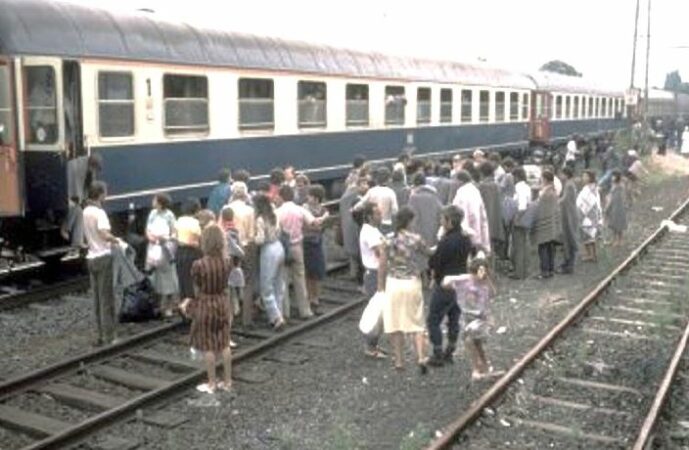
When not even a week had passed since July 2, 1990, when thousands of Albanian citizens climbed over the railings and walls of foreign embassies in Tirana and entered their premises with the intention of leaving Albania, the senior leadership of the Albanian People's Party, headed by Secretary General Ramiz Alia, held the 11th plenum of the Central Committee, which held its proceedings on July 6 and 7. Although the agenda was predetermined in three main points, where the development of education in Albania predominated, almost throughout the proceedings of that plenum (especially in point 4, "Miscellaneous"), the event of those days, otherwise known as "July 2 of the embassies", was discussed and debated. In that plenum, which was attended by all members and candidates of the Central Committee of the Albanian People's Party, the first secretaries of the district party committees, ministers, key cadres of the education, culture, science, economy sectors, leaders of the organization of the Albanian Labor Youth Union, from the apparatus of the Central Committee of the Albanian People's Party, Radio-Television, ATSH, etc., Nimet Cani, Ali Vukatana, Reiz Malile, Shpëtim Çaushi, Zylyftar Ramizi, Qemal Lame, Zef Loka, Pirro Kondi and Hekuran Isai were absent, who had been "in the field" for several days, "managing" the embassy event.
After the opening of the meeting by Ramiz Alia, the floor was given to the Minister of Education, Skënder Gjinushi, who also delivered the relevant report ("On the improvement of the education system and the further strengthening of the quality of the school"), the topic of that plenary session was "the embassy incident", discussing and analyzing in detail how and why it happened ("the role of foreign agencies"), up to the tasks that arose for managing that situation in those hot July days, where over five thousand Albanian citizens from all over the country were in the interiors of some of the main embassies in Tirana, awaiting departure from Albania.
In addition, throughout that meeting, but mainly in item no. 4 of the agenda (which was discussed in the last session), some of the main events that had occurred in different parts of the country during that year were analyzed, such as; the protests in Shkodra in January for the removal of the bust of Stalin; the events in the city of Kavaja where the people of that city clashed with police forces; the mass escapes from the state borders with Yugoslavia and Greece, mass gatherings in religious holy places, such as the Church of Shën-Ndout in Laç i Kurbinit; the legalization of religious beliefs and the opening of cult objects; or other problems that were being addressed, such as; the talks and the international factor for the restoration of diplomatic relations with the USA, the Soviet Union, (talks held with the Deputy Soviet Foreign Minister in Sofia by Sofokli Lazri); the Kosovo problem; international pressure for Albania to open up to the world and its accession to several international conventions; the privileges of the senior leadership of the Albanian People's Party and their families who lived mainly in the "Block"; the rumors circulating among the people about Enver Hoxha's family and Ramiz's relations with Nexhmije; changes in legislation and the penal code; the release of political prisoners; the issuance of passports to citizens who wanted to visit their relatives abroad; the new economic mechanism; the housing and employment of many extras in all districts of the country; the granting of land and livestock to the cooperative peasantry; and even the supply of the population of the cities with basic food products and various industrial goods.
As we will see from the archival documents belonging to the 11th plenum of the Central Committee of the Albanian People's Party, which we emphasize are being published for the first time, in addition to the leadership and some of the senior officials of that time, several other senior figures who continued their political careers after the 90s were also discussed or mentioned at that meeting, such as; Skënder Gjinushi, Fatos Nano, Sali Berisha, Rexhep Mejdani, Gramoz Pashko, Spiro Dede, Dritëro Agolli, Ismail Kadare, Moikom Zeqo, Mehmet Elezi, Lisen Bashkurti, Koço Kokëdhima, Ylli Popa, Aleks Luarasi, etc.
Likewise, in the voluminous file of this plenum, of great interest are also those documents belonging to the secretaries of the Party Committees of the districts or the "Information Group" who have gone to all the districts of the country and have identified all the main issues that have emerged in the meetings of the basic organizations of the party, where "On the letter of the Central Committee" was discussed, documents that constitute the largest and also the most important part of the file in question. It can even be said to be among the most important of the entire period of the communist regime of Enver Hoxha and his successor Ramiz Alia, since that period of time with the events that took place, marked the prologue to the fall of that regime.
Also of great interest are the documents belonging to the last session of that meeting with item no. 4 of the agenda "Miscellaneous", which constitutes the hottest point of the entire plenum, where the dismissal from duties and retirement of three members of the Politburo (Rita Marko, Manush Muftiu and Prokop Murra) was discussed, even with fierce debates, or the dismissal from ministerial duties or other high functions that they had held for years of several other "leaders", such as Simon Stefani, Pali Miska, Muho Asllani, Lenka Çuko, Vito Kapo, Pirro Kondi, Jovan Bardhi, etc., and the appointment of "new comrades" to the leadership of the high forums of the Party and the State, such as; Xhelil Gjoni, Abdyl Backa, Niko Gjyzari, Kiço Mustaqi, etc. Regarding these, etc., we are familiar with the documents in question, extracted from the Central State Archive (the Fund of the former Central Committee of the Albanian People's Liberation Army), which are published for the first time and with the relevant facsimiles by Memorie.al.
Continues from last issue
MINUTES OF THE MEETING OF THE 11TH PLENUM OF THE CENTRAL COMMITTEE OF THE ALP, HELD ON JULY 6 AND 7, 1990
VARIOUS
Some issues of today's situations and the political problems that arise from them.
COMRADE RAMIZ ALIA: The possibilities are to prevent these unexpected events, precisely where they originate. If it is thought that gatherings can be organized, a concrete plan must be thought out in advance on how to act in this or that case. If it is thought that the enemy may burn our warehouse, it is not enough to just repeat: "be vigilant!", but the guards must be reinforced and not leave only one person on guard. But it must be said that in many cases the enemy is finding us by surprise and unprepared. Therefore, let us learn lessons from these mistakes that are made.
In particular, I would like to draw your attention to you, comrades, first secretaries of the Party Committees in the districts, as well as members of the Party Central Committee, to have as many direct contacts with the masses as possible. There is no need to remind the leading comrades of Tirana that more than ever in this situation one of the most elementary work norms must be implemented: every morning a roll call of workers must be held. However, even to this day these comrades have not recorded who has entered the embassies. For example, you, comrade Nimet Cani, member of the Party Central Committee and first secretary of the Party Committee of Region No. 3, do you know which people from your region have entered the embassy?
And you, comrade Naumka Bozo, organizational secretary of the Tirana District Party Committee, do you have the lists of those who are currently in the embassies? I would also ask comrade Pirro Kondi this question, but he is not here. I do not understand from whom you expect orders to carry out, at least, this task, to identify the people who are absent from the work centers. What kind of work discipline are we talking about in the work centers, when we do not even manage to do this check? Even if 10 people who are absent from work have not all entered the embassies, they can be called and given a warning for dismissal, if they are absent without reason.
There is a specific law for unexcused absences from work. Let us not hesitate to implement this law, Comrade Qemal Lame. Those who repeat these absences should be warned that the law of the parasite will catch them. Measures should be taken against those elements who, as the people say, “have filled the cup”. Let us not politicize the actions of these people, but use the law that prohibits parasitism, gambling, the use of lotto, vagrancy, thievery, etc. But even these simple problems cannot be solved if the Party committees are not in charge of affairs. In this situation, we must work and act as in wartime.
Information must be well organized. From morning to evening we must receive complete information. This information cannot be achieved only with the secretaries of the Party organizations, but by increasing the role and responsibility of every communist and cadre. Comrade Hamit Shanku, who is the director of the Party Committee of the Autotractor Combine, must always be in charge of affairs and inform how things are going where he leads and it should not happen that vagabonds go to a trial that is held in the combine collective, while Party comrades and leading comrades do not go. Thus, instead of the Party line being implemented there, the desire of reaction is being implemented. The Amnesty International Agency even manages to send me a letter about this trial.
In addition, I have received other letters on this issue from various individuals living in Germany, Sweden, etc. Why is all this happening? Because the comrades of the Tirana Party Committee, the comrades of the court, the investigation and the leaders of the Combine do not attach importance to these concerns. That trial was held for a political purpose. Then, why is politics not being carried to the end and, worse, premises are being created for the trial to turn into the opposite, instead of serving the ideological and political homogeneity of this issue?!
I emphasize once again that the comrades of the Central Committee of the Party, where they work, must be in charge of the affairs. The comrade ministers must also help the leaders of Tirana, by making as many contacts as possible with the workers, with the people. Likewise, the activists and organizations of the Front in the neighborhoods, those of the Professional Unions, of the Youth, etc., must gather and be better activated. I also wanted to draw your attention to those problems that I raised in yesterday's speech. The ideas that were given in that speech must not remain only as study material for schools.
In that speech, political issues are raised, which must be discussed with the people, the communists, the youth, the workers must stand up. The party must organize and orient the perspective of the tasks of each of these forces. This work must also be done in the organizations we have, such as in the Ministry of Internal Affairs, the Ministry of Defense, as well as in all the organs of the dictatorship of the proletariat. I wanted to emphasize something else. The situations and problems they raise also require organizational measures and quick actions, so that the issues do not accumulate and do not create concerns.
For example, it is noted that in Shkodra the enemy continues to work with the aim of preparing riots, inciting discontent towards the government, etc. The Bureau of the Party Committee alone does not have the time and is unable to cope with the entire volume of work that must be done to prevent these enemy intentions that have already been concretized in occasional actions. Therefore, for this purpose, a headquarters with a few people must be created, that is, there must be a command.
In each district, defense headquarters have been organized, which can carry out this task, but it is not necessary for them to have 300-400 people. It is enough to have a unique direction and clarity of action. For example, for a piece of information that comes in, an order is thought out and given as to what needs to be done and what forces need to be mobilized to confront the event. Somewhere the youth can be mobilized, somewhere the Party or a group of workers, a group of police officers, etc. will be mobilized.
COMRADE DRITËRO AGOLLI: Company directors have greater authority. I have been to several companies in Tirana and I have noticed that only they are listened to…!
COMRADE RAMIZ ALIA: Without a doubt, their authority should also be used. But the issue is posed so that one does not think that everything can be resolved with the usual organizational forms, by passing on messages and responsibility from one link to another and no one acts.
COMRADE DRITËRO AGOLLI: No one listens to the instructors of the Party committees.
COMRADE RAMIZ ALIA: That is right, that is why we must think from an organizational point of view and create special headquarters, especially in those areas where there are or may arise serious problems. Particular care must be taken in large cities, such as Korça, etc. But let us not think that there can be a completely calm situation in any city. Do not forget that reaction will try to find ground wherever it can, throughout our country. Today, the most preferred weapon of external reaction for overthrowing the government in various countries is the creation of a suitable situation from within, while intervention from without would be nothing more than a military attack.
A military attack by the Yugoslavs, and also by the Greeks, can perhaps be expected, but for now the situation does not favor them. But if a serious situation is created inside, let's say in Gjirokastra or Saranda, they can find a pretext to attack. They can also artificially create and provoke such a situation, saying: "We will enter to protect our brothers in the minority!" Therefore, the comrades of the army should not underestimate the situations, but work wisely and reflect on these issues. If we have a healthy situation inside the country, the enemies have no choice.
Our police friends should also be more careful. These days, as the World Cup continues, there are gatherings of people watching TV at home. These people, after the matches end, go out into the streets in groups. But this does not mean that the police should accuse these groups of people of going out to demonstrate. However, if crowds of people come out of their homes, many of our friends should be among them. They should also go out into the homes to listen to the sports and go out with them. I brought this example because when we talk about organizing preventive work against ugly events, we must think through the details to avoid the unexpected and not be caught by surprise.
I think that Agron Tafa is wrong and bears serious responsibility for the Kavaja incident, if it happened as comrade Muho reported to me. Today is not the time to go out in front of the young people who are commenting on the match and, using the authority of the Party Secretary, tell them: “What are you doing like that?!” The Party Secretary could have entered into the conversation among them, in a humane manner, and asked them “Who played better, the German team?” He could have also expressed his thoughts about the match, but not to go and shout at them in a commanding manner, because such practices today irritate people.
Among those people there may be one, two or three people who benefit from a mistake of the secretary, from his attitude and behavior. Of course, with what I am saying, I do not want to justify the behavior and actions of the vagabonds of Kavaja, but I wanted to say that our cadres, our leaders should not fall into their wrong position. This shows that we are not living properly with today's situations and moments, we are not understanding correctly the different mentalities of people that appear more clearly, especially in these moments.
A little while ago it was mentioned here that it was not the moment to put the news about Mladenov's resignation in the newspaper, today. To act in this way means not understanding the moment. It did not matter if this news could be published tomorrow or the day after. While its publication today leaves room for an allusion: "Should Ramiz Alia also be asked to resign?" Does Marash Hajati, a member of the Party's Central Committee, and also the director of ATSH, think that such allusion can be made at this moment?!
COMRADE SOFOKLI LAZRI: Comrade Ramiz, we should not always think that Marash made this mistake out of stupidity. I do not consider Marash Hajati a “stupid”. If he admits that he is such, he should resign. He can admit that he made a mistake, but that is precisely why he should resign. I think that there are no stupid people in politics.
COMRADE HALIL LEJLI: To be honest, the press has been taking a lot of revenge lately...!
COMRADE RAMIZ ALIA: This is not just happening with the press…!
COMRADE HALIL LEJLI: There are some people who write…!
COMRADE RAMIZ ALIA: The issue must be seen even more broadly. I have no objection to the issue raised by Sofoja, but in this dialogue I raised several issues and emphasized in particular that in this situation our comrades, the leadership, the propaganda people must act very wisely. They must reflect better on the situations and moments we are going through, not to judge and tread lightly on the issues and problems that come before us. Everyone must be more careful, especially the secretaries of the district Party committees. Today is not the time to sleep, for "whistleblowers", in vain and without bread.
Today is the time for action and we must take action, together with the communists. We must raise the communists, the people, the working class, the youth and the intelligentsia. At this moment of great importance, the intelligentsia must also speak out with the opinion of the Party, comrade Dritëro. This is an important issue, because do not forget that the intelligentsia is very listened to by the youth. Therefore, if the reaction seeks "officers" for those it gathered in embassies, or for any opposition it desires, it seeks them precisely from the ranks of the intelligentsia. You must be careful about this. Our intelligentsia must be combative, and especially those intellectuals whose voices are heard.
There is no need to write long articles. It is enough for them to say even ten words in meetings and conversations with people, but they should be beneficial to the cause of the Party and stigmatize these actions that the reaction is taking against Albania. In this way, they will serve the cause of strengthening unity and the situation in the country. I believe there is no need now to give suggestions on how the work can be organized and what can be done in this direction. The forms of work should be sought and chosen from the most effective and appropriate ones. But once again I emphasize that this issue of great importance should be taken care of.
COMRADE NEXHMIJE HOXHA: Excuse me, comrade Ramiz. Two days ago at the University, a lecturer proposed that an opposition party could be created with those who have entered the embassies. Then he asked the question: “Why can’t the peasantry create a peasant party?”. Meanwhile, the comrade who went there yesterday from the Institute of Marxist-Leninist Studies to have a conversation to clarify the situations, said that the windows were also broken, but it was not clear who broke them. One should not sleep in the face of this situation!
COMRADE RAMIZ ALIA: Communists must stand up, along with all honest people.
COMRADE NIMET CANI: Among those who have thrown themselves into the German embassy, a guy who worked at Kinostudio, a typical thug, commands everyone.
COMRADE RAMIZ ALIA: We said a little while ago that we should not remain only in observations. You are the secretary of the Party committee and you must act. To raise the communists and the masses to block the way for these actions. This situation raises the need to strengthen the work of the Party. Do not expect meetings to be held once a month, without raising the problems that are encountered. If necessary, meetings can be held daily, they must be held under the pressure of sound opinion, the people, the situations must be clarified. Comrade Nexhmije mentioned here an example for the University. Appropriate measures must be taken to strengthen the work there and everywhere where such attitudes appear./ Memorie.al