



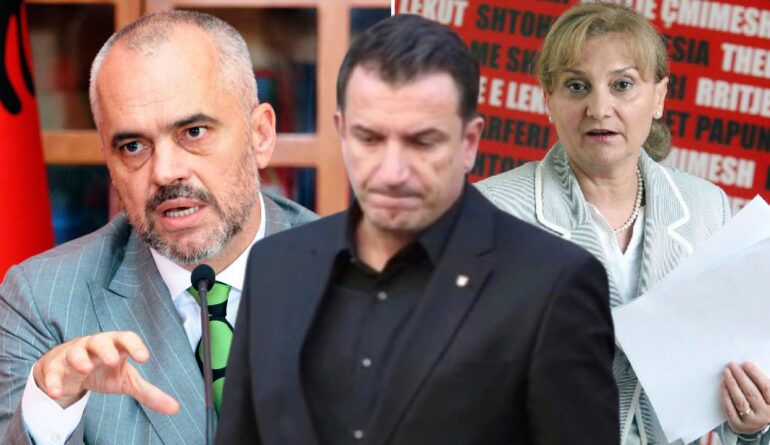



Experienced politician, former socialist minister Ermelinda Meksi, through a post on social networks reacted to the war in the Socialist Party, following the visit of Justice Minister Toni Gogu to Fier prison, where he met the mayor of Tirana, Erion Veliaj.
The latter has stated that he was threatened by Prime Minister Edi Rama, that he should resign and hand over the leadership of the capital's municipality to Arbër Hajdari.
Ermelinda Meksi says that if Veliaj's allegations are true, this would be scandalous. She demands that Minister Gogu not only make public statements, but also clarify the circumstances of the visit and its legality.
Post by former socialist minister Ermelinda Meksi
Institutions on trial
Erion Veliaj's letter and Minister Gogu's denial constitute a much more serious event than a conflict between two former friends or a clash within the Socialist Party.
If Erion Veliaj's claims are proven, we are dealing with an extremely disturbing precedent: the use of authority and state instruments to exert political pressure on a person in detention.
A minister's denial is not enough. It must be accompanied by facts and transparency. A minister cannot evade institutional responsibility with a denial.
In what capacity did the minister go to the prison? How did the visit take place and where was it documented, and who was aware of it?
These are not questions that can remain unanswered. Responsible institutions have the obligation to verify every claim, make the facts public, and identify responsibilities. Institutional silence or a formal denial is not accountability.
This event requires addressing responsibilities at three levels:
– The Minister of Justice should fully clarify the circumstances and legality of the visit.
– The Prime Minister should guarantee that executive power is not used for pressure or political bargaining.
– Justice institutions should verify claims independently and guarantee the legality of the process and respect for individual rights.
This is not at all protecting Veliaj from responsibility for the accusations against him, which must be investigated and judged by justice. It is about protecting the principles on which a democratic state functions: human rights do not depend on political sympathies or whether you are powerful or an ordinary citizen.
If this happens to a mayor, what guarantees are there to protect the ordinary citizen?
The state is no one's property, justice is not an instrument of power, and the freedom and dignity of the individual cannot become the object of political bargaining.
This is a matter of the state, of our institutions, and of our democracy.
E.Mexico, November 2, 2026