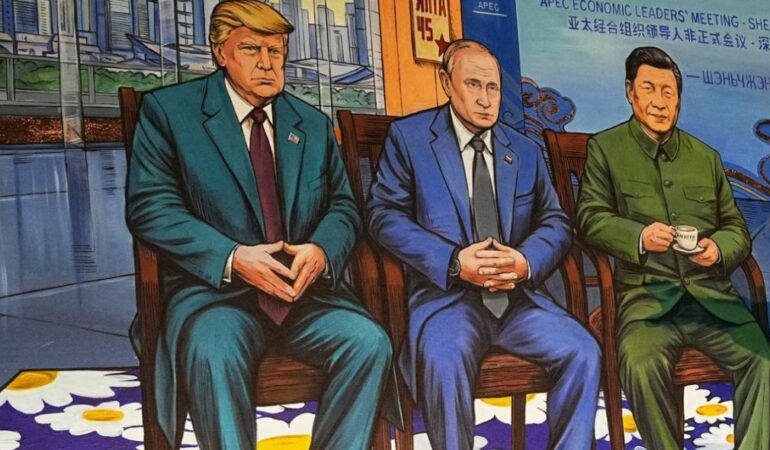



US President Donald Trump is traveling to China, where he is expected to hold a trilateral meeting with his Chinese counterpart Xi Jinping and Russian President Vladimir Putin on November 19. The summit, which will take place in Shenzhen as part of the Asia-Pacific Economic Cooperation (APEC) leaders' meeting, is being watched with concern by Europe and Asian capitals, which fear that decisions on security and international balances may be made without their participation.
Trump arrives in China after a stop in Manila, where he held meetings with the leaders of India, Japan and Australia. The meeting with Xi Jinping and Putin is expected to be one of the most important diplomatic developments of the week, while the focus will be on issues that directly affect global security, from the war in Ukraine and the conflict in Iran, to nuclear weapons and tensions in Asia.
The bilateral and trilateral meetings will take place on the sidelines of the APEC summit, an organization whose members represent about 62% of global Gross Domestic Product and nearly half of world trade.
The significance of this meeting goes beyond the official agenda. Some have called it a “Yalta 2.0,” referring to the 1945 conference in Crimea, where Franklin Roosevelt, Winston Churchill, and Joseph Stalin discussed the international order after World War II.
For US allies, the key question is whether Trump's personal diplomacy will help ease tensions or pave the way for broader agreements between major powers, leaving countries that could face their own consequences off the table.
Expectations for an immediate agreement remain limited. According to US information on the preparations for the meeting, Trump wants to discuss nuclear arms reduction and the war in Iran. Washington presents the meeting as an opportunity to start a dialogue between the three powers, while treating the Ukraine issue as a separate process.
However, this difference has not been enough to calm European governments. Their concern is related to the possibility that negotiations with Moscow could expand towards a review of the security architecture in Europe, without the direct involvement of the countries affected by these decisions.
According to NBC News, Jared Kushner's references to broader post-war European security arrangements have alarmed European officials. They fear that efforts to end the war in Ukraine could devolve into negotiations over NATO's role and security conditions across the continent.
Moscow has long called for limits on NATO's expansion and presence, while European countries insist that Russia is the one who has violated existing security rules.
The EU High Representative for Foreign Policy, Kaja Kallas, has warned of the risk of Washington falling into the “Moscow trap.” German Foreign Minister Johann Wadephul has also stated that Europe already has a security architecture and does not need to create a new one.
On the other hand, the White House has stated that it aims to strengthen existing agreements, while maintaining NATO at their center, and that any final agreement must receive the consent of the parties involved.
Kiev also wants any process to begin with a ceasefire and opposes turning discussions about the war into comprehensive negotiations on European security. Meanwhile, it remains unclear what role European countries will play in future rounds of talks.
In Asia, the concern is different, but it is related to the same fear: the possibility that the two largest powers could reach an understanding that would affect other countries in the region, without consulting them.
Filipino political scientist Richard Heydarian has summed up this concern with a significant phrase: "Anyone who does not sit at the table risks being on the menu."
Meanwhile, Indonesian political scientist Dewi Fortuna Anwar has warned of the possibility of creating a "G2" format, where the US and China would cooperate to divide spheres of influence. According to her, such an understanding would limit the room for smaller countries to maneuver between the two powers.
For many Asian states, good relations between Washington and Beijing are important, but they do not want an agreement between the two countries to determine their political and security future.