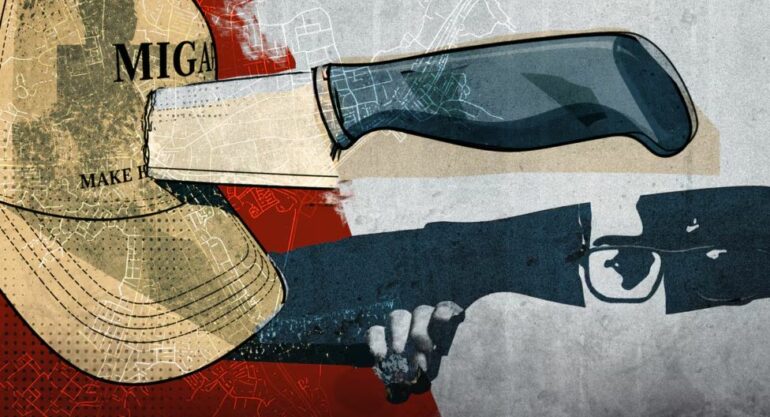



One Thursday in early March, Milad Pourtalebian returned to his apartment to find it ransacked and ransacked. Then, he noticed a chilling detail that suggested this was no robbery: His baseball cap with the words “Make Iran Great Again” had been stuck to the wall with a large kitchen knife.
Pourtalebian is an Iranian citizen and, since arriving in Canada in 2024, has organized rallies of the Iranian opposition in exile in his adopted city of Saskatoon, Saskatchewan.
The break-in, which came days after US and Israeli airstrikes triggered a war with Iran, followed a series of online threats against the 32-year-old over his activities. He immediately reported the incident to police, telling authorities he had been targeted for political reasons.
"The incident was initially extremely frightening for me," he told Radio Free Europe, adding that he has since overcome that feeling. "I decided not to let fear stop me from expressing my political views. I think of the thousands of Iranians who have lost their lives seeking freedom."
The photographs, police documents, and screenshots from social media that Pourtalebian shared with Radio Free Europe give an idea that, despite being thousands of kilometers away from Iran, he is not beyond the reach of the country's security services.
A post on Telegram denounces him for "propaganda activities against the political establishment" and for supporting "America's and the Zionist regime's attack on Iran."
The post ends by saying: "This person lives in Saskatoon. A few months ago, we found him and delivered our message to his home."
This, Pourtalebian said, was “particularly troubling.” Nothing was taken from his apartment and no one was arrested.
Transnational repression
Pourtalebian's experience is specific, but it appears to be part of a broader phenomenon in which authoritarian states pursue their opponents even after they find refuge in seemingly safe Western countries.
Iran has practiced assassinations and attacks for decades, but its global pressure goes far beyond physical threats.
Factnameh, a Persian-language fact-checking service based in Canada, recently noted an increase in “crowd-sponsored surveillance, the publication of personal data, and technology-enabled intimidation targeting critics outside Iran.”
Among the tools used is Alaj, a website where people can file complaints, which reportedly keeps files on about 1.600 people. Iranian state television has threatened those on the lists with “seizure of assets, complete suspension of consular services and Interpol Red Notices,” Factnameh said. Another tool, Goorkan (Persian for “Grave Digger”), publishes personal data of those it calls “traitors.”
US, British and Dutch intelligence agencies reported last month that Iran was conducting a global cyber campaign. The US Federal Bureau of Investigation (FBI) said a malicious program called Heavygram was used “to conduct malicious cyber activities targeting Iranian dissidents, anti-Iran journalists and other opposition groups around the world.”
Iran is not alone in persecuting critics abroad.
Yana Gorkhovskaia, director of research and analysis at Freedom House, based in Washington, has been studying this phenomenon for years.
"China, Iran and Russia are among the top 10 perpetrators of transnational repression, according to our data. China significantly outpaces all other governments," she told Radio Free Europe. "Of these three countries, Russia is by far the most violent in terms of assassinations and attacks."
Well-known examples include the poisonings of defectors Alexander Litvinenko and Sergei Skripal in Britain, as well as the hammer attack on opposition activist Leonid Volkov, an associate of the late Russian dissident, Alexei Navalny, in Lithuania.
This is something that extremely worries Mikhail Klimaryev, a Russian cybersecurity expert and Kremlin critic who fled Russia after it launched a full-scale invasion of Ukraine in 2022.
Now living in Berlin, where he collaborates with Volkov, the 53-year-old told Radio Free Europe that, because of the threat, he had noticed "a kind of paranoia" in himself.
"I'm extremely concerned about security. At least from the perspective of a normal, healthy person. When I'm outside, I check if someone is following me. Before I touch the door handle of my apartment, I check it first, because there was that case where a door handle was smeared with Novichok," he said.
But Klimaryev said his daily life was also affected by a host of smaller pressures, from spam attacks to administrative difficulties, which together constitute "a psychological war" by Moscow against people like him.
For example, he cannot renew his Russian passport, which expires in 2029. This will affect his residence status in Germany.
"It will be an administrative problem, and it will not be as simple as it might seem. I will have to hire a lawyer," he said.
Klimaryov explained that he does not have asylum in Germany and does not want to apply for it because it would mean he would not be able to continue running a business that employs 20 people.
Travel is another problem. Russia has put him on a terrorist list, which could cause problems at any border. He recalled that, on his way back from a recent trip to the United States, an officer “with a machine gun and a dog” pulled him out of the boarding line and questioned him for 30 minutes.
The risk of extradition means he has to be careful about which countries he visits.
Klimaryov is also on the list of foreign agents in Russia and owes about $1 million in fines imposed on him by authorities, which he says are for political reasons.
In many cases, he has been unable to deal with administrative cases piling up against him in his homeland because his Russian phone number was canceled, preventing him from communicating with authorities online or accessing his bank accounts in Russia.
Klimaryev says he doesn't use his phone unless asked to by German authorities and doesn't give his number to anyone else, for fear of being hacked. He helps other Russians who fall prey to phishing attacks and says he once almost fell victim to one himself.
"I managed to stop myself at the last moment. It was a scam of a very high level," he said, describing a sophisticated exchange of messages with someone posing as a potential client of his company. After several weeks of communication, he almost put a code sent to Telegram, which could have compromised his account.
"Does all this affect me psychologically? Of course it does," said Klimaryov. "I've sought medical advice.... I'm panicking. Panic attacks - do you know what they are?"
Despite this, Klimaryov insisted that he does not consider himself a victim. "I am better off than many people. I am not in prison. I can make a living."
But Klimaryev added that he is considering medical advice to suspend his political activities as a result of the pressure. Gorkhovskaya stressed that this is precisely the goal.
"Surveillance, intimidation, threats to family, digital threats – they work, to make people at least think twice about whether it's worth participating in a protest or doing something publicly," she said.
According to Freedom House, other major states responsible for transnational repression include Turkey, Saudi Arabia and Rwanda. Gorkhovskaya said that strong and sustained responses from Western countries are rare. This is due both to the possibility of credible denial of such practices and to broader political considerations.
“The perpetrators of transnational repression do not pay a cost for targeting dissidents abroad… They learn from each other that this is a practice they can continue to use,” Gorkhovskaia said.
Pourtalebian said he would like to see a tougher response from Canada, arguing that it "remains too open to individuals associated with the Islamic Republic."
Saskatoon police told Radio Free Europe/Radio Liberty that they had closed the case file, but would reopen it if "further information regarding a suspect or additional evidence is presented."/ REL