


Hardline commentators and media outlets close to Iran's Islamic Revolutionary Guard Corps (IRGC) are increasingly calling for Iran to defy the US naval blockade of Iranian ports and waters, as revenues from crude oil and condensate exports are expected to fall to zero by mid-December.
They propose that a "group of oil tankers" sail through the blockade, as well as threats to strike the oil infrastructure of Iran's neighboring countries in the Persian Gulf if US forces attack Iranian ships.
Iranian forces have already attempted to attack American targets in Bahrain and Kuwait this week.
The campaign to promote the idea of breaking the blockade gained momentum on November 19, when the Fars news agency, affiliated with the Islamic Revolutionary Guard Corps, published a commentary arguing in favor of sending an "oil tanker convoy."
That same day, the ship tracking service, TankerTrackers.com, published a short message on the social network X, saying that "Iran appears to be preparing to resume oil exports."
No official Iranian institution has formally announced any such plan, but the discussions show how much Tehran is feeling the impact of the US blockade.
The closest signal to an official stance came from Revolutionary Guard spokesman Hossein Mohebbi. On November 19, during a rally in Tehran, he said: “We will not allow the continuation of the naval, land and air blockade imposed on our country.”
Still just an idea
To support its argument, the Fars news agency referred to the Shahnameh, Iran's national epic. In this work, when the mythical hero Fereydun arrives at the Arvand River, on his way to overthrow the tyrant Zahhak, the river's guard refuses to give him a boat. Fereydun does not wait. He and his men enter the water with their horses and cross the river.
“We will not wait for America’s permission,” Fars argued. “We open the road and increase the cost of closing it so much that the other side will conclude that it is better to leave it open.”
Fars warned that any attack on an Iranian tanker could prompt Tehran to retaliate by hitting oil facilities across the Persian Gulf. It specifically mentioned facilities in Qatar, Saudi Arabia and the United Arab Emirates.
The proposal quickly found support among hard-line figures, some of whom presented it as a decision expected to be made soon, rather than simply a suggestion.
MP Ebrahim Azizi, chairman of the important parliamentary Committee on National Security and Foreign Policy, declared in English on X that Iran “cannot be blocked.” At the end of the post, he also placed an hourglass symbol.
Hardline commentator Ruhollah Jomei wrote about “the Islamic Republic’s decision to load crude oil and send a tanker to China,” the largest buyer of Iranian oil.
Mojtaba Najafi, who some Iranian media outlets claim has connections to power circles, wrote: "Apparently, Tehran no longer wants to stand idly by in the face of the blockade and threats."
If the reports are true, Iran is trying to "actively challenge the blockade," said Hamidreza Azizi, an analyst at the International Crisis Group.
In a post on X, he argued that if any tankers manage to get through, the blockade loses credibility. If US forces stop or attack it, Tehran gains a direct reason for retaliation.
Azizi added that Iran is trying to "take the military initiative, leaving Washington responsible for instigating the next escalation."
The critical threshold of mid-December
According to energy intelligence firm Kpler, Iran's revenue from crude oil and condensate exports could fall to zero by mid-December. This would be the first time in the country's history that this has happened.
The effects of the blockade are already visible in the shipping of Iranian oil. Kpler data shows that the amount of Iranian oil on ships outside the blockade zone peaked at 88.8 million barrels on July 14, when the blockade was re-imposed. By mid-October, this amount had fallen to zero, as the last cargoes were unloaded in China.
Meanwhile, another 43 million barrels of oil remain trapped within the blockade zone, leaving Tehran with fewer and fewer oil reserves it can deliver to buyers.
In an interview with Radio Free Europe/Radio Liberty's Radio Farda, Homayoun Falakshahi, senior commodities analyst at Kpler, warned that recent developments should not be interpreted as evidence that Iran is preparing an organized attempt to break the blockade.
"Our view is that it is still too early to say that Iran has taken serious steps to break the naval blockade," he said.
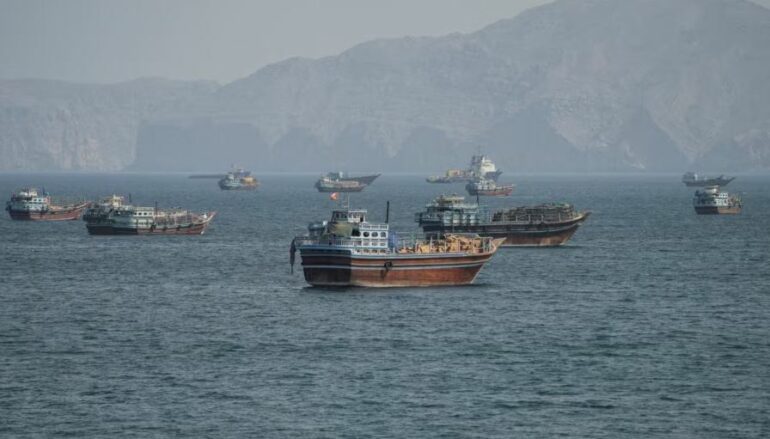
Kpler has identified about 20 tankers near Harg Island, Iran's main oil export terminal, Falakshahi said. Most of them have already loaded their cargoes of oil, but have remained stationary, apparently waiting for the blockade to be lifted before attempting to sail. So far, Kpler has spotted only one tanker moving.
However, at least one significant development has been recorded. On November 17, Kpler discovered that an Iranian crude oil tanker was transferring its cargo to another ship. The tanker that received the cargo is a ship that is usually used to transport Russian fuel oil, Falakshahi said.
However, he cautioned that this transfer should not be given undue importance. According to him, it may have been caused by a technical problem on the first ship and not necessarily part of a broader effort to evade the blockade.
Falakshahi added that Iran usually transfers oil from one ship to another near Malaysia or off the coast of Oman, not near Harg Island.
"I believe we need to wait a few more days to see if they will attempt to move more tankers," Falakshahi said.
Costly blockade
The United States first imposed a blockade on Iranian ports on April 13 after talks between the United States and Iran in Islamabad failed. The blockade was lifted on June 18, based on a memorandum of understanding signed the day before.
After that deal failed, Washington reimposed the blockade on July 14, and it has remained in place ever since. In total, Iranian ports have been under blockade for about 195 days, including the last 129 days without interruption.
However, the blockade is also costing Washington dearly, both financially and in terms of military resources.
During a Senate hearing this week, Democratic Senator Elizabeth Warren cited independent estimates that the blockade is costing about $32.5 million a day, a figure confirmed by Hung Cao, the acting secretary of the US Navy.
Bloomberg, which published the figure cited by Warren, also reported that this operation engages more than 30 percent of the US Navy's warships.
The Pentagon has estimated the total cost of the war with Iran at $48.3 billion as of November 13. This figure does not include damage caused to US bases in the region.
However, this amount is only a fraction of the revenue that Iran risks losing. Kpler had previously estimated that the blockade was causing Tehran to lose between $200 million and $250 million a day in unrealized oil revenue./ REL