


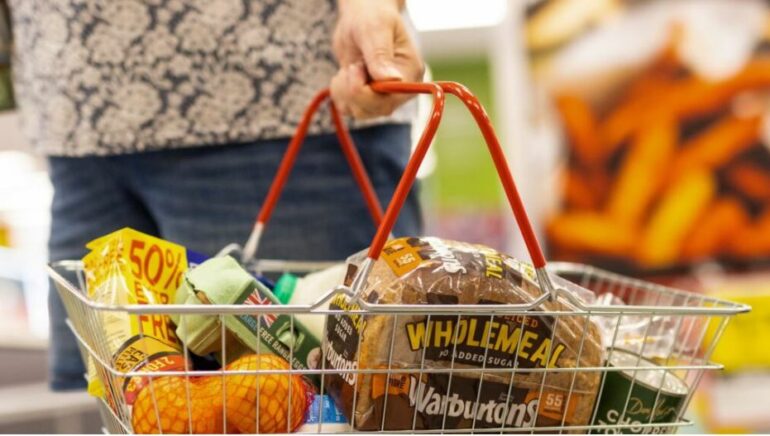



In 2025, Albania had the highest share of food expenditures in relation to the economy in Europe.
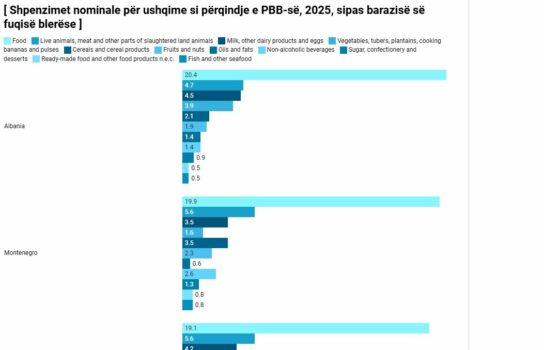
In 2025, nominal food spending was 20.4% of Gross Domestic Product (GDP), or about a fifth of the economy, compared to just 6.2%, which was the European Union average.
Even a regional comparison shows a noticeable difference. In Montenegro, food spending was 19.9% of GDP, in Bosnia and Herzegovina 19.1%, in North Macedonia 17.9% and in Serbia only 12.8%.
Such a high weight is primarily related to low income levels. For families with more limited incomes, the bulk of the budget is focused on basic needs, and food is among the first.
In higher-income countries, after food needs are met, a much larger portion of income remains for housing, transportation, health, education, culture, entertainment, and savings.
Albania has individual consumption per capita, measured in purchasing power parity, of 48% of the EU average, while per capita income is only 43% of the European average. However, food expenditure relative to the economy is over three times higher than in the EU.
In value, according to Eurostat data, Albania spends 5.1 billion euros on food.
First, Albania has a high weight of some of the most basic products in the economy, ranking at the top of Europe for spending on milk and dairy products, oils and fats, and vegetables.
The group “milk, other dairy products and eggs” represented about 4.5% of Albania's GDP in 2025. The European Union average was only 1%.
No other country in the European table had a higher weight.
In Bosnia and Herzegovina, spending on this group was 4.2% of GDP, in Montenegro 3.5%, in North Macedonia 3.4% and in Serbia 2.2%. In Greece the share was only 1.7%, while in Italy 1.2%.
The weight of milk, dairy and eggs in the Albanian economy is thus 4.5 times higher than the EU average.
There is no data to suggest that Albanians consume more dairy products than Europe. The difference is more likely to be due to the high price level of these products. In 2025,
Albania had an index of 135.6 for milk, dairy products and eggs, where the EU average is 100. Prices were 35.6% above the European average, ranking Albania the third most expensive in Europe for this group. In value, spending for this group was 1.1 billion euros.
The difference with the region was even stronger. The index was 107.1 in Serbia, 95 in Montenegro, 92 in Bosnia and Herzegovina and 89.6 in North Macedonia. Albanians paid for these products about 27% more expensive than Serbs, 43% more expensive than Montenegrins and over 50% more expensive than consumers in North Macedonia.
Another strong difference is in oils and fats. In Albania, spending on this category was 1.4% of GDP, compared to only 0.2% in the European Union. Relative to the size of the economy, Albania spends seven times more than the EU average on this group of products. In value, spending was 356 million euros.
Again, Albania had the highest share among the European countries included in the table. In Montenegro, Bosnia and Herzegovina and North Macedonia, oils and fats accounted for only 0.6% of GDP, while in Serbia it was 0.4%. Even Greece, relatively high compared to the EU, was at 0.7%.
Prices of oils and fats in Albania were also above the European average in 2025. The price index was 112.5, or 12.5% above the EU average. In this group, however, Albania was not the most expensive in the region, as Serbia had an index of 128.4 and Montenegro 119.4. Bosnia and Herzegovina was at 99.2 and North Macedonia at 95.
Vegetables have an equally unusual weight. The group that Eurostat classifies as “vegetables, tubers, cooking bananas and legumes” represented 3.9% of Albania’s GDP in 2025, almost five times the European Union average of 0.8%. Almost 1 billion euros are spent on vegetables annually.
Albania shares the highest level with North Macedonia, also with 3.9% of GDP. In Bosnia and Herzegovina the share was only 1.7%, in Montenegro 1.6% and in Serbia 1.4%. In Greece it was also 1.4%, while in Italy 1.2%.
Unlike dairy and oils, prices for this group in Albania remain below the EU average, but are much higher than in most of the region.
The price index for vegetables was 91.2, almost the same as Serbia, with 91. However, prices in Albania were about 20% higher than in Bosnia and Herzegovina, 22% higher than in Montenegro, and 27% higher than in North Macedonia.
Meat is the product that accounts for the largest share of food expenditure in Albania. The group of meat and slaughtered animal products represented 4.7% of GDP, compared to 1.3% on average in the EU. The weight was about 3.6 times higher than the European average. In value, the expenditure is almost 1.2 billion euros.
In the region, only Montenegro and Bosnia and Herzegovina had a higher share, with 5.6% of GDP each. Serbia was at 3.6% and North Macedonia at 3.4%.
In terms of prices, meat in Albania was only 2% cheaper than the EU average, with an index of 98, but it was the most expensive in the region. The index was 86.1 in Serbia, 83 in Bosnia and Herzegovina, 77.6 in North Macedonia and only 71 in Montenegro.
Fruits and nuts also account for a much larger share of the Albanian economy than in the EU. Spending on them was 1.9% of GDP, compared to 0.5% in the European Union, or almost four times as much. Montenegro and North Macedonia had a higher share, at 2.3% each, while Bosnia and Herzegovina was at 1.7% and Serbia at just 1%.
Fruit and nut prices in Albania were 92.1% of the EU average, but the gap with the region's cheaper economies was large. In Bosnia and Herzegovina the index was 71.2 and in North Macedonia 52.4.
In comparison, fruits and nuts in Albania cost about 76% more. For cereals and their products, spending was 2.1% of GDP, more than double the EU average of 1%. In this category, Albania does not lead the region: Montenegro reaches 3.5%.
Bosnia and Herzegovina at 2.7%, North Macedonia at 2.5% and Serbia at 2.2%.
The large weight that food plays in the Albanian economy is now being accompanied by another development. In 2025, for the first time, the level of food prices in Albania exceeded the European Union average.
The food index reached 102.9, or 2.9% above the EU average, from 99.6 a year earlier and around 85 in 2022. Albania is the only country in the region where food prices have exceeded the European average. Serbia, the second most expensive, had an index of 96.6, while Montenegro and Bosnia and Herzegovina were at 84.6 and North Macedonia at just 74.3.
When non-alcoholic beverages are included, Albania's index reaches 103.8. In Serbia it is 97.1, in Montenegro 86.5, in Bosnia and Herzegovina 85.8 and in North Macedonia 74.8.
Food and non-alcoholic beverages cost about 7% more in Albania than in Serbia, 20% more than in Montenegro, 21% more than in Bosnia and Herzegovina, and almost 39% more than in North Macedonia.
Of the 12 detailed food groups reported by Eurostat, in half of them prices in Albania are already above the European Union average. Among them are milk and dairy products, oils and fats, sugar and confectionery, non-alcoholic beverages and ready meals, while meat and fish are close to the European average.
Non-alcoholic beverages, on which Albania spends 1.4% of GDP, compared to 0.6% in the EU, had a price index of 114.3 in 2025, or 14.3% above the European average and the highest in the region.
Sugar, sweets and confectionery had an index of 123.1, or 23.1% above the EU average, while ready meals and other food products reached 128.2, or 28.2% more expensive than the European average. /Monitor.al/