


Higher pressures from labor shortages, pensions insufficient to meet the cost of living, and the structure of an economy that generates mainly low-skilled jobs are keeping older Albanians active in the labor market much longer than their peers in Europe and the Region.
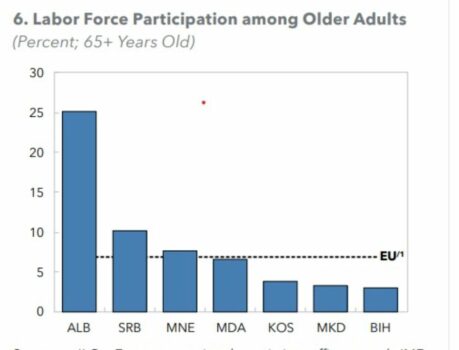
Data referenced by the International Monetary Fund shows that Albania records the highest level of labor market participation in the over-65 age group in the entire region, exceeding the 25% threshold, or more than three times the European Union average.
Data analyzed by the IMF show that the willingness of Albanian seniors to work is much higher than the other 5 Western Balkan countries and the average of the B member countries.
After Albania, Serbia ranks closest with around 10% participation of older people in the labor market, followed by Montenegro with just under 8%, while the average for the European Union is around 7%. Below the European average are Moldova with around 6.5%–7%, Kosovo with around 4%, North Macedonia with just over 3% and Bosnia and Herzegovina with around 3%.
While in countries such as Kosovo, North Macedonia and Bosnia and Herzegovina increasing the inclusion of older workers is seen as an opportunity to expand the workforce due to current low levels, Albania presents a completely different demographic profile in employment. In parallel with the high activity rate of older people, the country faces sharp challenges in the other age groups.
Albania, together with Kosovo and North Macedonia, ranks among the countries with a high percentage of young people who are neither in employment, education nor training (NEET group) with over 20%. This high indicator among young people leads to a significant loss of human capital and weakens the overall productivity of the economy.
The International Monetary Fund notes that to address these structural imbalances and improve labor market performance with the requirements of EU membership, reform agendas should focus on facilitating the transition from school to work and increasing the quality of human capital.
For example, Albania needs to expand internship programs, strengthen cooperation between the education system and employers, and have better career guidance to facilitate the entry of young people into the labor market.
At the same time, matching labor supply with demand remains critical to boosting productivity and addressing skills mismatches. This means strengthening vocational education and training, modernizing curricula with a strong focus on STEM (science, technology, engineering, and mathematics) fields, and expanding retraining and lifelong learning programs, including workers in mid- and late-career stages./ Monitor