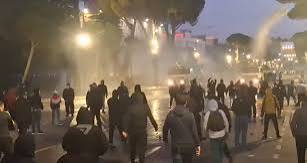



The Council of Ministers has approved a series of acts and decisions at its last meeting, among the most important of which is the normative act on compensation and recovery of damage caused to property by acts of violence during gatherings.
According to the decision, the aim is to guarantee effective compensation for damages caused to property, while the financial burden does not remain with the state, but is borne by the persons responsible for causing them. To this end, mechanisms will be used to recover the amounts paid by the state.
The government has also approved changes to the regulation for the classification of accommodation structures, as well as the criteria and procedures for the certification of agritourism activities.
The meeting also approved the decision on the types of weapons and other means of use of force that are allowed to be held by the Supervisory Agency in the System of Execution of Criminal Decisions.
In the field of international cooperation, the Council of Ministers has approved in principle the agreement with the European Union on Albania's participation in the anti-fraud program, as well as the draft law on the ratification of the agreement with NATO regarding Ukraine's priority requirements list (PURL).
REGULATORY ACT ON COMPENSATION AND RECOVERY OF DAMAGES CAUSED TO PROPERTY BY ACTS OF VIOLENCE DURING ASSEMBLIES
In support of Article 101 of the Constitution, upon the proposal of the Minister of Economy and Innovation and the Minister of Justice, the Council of Ministers
DECIDED:
Article 1
Objects
This normative act establishes the rules for compensation for damage caused to property by acts of violence during gatherings in public places or open to the public, the civil liability of persons who have caused such damage, as well as the procedures for recovering amounts paid by the state.
Article 2
Purpose
The purpose of this normative act is:
a) ensure effective compensation for damage caused to property by acts of violence during assemblies;
b) to guarantee that the financial burden of the damages caused is borne by the persons responsible for causing them, through mechanisms for recovering the amounts paid by the state.
The implementation of this normative act does not violate the freedom of peaceful assembly, according to Article 47 of the Constitution and Article 11 of the European Convention on Human Rights, as well as the responsibility of the state for damages caused by its organs, when there are any, according to the legislation in force.
Article 3
Scope of application
This normative act applies to gatherings in public places or open to the public, regardless of whether they are announced, prohibited or spontaneous, including gatherings on the occasion of sporting, cultural or festive activities.
Article 4
Definitions
In this normative act, the following terms have the following meanings:
a) “Assembly”, the same meaning as defined in Law No. 8773, dated 23.4.2001, “On Assemblies”, as amended;
b) “Injured party” means any natural or legal person, public or private, to whom material damage has been caused;
c) “Perpetrator of damage”, the person who directly committed the act of violence or damage to property, or the persons who committed it jointly.
Article 5
The principle of personal responsibility
1. No one shall be held liable under this normative act solely for participating in a gathering.
2. Liability under this normative act arises only from the actions or omissions of a person or organization, including the organization and incitement of acts of violence, in addition to the execution of these acts.
3. This normative act shall be interpreted and implemented in a manner that interferes as little as possible with the freedom of peaceful assembly and freedom of expression.
Article 6
Preliminary compensation from the state
1. Based on this normative act, the state may compensate in advance, in full or in part, the property damage of injured individuals, as well as legal entities with commercial activity below 14,000,000 lek per year, caused by acts of violence during gatherings.
2. Compensation, according to this normative act, is granted only for property that is not insured. When the damaged property is insured, the damage is compensated by the insurance company, according to the insurance contract, which, after payment, exercises the right of recourse against the person causing the damage, according to the legislation in force. When the insurance contract does not cover the risk of damage from riots, gatherings or violent acts, the property is considered uninsured, for the purpose of this normative act. In case the insurance contract does not fully cover the value of the damage caused, the uncovered part is compensated according to the rules of this normative act.
3. If compensation is determined under this article for damages found to have been caused by acts of violence during the assembly, this compensation shall be paid regardless of whether the perpetrator of the damage has been identified.
4. The injured party, who accepts the amount of compensation, is considered compensated up to the amount paid and cannot claim this amount again from the perpetrator of the damage. The injured party retains the right, in accordance with the Civil Code, to claim other parts and types of damage that he does not benefit from under this normative act, from the perpetrator of the damage.
5. The criteria, conditions, procedure, compensation measure and the body that decides on compensation shall be determined on a case-by-case basis by the decision of the Council of Ministers, through which it is decided to undertake the initiative of compensation for damages caused during the assembly. The assessment, whether the state will commit to compensation under this article, shall be carried out by taking into account the budgetary situation and budgetary needs at the given time, the extent of the damage caused during the specific assembly, as well as the extent of the consequences for the injured parties.
Article 7
Regression
1. Upon payment of compensation, the state enters, to the extent of the amount paid, into the rights of the injured party against the persons responsible for causing the damage, including entities that are jointly and severally liable, according to Article 9 of this normative act.
2. The institution that provided the compensation and the State Police shall make available to the State Attorney's Office the data and documentation on the compensation provided and on the identification of the perpetrators of the damage.
3. The State Attorney's Office invites the entity identified as responsible for causing the damage to voluntarily return the amount of compensation. If the entity does not repay the amount within 30 days from the date of receipt of the invitation and does not exercise its right to conclude a restoration agreement, according to Article 10 of this normative act, the State Attorney's Office is authorized, based on this normative act, to file a claim for recourse against the perpetrators of the damage, to the extent of the compensation provided to the injured party.
Article 8
Recovery of damages caused to state and public property
1. Regardless of whether preliminary compensation is established, according to this normative act or not, in cases where the injured parties from acts of violence are public institutions, the State Attorney's Office, in any case, requests compensation for the damage on their behalf and for their account. The State Attorney's Office exercises the powers of representation in accordance with the legislation regulating its organization and functioning.
2. The State Police and the damaged institutions shall make available to the State Attorney's Office the data for the identification of the perpetrators who caused the damage, the data on the damage and its financial assessment, for the damage caused to state and public property. The State Attorney's Office shall request the voluntary payment of the damage within the deadline set out in point 3 of this article.
3. If the subject does not repay the amount within 30 days from the date of receipt of the request for voluntary payment and does not exercise its right to conclude a restoration agreement, according to Article 10 of this normative act, the State Attorney's Office shall file a lawsuit for compensation for damage, in accordance with the provisions of the Civil Code.
Article 9
Joint and several liability and liability for minors
1. The organization or individuals who have developed, directed and organized the gathering, if any, are jointly and severally liable with the perpetrators for the damage, except in the case where it is proven that the violent actions were not instigated by them and that they did not have the opportunity to prevent them.
2. When the subjects who caused the damage are minors or persons incapable of acting, the provisions of Articles 613 and 614 of the Civil Code apply.
Article 10
Restoration agreement
1. The State Attorney's Office may enter into an agreement with the debtor for his obligation to be fully or partially repaid through work in the public interest.
2. The restoration agreement is concluded only with the free and express consent of the debtor and determines the type of work, its duration, the method of its evaluation and the conditions for fulfilling the obligation. Refusal to conclude the agreement does not entail any consequences other than the continuation of legal procedures for the recovery of the civil obligation.
3. For minors, the agreement is concluded with the consent of the parents, after consulting the child protection unit, respecting the legislation on child protection and the legal restrictions on their work. The work must be age-appropriate and not interfere with schooling.
4. The value of the work cannot exceed the amount of the obligation. When a joint and several obligation is discharged by several debtors, the total value of the work cannot exceed the amount of the obligation.
5. The methods of implementation of this article shall be determined by decision of the Council of Ministers.
Article 11
Relationship with the responsibility of authors
1. This normative act does not affect the full liability of the perpetrators of the damage, according to the Civil Code, nor the right of the injured party to full compensation from them.
2. Limiting state compensation only to property damage does not violate the right of injured persons to request, under the provisions of the Civil Code, compensation for other damages, including non-pecuniary damages, from the responsible persons.
3. The injured party cannot receive in total more than the damage caused.
Article 12
Cases where criminal proceedings are also conducted
1. When criminal proceedings are conducted for the same facts, the State Attorney's Office, in the case where it requests recourse or compensation for damage, may file a civil lawsuit in the criminal process, according to the provisions of the Code of Criminal Procedure.
2. If a final court decision of acquittal or a decision not to initiate or discontinue criminal proceedings, or to discontinue the case, has been made against a person because it has been determined that he did not commit the offense, the State Attorney's Office shall waive the trial of the lawsuit. Other decisions of discontinuation shall not automatically exclude civil liability, which is determined according to the legislation in force.
Article 13
Exemption from execution
Social assistance and disability payments cannot be seized for obligations under this normative act.
Article 14
reporting
1. The State Attorney's Office maintains data on lawsuits, decisions and amounts collected, according to this normative act, as well as on restoration agreements.
2. The Minister responsible for Justice shall submit to the Assembly each year a report on the implementation of this normative act, including its impact on the exercise of freedom of assembly.
Article 15
Bylaws
The Council of Ministers is hereby instructed to issue, within 3 months from the entry into force of this normative act, the sub-legal act, in implementation of point 5, article 10, of this normative act. The decisions of the Council of Ministers, according to point 5, article 6, of this normative act, are adopted on a case-by-case basis.
Article 16
Entry into force
This normative act enters into force immediately and is published in the "Official Gazette".
PRIME
EDI RAMA
In short supply and to order
DEPUTY PRIME MINISTER
ALBANA KOÇIU