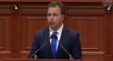



Ina Zhupa has issued a statement to the media where she focused on the issue of protected areas.
Zhupa stated that the government has not reflected at all on protected areas and that the law has not been repealed.
She emphasizes that the government is not repealing the law on protected areas because, according to her, it does not want construction plans to be disrupted.
Full Statement;
As you know, for 2 years I have been opposing the law on protected areas, no. 21/2024, as destructive of their protection and a mechanism for unbridled construction. On May 14, 2026, I filed the draft law for the repeal of law no. 21/2024, with the aim of restoring the legal guarantees of nature protection. My request is not an initiative disconnected from reality, but is in line with the concern expressed by European institutions and Albanian citizens.
The European Parliament has not only requested this once, but several times. Even in its resolution of 9 July 2025, it had expressed serious concern about the legal changes that allowed large infrastructure and tourism projects in ecologically sensitive areas, demanding a reversal of these changes. In June 2026, the request became even clearer and more concrete for the repeal of Law 21/2024.
Meanwhile, Rama and his government, with decision no. 853, dated 12.11.2026, express their opposition to the repeal of law no. 21/2024.
First, the repeal would create the possibility of disrupting their construction plans already foreseen in Zvërnec and elsewhere in Albania. And Edi Rama cannot accept this.
The Council of Ministers claims that the repeal could violate the legal security of those who have received construction projects, because the law has produced sub-legal acts, decisions and administrative procedures.
But this is not a reason not to repeal it. On the contrary, it is the main reason why repeal is required. Precisely to stop the destruction of nature, the massacre of protected areas, the construction of villas and resorts everywhere, for private interests.
Nothing would prevent a normal government from providing clear transitional provisions that determine the treatment of existing acts and procedures. In fact, the government itself admits in its opinion that a special transitional arrangement is needed. So, it admits that the consequences of the repeal can be addressed legally, but it uses this need as an argument for not repealing.
Legal certainty does not mean perpetuating a clientelist, anti-national law that is harmful to the country's natural heritage and identity.
Secondly, the government is against it because the Constitutional Court has rejected claims of the law's unconstitutionality.
The Government refers to decision no. 45, dated 31.07.2025, by which the request of one-fifth of the deputies, represented by me, to repeal the law was rejected. The decision had parts where the Court was divided 4 to 4 and this shows a lot. Clearly, the Court has provided sufficient arguments for both sides.
But here the government confuses two different issues: the control of constitutionality by the Constitutional Court and the right of the Assembly to amend or repeal a law.
Then, we know the climate of how decisions are made here, where the President of the Court, without having fully settled into the position of President, took a position from the majority at the Bank of Albania.
Third, the government reduces nature protection to an EIA procedure for every project.
This is one of the most serious problems with the government's argument.
She says that there is no absolute ban on activities in protected areas and that each project must be assessed individually through environmental impact procedures.
But the protection of an area cannot depend solely on whether or not a project passes an administrative procedure. Protection begins with the very status, category, zoning, and legal restrictions of the territory.
Environmental Impact Assessment is not a substitute for a strong legal protection regime. It cannot compensate for the removal of safeguards that should be in place before an investment project is presented.
Fourth, the government ignores the European Parliament's clear request to repeal Law 21/2024.
On June 17, 2026, the European Parliament adopted resolution P10_TA(2026)0217 on Albania, in which it calls for the repeal of the 2024 amendments to the law on protected areas.
Paragraph 46a calls for an immediate moratorium on new permit procedures, construction works and development interventions in protected areas, until incompatible provisions are repealed and compliance with European standards is ensured.
The resolution also criticizes the transfer of important decision-making powers to the National Territorial Council, weakening environmental control.
The government cannot talk about European integration and at the same time refuse to implement the political message of European institutions precisely on an issue related to Chapter 27, Environment and Climate Change.
The Flamingo Revolution is proof that citizens do not accept that Albania's natural resources be treated as property to be divided between investors and the government.
Citizens protested for Zvërnec, for Vjosa-Narta, for biodiversity, for the right to live in a place where the enrichment of a handful of people does not steal the heritage for future generations.
No investment can take precedence over the public interest and the preservation of our natural assets, which cannot be restored once destroyed.